Mathilde Moaty will defend her doctoral thesis in Spatial Planning and Urbanism, entitled:
Conflict and Urban Production:
Mobilizations, Materialities, and Heritage-Based Social Forms in Vila Leopoldina (São Paulo).
The defense will take place on Tuesday, June 4, at 2 p.m., at the Ecole des Ponts et Chaussées (room P303 – 3rd floor of the PRONY wing), in Champs-sur-Marne.
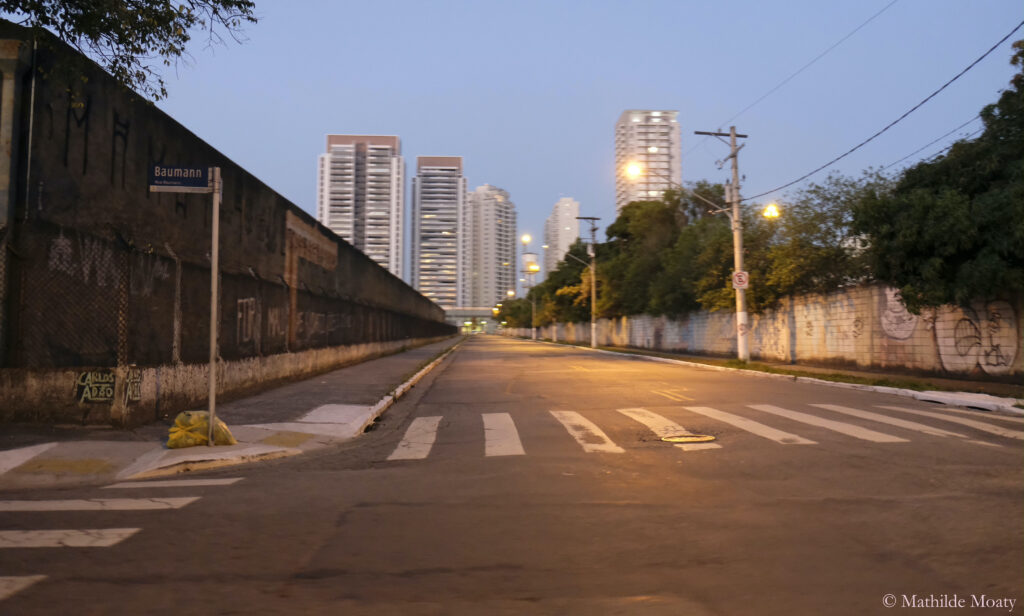
Thesis summary: Since the late
1980s, São Paulo has been a prime testing ground for urban planning instruments. Successive municipal teams from various political backgrounds have implemented vast urban renewal projects, delimiting exceptional perimeters within which specific regulations apply. Flexible construction parameters and facilitated private investment are some of the principles intended to leverage the rapid rehabilitation and transformation of land and its uses, as well as the financing of affordable housing. These measures have proven ineffective in countering the immense socio-spatial inequalities that characterize Brazilian cities. On the contrary, they contribute to conflictual situations and the exclusion of part of the population from access to decent housing.
In 2016, a new urban intervention project (PIU) was proposed to the municipality by a Brazilian multinational company that owns land in the Vila Leopoldina neighborhood in the western part of São Paulo. This urban renewal project immediately sparked a conflict between three groups of actors rooted in the neighborhood: the private company, the historical economic and financial elite, which shapes Brazil's patrimonialist social structure; upper-middle-class residents, a small local elite that has more recently moved into secure high-rise condominiums; and poor communities, excluded from access to decent housing.
Based on field research in São Paulo and an online analysis of social networks and public consultations, the thesis traces the origins of the conflict and studies the forms of mobilization and their spaces, with a particular focus on built materiality. It hypothesizes that this territorialized conflict around an urban instrument (the PIU) reveals both the social structures of Brazilian society and the patrimonialist urban production characteristic of large cities in Brazil. To demonstrate this, the thesis analyzes and compares the territorialized moral economies of the three groups of actors in conflict.
Keywords: conflict; urban development; urban materiality; heritage; moral economy; São Paulo.
The jury will be composed of:
- Marie-Hélène Bacqué, Professor, Paris-Ouest University (Rapporteur)
- Agnès Deboulet, Professor, University of Paris 8 (Examiner)
- Ana Fernandes, Professor, Federal University of Bahia (Rapporteur)
- Sylvy Jaglin, Professor, Gustave Eiffel University (Co-supervisor)
- Ozan Karaman, Research Fellow, CNRS (Thesis Co-supervisor)
- João Sette Whitaker Ferreira, Professor, University of São Paulo (Co-supervisor)
The defense will be held in person and will be broadcast on Zoom. If you would like to attend the defense or receive practical information, please contact Mathilde Moaty by email (mathilde.moaty@enpc.fr).