 Valérie November and Alice Azémar contributed to the article:
Valérie November, Alice Azémar, Sophie Lecacheux, and Thierry Winter
The anticipation/decision pair grappling with the exceptional, the unexpected, and uncertainty.
EchoGéo, No. 51
https://doi.org/10.4000/echogeo.18949
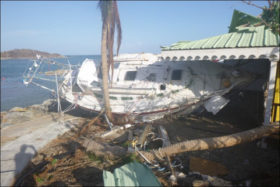
Photo: House destroyed by a ship running aground during Hurricane Irma in Cul-de-Sac (Saint Martin), Source: BRGM
Anticipation and decision-making in crisis situations have been the subject of numerous studies that highlight the polysemy of these concepts and the difficulties regularly encountered in their implementation (context of uncertainty, format and circulation of information, different perceptions of the situation between actors and geographical scales, etc.). Through two case studies set during the Irma-José-Maria crisis, one observed in CIC at the interministerial level and the other experienced by a state operator at the territorial level, this article illustrates these obstacles and highlights the fragmentation of the anticipation/decision pair in the practice of the various ORSEC levels. It appears that the lack of a shared vision within and between crisis units on the nature, time frame, and methodological framework of the anticipation function were all obstacles to its effective implementation during the hurricane sequence. This situation stems in particular from the coexistence of different ministerial cultures of anticipation. As time appears to be a structuring and critical element of an adaptive and shared anticipatory approach, the authors argue for an understanding of the anticipation/decision-making pair in terms of a continuum, assuming the plurality of cultures and integrating all time frames.