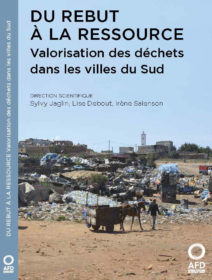
 Under the scientific direction of Sylvy Jaglin, Lise Debout, and Irène Salenson
From waste to resource. Waste recovery in cities in the Global South.
AFD, 2018, 300 p.
The amount of waste produced worldwide is skyrocketing: it is expected to increase by 69% between 2012 and 2025, according to a study published by the World Bank. This increase, linked to population and urban growth, is more pronounced in Southern countries. However, municipalities in these countries often lack the necessary resources. In the 1990s, reforms attempted to improve waste management by experimenting with the delegation of public services and modernizing equipment. Their mixed success, combined with growing awareness of environmental and climate degradation, led to new approaches in the 2010s. Today, the focus is on promoting the circular economy (see Sustainable Development Goal No. 12). In this virtuous circle, waste is no longer considered rubbish but a resource that could become lucrative. How does recovery reshape the playing field? Who benefits from the profits? What is the competition between artisanal waste collectors and industrial recyclers? What tools and principles should be used to regulate recovery activities?
From Buenos Aires to Lomé, via Port-au-Prince and Casablanca, this book examines the restructuring of the waste sector and the relationship between public service management and the commodification of recovery. This tension is examined from four perspectives: (i) the confrontation between social logic and economic profitability; (ii) the spatial integration of recycling activities into urban areas; (iii) the contribution of recovery revenues to the financing of public services; (iv) the environmental promise of infinite recycling of objects and materials.