The session will be organized around the book L'ordre électrique (The Electrical Order) by Fanny Lopez, historian of architecture and technology, senior lecturer authorized to supervise research at ENSA Paris-Est at Gustave Eiffel University, and co-director of LIAT at ENSA Paris-Malaquais.
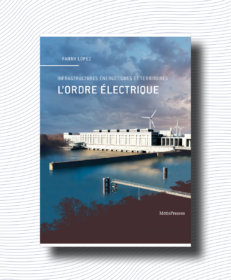 Industrial mastery of electricity and the electrical order that directly resulted from it have shaped our societies for over a century. They have enabled exponential growth and consumption, while leading to the appropriation of living environments.
Today, a profound reconfiguration of resource territories is underway, challenging our lifestyles and the nature and scale of the infrastructure and territories that enable us to survive, even though many of them are severely degraded.
The quest for land and self-sufficiency has continually disrupted the electrical order. This book offers a critical history of these infrastructures, from their advent in the late 19th century, followed by their rapid large-scale development—the monuments of electrical capitalism—to the recent crises and transformations that have led to the emergence of infrastructural diversity and more local governance.
Positive energy territories, micro-electricity grids in London, Berlin, and New York, and mini-power plants in urban, rural, and domestic settings are redrawing smaller-scale production trajectories, promoting dynamics of reappropriation and new interconnection systems. These achievements are disrupting the socio-technical hierarchies inherited from the past and redeploying our urban and territorial energy futures.
Fanny Lopez's latest book:
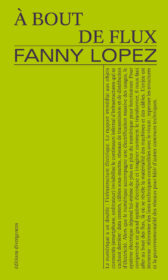
Digital technology has a double: electrical infrastructure. Our immediate relationship with connected objects (smartphones, computers) obscures the infernal continuum of infrastructure that lies behind them: data centers, submarine cables, electricity transmission and distribution networks. While digital technology is accompanying a massive electrification of uses, the electrical system itself is increasingly dependent on digital technology to function. To understand this vast electrical system and imagine how to transform it, we need to follow the flows to their end point, where the materiality of machines and cables is revealed. The challenge is immense: reinventing technical links that are compatible with living beings; rethinking the structures and governance of networks to build other technical commons.