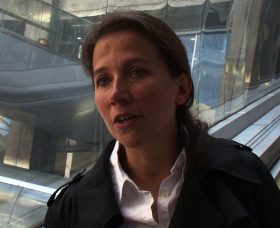
 Nathalie Roseau
will defend her Habilitation à diriger les recherches (HDR) on Monday, June 24, 2019,
at 2:00 p.m. (Amphitheater Navier, Ecole des Ponts ParisTech)
- Jean-Louis Cohen, Sheldon H. Solow Professor in the History of Architecture, New York University
- Carola Hein, Professor and Head of the History of Architecture and Urban Planning, Delft University of Technology
- Dominique Lorrain, Emeritus Director of Research, CNRS, LATTS (UMR 8134)
- Antoine Picon, Director of Research, Ecole des Ponts ParisTech, LATTS (UMR 8134) and Professor of the History of Architecture and Technology, Harvard University (supervisor)
- Olivier Ratouis, Professor at the University of Paris Nanterre, LAVUE (UMR 7218)
- Paola Viganò, Professor at the Swiss Federal Institute of Technology in Lausanne, Lab-U
- Based on reports by Carola Hein, Catherine Maumi (Professor at the Grenoble National School of Architecture, MHAevt (EA 7445)) and Olivier Ratouis.
Unpublished manuscript
Time and Infrastructure, Essay on Urban Planning in Metropolises
How does urban infrastructure come about? How are they built? How do they grow? A practical object designed to meet urban needs, infrastructure is a subject in its own right, with its own capacity for emancipation that acts on space, an "explanatory and explained variable" of the city in the making, to quote Bernard Lepetit. Futurism and obsolescence, desynchronization and discordance, latency and acceleration, overtaking and falling behind: often problematic, infrastructure represents a promise, renewed to usher in the future of cities or rehabilitated to reconnect with their past. By shedding light on the causalities according to which they are built and developed in their urban environment, this research hypothesizes that the prism of infrastructure offers the possibility of making the temporalities of cities, their representations, and their practices intelligible. It is structured around three narratives that take us successively to New York, Paris, and Hong Kong. Looking back at the trajectories of the New York parkway from 1870 to the present day, the legacy of Greater Paris during the "Trente Glorieuses" and the deployment of the Hong Kong archipelago's aerial infrastructure since the 1990s, they consider infrastructure from a situated and transnational perspective according to three figures that help us understand its role in the expansion of cities: the oxymoron, the seismograph, and the meta-object. What infrastructural materialities tell us about urban futures: through the study of these large-scale objects, this research invites reflection on contemporary urban planning.