End : 27 November 2026 à 16:00
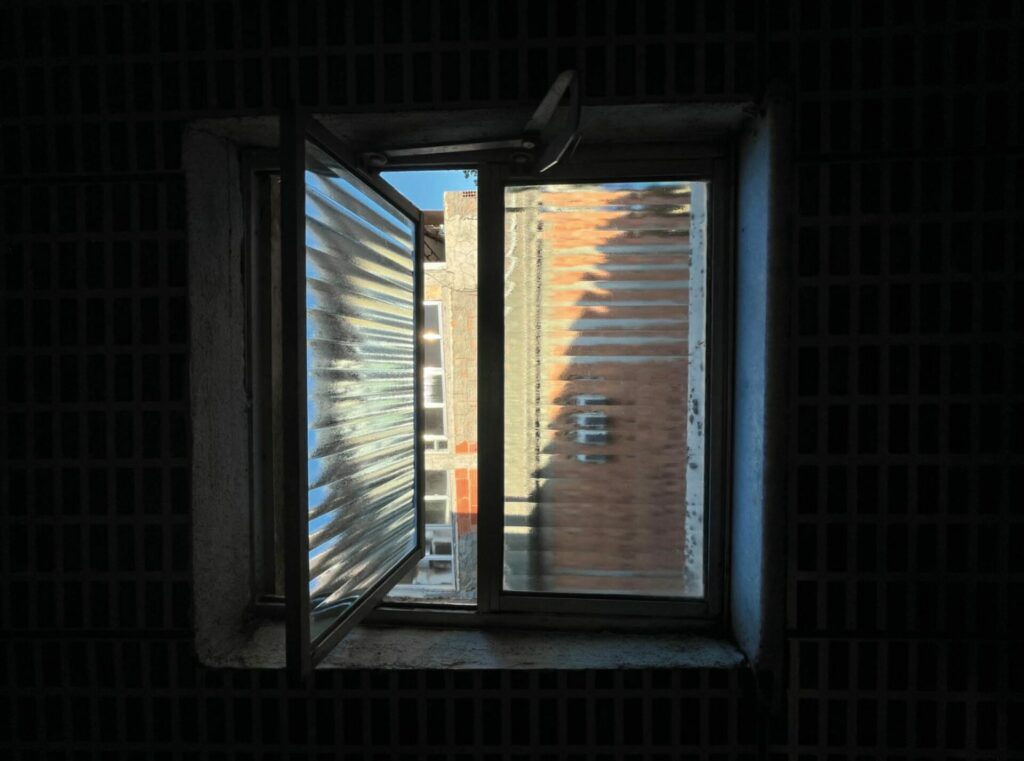
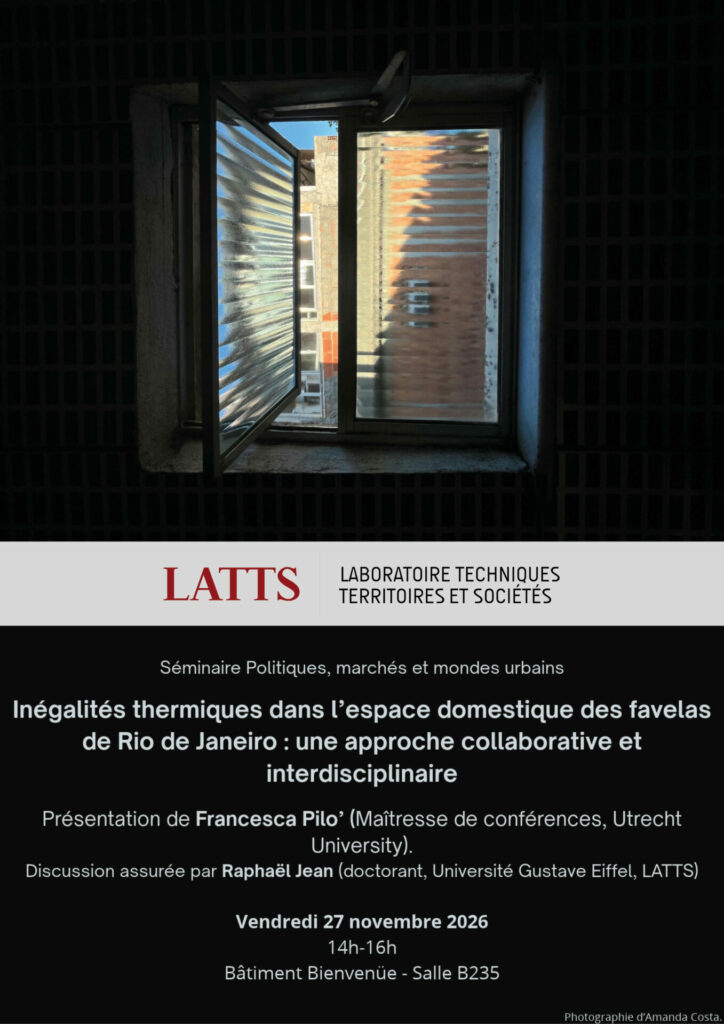
The next session of the PMMU seminar will take place on Friday, November 27, 2026, from 2:00 p.m. to 4:00 p.m., in Room B235 of the Bienvenüe Building. It will be titled “Thermal Inequalities in the Domestic Spaces of Rio de Janeiro’s Favelas: A Collaborative and Interdisciplinary Approach.”
Our former colleague Francesca Pilò, now an Assistant Professor in the Department of Human Geography and Spatial Planning at Utrecht University, will present research that is both methodologically innovative and highly relevant.
This work will be discussed by Raphaël Jean, a Ph.D. student at Latts.
Session Overview
This presentation outlines the initial findings of a collaborative project on thermal inequalities in the favelas of Rio de Janeiro. The research places the domestic space and its urban services at the center of the investigation, using an interdisciplinary approach—combining architecture, urban planning, and climatology—and a collaborative approach—involving a Brazilian NGO and six female residents from two favelas, who serve as “community researchers.” This approach stems from the observation that, while Rio de Janeiro has recently adopted a heat emergency protocol, the domestic space remains a blind spot in these policies. Documenting the thermal conditions of housing and the experiences of residents therefore motivated this research to support an advocacy effort.
By combining temperature and humidity measurements inside homes in two favelas, a thermal assessment of building materials, “infrastructure heat logs,” and a survey of 120 residents, the project demonstrates how thermal inequalities accumulate at the interface between housing and failing urban services. The research also shows that indoor temperatures can reach hazardous levels well before the city’s official heat alerts are triggered, highlighting the inability of official warning systems to reflect spatial variations in thermal exposure within the city. More broadly, this research invites us to reflect on the conditions of domestic habitability during extreme weather events, by showing how heat makes the material interdependencies of daily life—which determine the (im)possibilities of inhabiting a home—particularly visible, along with the governance challenges this poses.