End : 23 January 2026 à 16:00
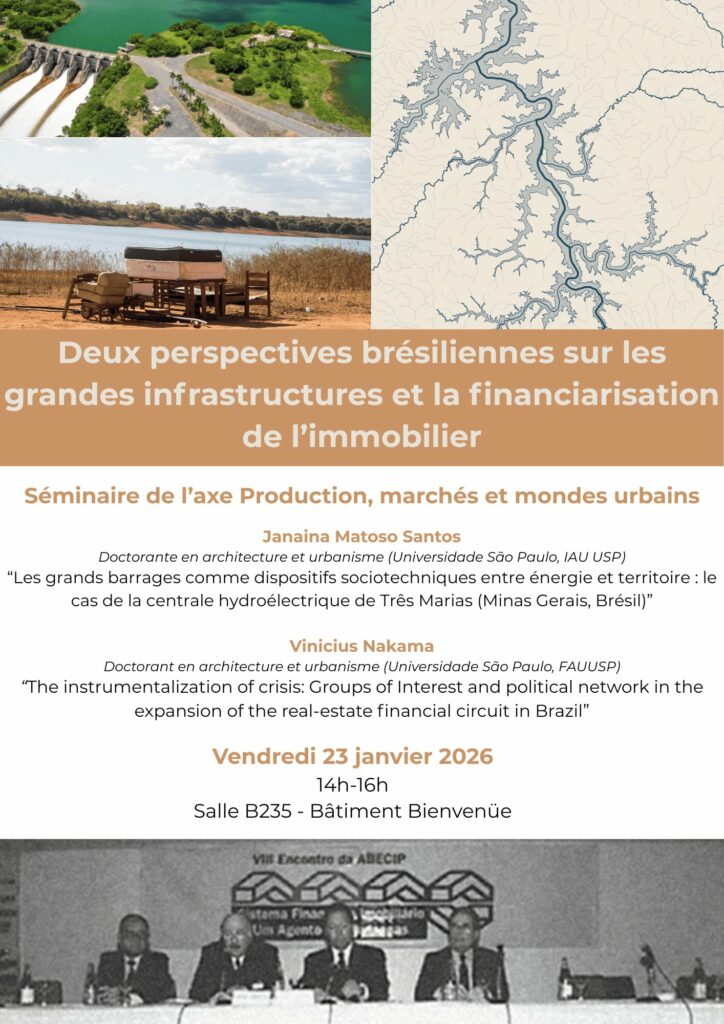
The PMMU department is organising a seminar on Friday 23 January 2026, from 2pm to 4pm in room B235 (Bienvenüe Building) and via videoconference on Zoom.
On this occasion, Janaina Matoso Santos and Vinicius Nakama will present their thesis work, particularly that which they have carried out at LATTS since their arrival and as their stay draws to a close.
For those who are unable to attend in person, here is the link to the Zoom meeting: https://univ-eiffel.zoom.us/j/89170473121
Meeting ID: 891 7047 3121
Password: 94eh3Mw1
Large dams as socio-technical devices between energy and territory: the case of the Três Marias hydroelectric power station (Minas Gerais, Brazil)
Abstract: The Três Marias Hydroelectric Power Plant (Minas Gerais State, Brazil) was built in the 1960s, at a time when Brazil’s energy systems were being developed with a view to expanding industrialisation. The large reservoir, covering an area of 1,040 km², flooded land that now belongs to eight municipalities with which it has had direct relations for six decades. This research examines how large dams operate over time through a dual relationship: (a) they are designed and operated as components of a large-scale energy system; and (b) once built, they function as devices for territorial reconfiguration at the local level, producing effects that are not always related to energy production. During the doctoral internship at LATTS, the aim is to broaden the theoretical and methodological basis of the ongoing research in order to refine the analyses of the effects of the Três Marias reservoir on neighbouring municipalities and the ways in which these effects are linked to the energy system of which the power plant is a part. To this end, the literature on infrastructure that has developed mainly since the end of the 20th century, a period described by some authors as the “infrastructural turn” in the social sciences, will be mobilised. During the presentation at the PMMU seminar, this theoretical framework will be discussed, showing how it relates to the previous stages of the research.
The instrumentalisation of crisis: Interest groups and political networks in the expansion of the real estate-financial circuit in Brazil
Abstract: The research examines the institutionalisation of real estate-based financial instruments in Brazil, with particular attention to periods of crisis. It posits that these instruments are not neutral but are shaped by situated sociopolitical processes that define their purposes. We argue that the design of these instruments, as the outcome of collective action by groups of interest within political and regulatory arenas, generates networks of influence and power in interaction with the state. At a more abstract level, these processes contribute to the assembly of a real estate-financial circuit. Methodologically, the study adopts a mixed-methods approach, combining critical literature review and documentary research with political network analysis. In doing so, it is expected to contribute to debates on financialisation by showing how these instruments, anchored in the production of urban space, are crafted to circulate financial capital and overcome the limits of capital accumulation.
We look forward to seeing you at this scientific exchange.