End : 01 April 2026 à 12:00
Seminar overview
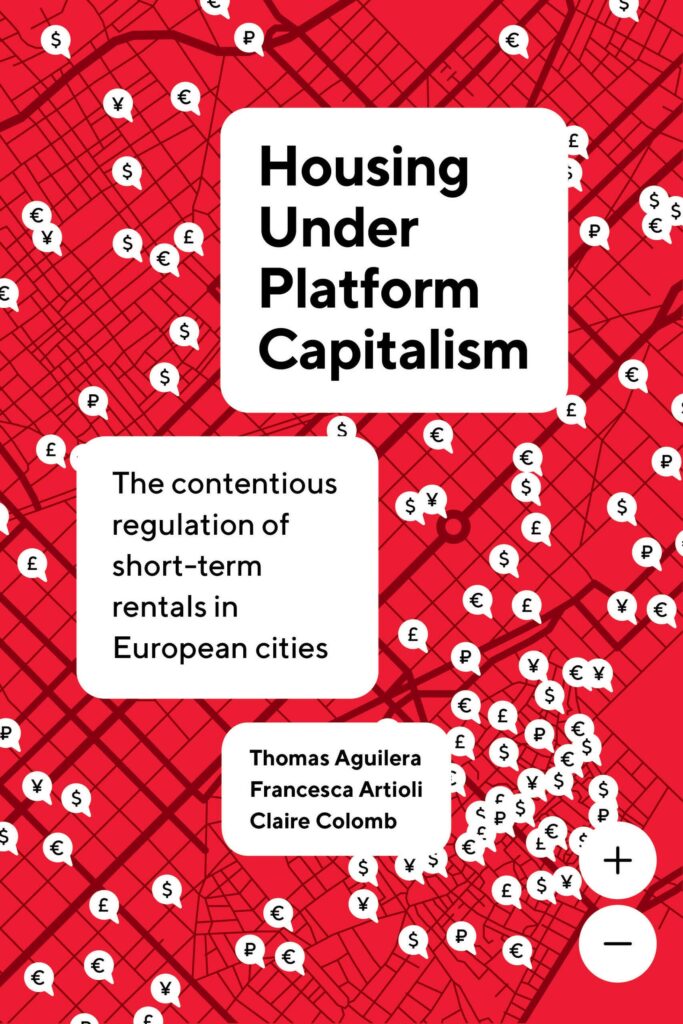
The Tripode research group (Digital Transitions – Regulation, Infrastructures, Practices, Data), in collaboration with the Politics, Markets and Urban Worlds (PMMU) research area at LATTS, is pleased to invite you to a seminar on the book *Housing under Platform Capitalism: The Contentious Regulation of Short-Term Rentals in European Cities* (University of California Press, 2025). Following a presentation by the three authors, Thomas Aguilera (Sciences Po Rennes, Arènes), Francesca Artioli (Université Paris-Est Créteil, Lab’Urba) and Claire Colomb (University of Cambridge), the discussion will be moderated by Lise Fourdrignier (UGE, LATTS) and Antoine Courmont (UGE, LATTS).
Summary of the book “Housing Under Platform Capitalism”
Fifteen years after the launch of Airbnb, most cities around the world have introduced plans to regulate these markets. However, there is a wide variety of governance and regulatory approaches across different regions, particularly in Europe. Drawing on comparative, multi-level research and employing mixed methods across twelve major European cities (Amsterdam, Barcelona, Berlin, Brussels, Lisbon, London, Madrid, Milan, Paris, Prague, Rome, Vienna), we highlight and explain the development of different types of regulatory regimes. In some cities, public policies aim to curb market development in order to protect the stock of affordable housing for permanent residents or to limit the effects of overtourism; in other cities, by contrast, regulations are designed to support the market in order to legalise it, tax it and make their territory attractive.
This variety of responses can be explained by institutional and socio-economic factors linked to welfare state systems, types of urban capitalism and housing markets, but also by the political processes of mobilisation involving citizens’ movements, property and land owners, financial actors, the tourism and housing sectors, and local and national governments. This book examines the capacity of states and local governments to govern cities, housing markets, tourism and, more generally, platform capitalism. It thus contributes to the comparative study of multi-level governance, the sociology of the state and the comparative political economy of capitalisms.