Christine Fassert and François-Mathieu Poupeau contributed to the Dictionnaire d'écologie politique (Dictionary of Political Ecology), published on October 17, 2025, by Presses de Sciences Po.
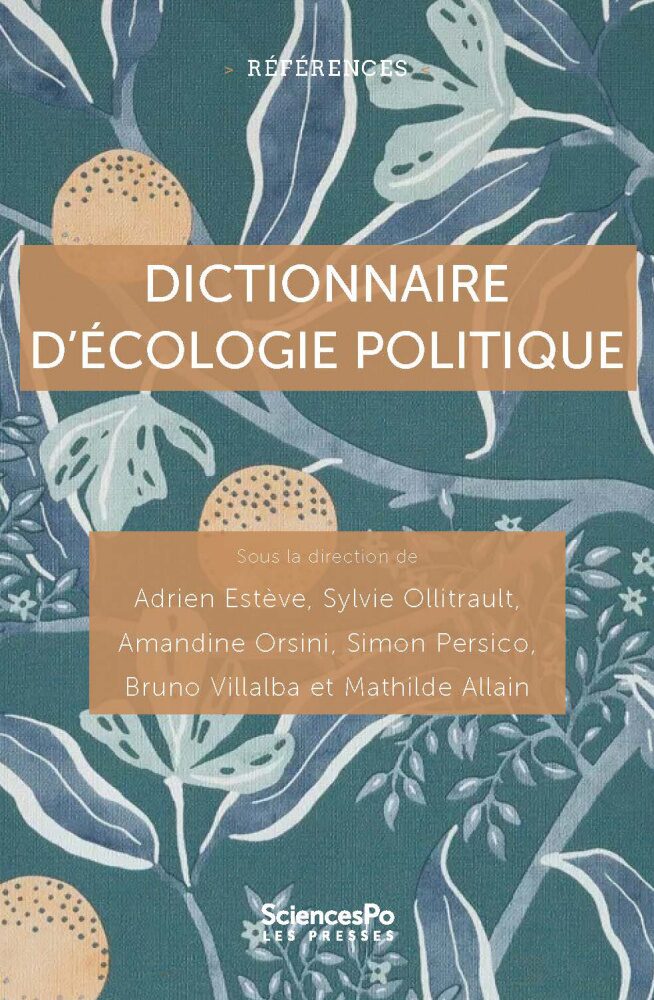
With over a hundred entries written by nearly 150 researchers, this dictionary reflects the wealth of work devoted to political ecology and its relevance in deciphering the contemporary transformations of our societies.
From "Agriculture" to "Sacrifice Zone," it presents the plurality of concepts, ideas, and findings developed by political science and related disciplines to reflect on the relationships between humans and their environment, showing their evolution and political consequences. Revealing the liveliness of scientific debates, often linked to social and political issues, it contributes to broadening the scope of reflection on ecology as we enter a period of radical uncertainty about the effects of environmental crises.
Christine Fassert co-authored the chapter "Nuclear/Anti-Nuclear" with Sezin Topçu.
The nuclear industry is one of the few techno-industrial sectors that has been the subject of sustained controversy since its inception. As a result, its history has been marked by evolving technologies of governance and constantly changing relationships between the state, industry, ecology, and society.
François-Mathieu Poupeau co-authored the chapter "Instruments" with Marie Hrabanski and Antoine Ducastel.
In their reports on the fight against climate change and the protection of biodiversity, often presented as two major pillars of environmental policy, the Intergovernmental Panel on Climate Change (IPCC) and the Intergovernmental Science-Policy Platform on Biodiversity and Ecosystem Services (IPBES) devote considerable space to public policy tools. This mobilization, often for the purposes of "good governance," should not reduce the approach to instruments to its normative dimension of collective decision-making support. As understood by many political scientists since the 1980s (Lascoumes and Le Galès, 2004), this approach also takes a more analytical, even critical, perspective, viewing instruments as markers of the relationships between rulers and ruled and of the political, economic, and social choices and effects that underlie them. In doing so, the instrument-based approach intersects with debates in political ecology. Without claiming to exhaust all the points of convergence between these two fields of study, this note seeks to outline some of the lines and axes of a dialogue that appears to be most fruitful and thus to strengthen political ecology, through instruments, in countries in the North and South.