 On Wednesday, March 14
, 2018
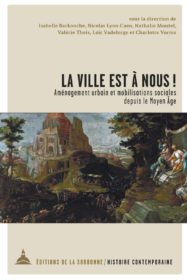
, at 8 p.m., the Le Genre Urbain bookstore is hosting a discussion about the book La Ville est à nous ! Aménagement urbain et mobilisations sociales depuis le Moyen Age (The City Belongs to Us! Urban Planning and Social Mobilization Since the Middle Ages), published by Éditions de la Sorbonne.
See the "minute urbaine" dedicated to it by the bookseller: https://www.youtube.com/watch?v=WWvl7hRuCPU&feature=share
This book includes a contribution by Martine Drozdz on social mobilization in urban regeneration projects in London.
Edited by Isabelle Backouche, Nicolas Lyon-Caen, Nathalie Montel, Valérie Theis, Loïc Vadelorge, Charlotte Vorms
La ville est à nous ! Aménagement urbain et mobilisations sociales depuis le Moyen-Âge
Editions de la Sorbonne / Histoire contemporaine, 2018, 368 p.
While urban planning as a discipline was established in the 20th century, social movements that challenge urban development have a much longer history. This book focuses on the many forms of collective mobilization that, since the Middle Ages, have targeted the city or, on a different scale, the region and the neighborhood. From medieval Netherlands to present-day Marseille, this book identifies the social relationships that develop when groups see their physical space change, whether they oppose the changes or engage in alternative transformations. By paying attention to the variety of the protagonists' experiences and their repertoires of action, from consultation to taking up arms, this book also seeks to historicize resistance to the modernization efforts of public authorities. In doing so, it sheds light on the issue of participation, the institutionalized aspect of public involvement in urban planning. It strives to reconstruct the concrete contexts and their evolution by addressing three main questions: What is a process of politicization? How do the various individual and collective interests at stake interact? How can we write a social history of major public works?