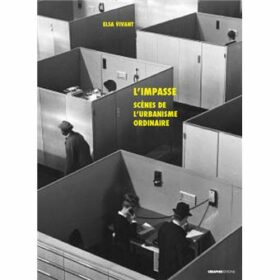
 The Dead End Scenes of Everyday Urban Planning
Elsa
Vivant
Créaphis Editions, 2021
Elsa Vivant uses fiction to describe the working and living conditions of all those involved in city life. Through their stories, the narrative moves between several sociological situations based on research documentation and embracing subjectivity.
The renewed experiences of explaining urban planning, its diversity, and its importance are at the origin of the writing of Chronicles of Ordinary Urban Planning. Understanding the working conditions of urban planners, their connection to what they produce, and the difficulties associated with the specificities of their working conditions (relationships with elected officials, constant changes in the administrative and political context, the weight of technical, financial, and regulatory constraints, contradictory injunctions between individual values and convictions and working conditions, etc.) sheds new light on the methods of what is now known as urban manufacturing (the term "manufacturing" implicitly referring to industrial work). How does the increasing fragmentation of urban planners' activities, through the use of service providers and subcontractors, weaken the professionals themselves and the purpose of their work by diluting responsibilities and causing a loss of memory about the territory and projects? The proliferation of actors involved in development contributes to a division of tasks and responsibilities, making coordination the main focus of urban planners' daily work.
Elsa Vivant chooses to use fiction based on the survey documentation and embraces the subjectivity of the respondents and the investigator. In these chronicles of ordinary urban planning, we meet a social scientist studying the challenges of creating a recreational facility in connection with the construction of a metro station in a neighborhood undergoing urban renewal. We follow her to meetings, site visits, and demolition observations. We read the archival materials she has collected. We meet the professionals involved at different levels, each representing an issue and a category of actor. We drift towards other issues relating to the complexity of urban renewal operations, questions that are not asked, and relationships with residents. We share the feeling of powerlessness of certain professionals overwhelmed by contradictory demands. How can we get out of this situation? We find loopholes in distancing ourselves, experimentation, artistic expression, and solidarity.
The characters are conceived as ideal types. They are forged from the analysis of more than fifty interviews with urban planning professionals in which they expressed their enthusiasm and doubts about the political orientation of their interventions and the loss of meaning. The choice of a fictional style that reads like a novel reflects the subjectivity of professionals in relation to their work: involved in the production of the city as actors, but as inhabitants, they themselves are subject to the reality of urban, cultural, and social change. Through their trajectories, the narrative moves between several sociological situations: urban renewal, the deterioration of condominiums, the creation of infrastructure, suburban densification, policies to beautify public spaces, support for degrowth in rural towns, etc.
The author has chosen to assemble fragments and forms in which the narrative follows several parallel plots. She draws on archival documents to highlight the poetic dimension of these professional writings and reveal their political significance: an advertisement for a condominium that quickly fell into disrepair, the user manual for a public building with "high environmental quality and positive energy," and an open letter from a mayor following an employee's suicide attempt at work. Professional and obscure jargon is featured in the "Steering Committee" sequences, where a project manager recites a monologue whose meaning is all the more abstract because no one is listening, everyone being immersed in their smartphones and lost in their thoughts. A parallel narrative, the investigation diary, describes the situations observed and compares them with those experienced in the world of research, where similar constraints weigh on the work.
Begun in 2015, this project was marked by the Paris attacks. Their place in this narrative stems from the questions they raise for urban planning. This professional world is representative of the most vulnerable social groups (young urban graduates), especially since the northeast of Paris is home to a large number of architecture and urban planning agencies. The epilogue to the police pursuit of the terrorists, a military assault on a dilapidated building in a working-class suburb, exposed the practices of slum landlords and the slowness of legal proceedings against them. To quote some of those interviewed, these attacks and the religious radicalization they represent lead them to question the frameworks of urban planning, wondering whether, particularly in the context of urban renewal, they have made mistakes, whether they have overlooked important issues, and whether, professionally, they bear some responsibility. No one has the answers, but many are asking the questions. The characters, the respondents, and the researcher are all experiencing the same reality, that of a moment in the world dominated by astonishment, doubt, incomprehension, and a feeling of powerlessness.
At the Le Genre Urbain bookstore, 8:00 p.m. (Paris)