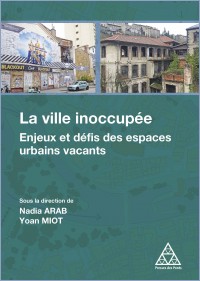
The Unoccupied City: Issues and Challenges of Vacant Urban Spaces
Edited by Nadia Arab and Yoan Miot
Paris, Presses des Ponts, 2020, 230p.
At a time when the ecological transition is increasingly imposing limits on land use, as evidenced by the recent bill aiming for "zero net artificialization" of national land, vacant urban spaces are emerging as a growing and increasingly topical issue in both France and internationally. Furthermore, the issue of vacant spaces and their reactivation goes far beyond the case of transitional urban planning, which has already been widely discussed. Unlike the issue of transitional urban planning, the treatment of vacant spaces is not only a question of temporary occupation or a precursor to an urban planning project or experimentation with uses. This book fills a gap both in its approach and in the results it produces for research and practice.
Vacant spaces refer to built or unbuilt spaces that were constructed and used for a purpose before becoming unused or underused, destroyed, or even never occupied. This phenomenon affects large cities as well as medium-sized and small towns, dynamic areas with tight real estate markets, and cities in decline, where the situation is even more alarming. This multifaceted phenomenon manifests itself in various ways, through the presence of partially or entirely vacant buildings and/or dilapidated retail spaces, in concentrated and massive forms or in a more diffuse manner. These unused spaces can be small or large; there is no standard. The same applies to their state of repair or deterioration, as well as the length of time they have been vacant. Finally, this diversity also applies to their owners. While a growing body of work is focusing on this issue, few studies take a cross-cutting approach and seek to draw lessons both from the perspective of explaining the phenomenon and from the methodological questions raised by the production of knowledge on the phenomenon, or even from the methods of reactivating and redeveloping these unused spaces.
Based on this observation and editorial choice, the book is structured in three distinct parts. The first part aims to report on approaches and measures of the phenomenon of vacant spaces by looking at different types of vacant spaces (offices, shops, service premises). Based on the work of professionals and researchers, it puts definitions and methods for approaching vacant spaces into perspective and reminds us how much the activity of measuring a phenomenon reflects representations of the problem and frames the possibilities for action. The second part focuses on the actors involved in the redevelopment of vacant spaces. Here again, a variety of situations and types of vacant spaces are analyzed: housing, ground floors, brownfield sites, and offices in both large cities and declining towns. The chapters in this section are structured around a close examination of the activities of actors involved in redevelopment, highlighting both the diversity of approaches currently being developed and certain recurring themes (influencing supply, influencing demand, matching supply and demand). Finally, the third part offers an international perspective on three countries that have long been confronted with the problems of vacant spaces. This perspective highlights the role of the national legal context concerning land ownership in how vacant spaces are approached and dealt with.