Yoan Miot and Aude Danieli will present their research findings during this study day on November 22, 2017, at the Institut d'Etudes Politiques de Rennes.
Yoan Miot will speak on the following topic: "Going green to survive. Energy transition policy in a declining city. The case of Vitry-le-François."
Aude Danieli will give a presentation entitled: "Linky smart meters and citizen power. Energy, a new focus for local mobilization?"
Organized by Arènes' Cross-disciplinary Project on Environment, Sustainable Development, and Political Ecology and the Chair in Territories and Changes in Public Action at Sciences Po Rennes.
Practical information and full program available at: http://www.arenes.eu/journee-detude-politiques-locales-de-lenergie/
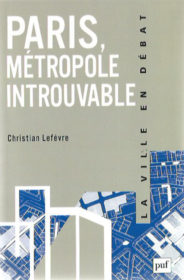 Christian Lefèvre
Paris, métropole introuvable
PUF, 2017, 152 p. (Coll. La ville en débat)
The Paris metropolitan area is struggling to keep pace with globalization, despite its economic and cultural power, which makes it one of the world's leading cities. This is undoubtedly because its history and political culture have confined this territory to a national framework that is partly self-referential.
By comparing Paris with its two great rivals, London and New York, this book provides a better understanding of the historical and cultural uniqueness of the French capital. Largely dominated by the political world, the Île-de-France system of actors is finding it difficult to open up. The Île-de-France region thus appears to be a place of conflict where different worldviews clash, particularly regarding the region's place in globalization and policy priorities. Focusing mainly on the last twenty years and in particular on the debate on Greater Paris, the book shows that globalization remains unconsidered by most actors in the Paris region, which largely explains the conflicts that divide it.
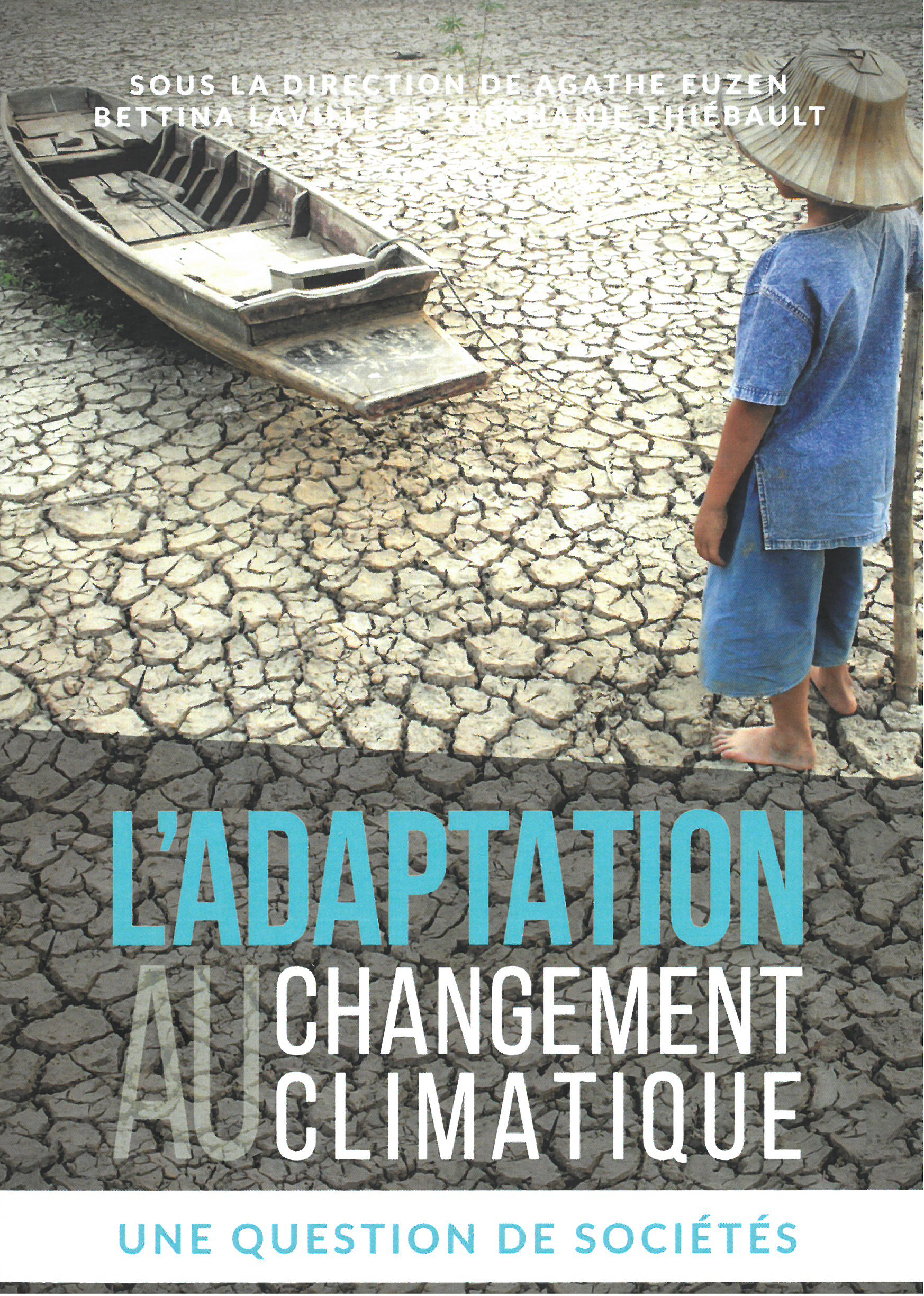
Edited by Agathe Euzen, Bettina Laville, and Stéphanie Thiébault
Adapting to climate change. A question for societies
CNRS Editions, 2017, 416 p.
Adapting to climate change and global change has become a vital objective for all societies. Sometimes brutally confronted with the increased frequency and intensity of meteorological phenomena such as floods, droughts, and tornadoes, they must also deal with rising temperatures and their impact on the balance of ecosystems, the evolution of animal and plant species, and the development of human populations, their living conditions, and their social organization. While the study of climate variations over time shows the ability of ecosystems to adapt or transform, the acceleration of certain phenomena, such as the global increase in temperature due to human activities, may lead to a point of no return. This book, composed of some fifty articles written by scientists and experts on the subject, is unique. It encourages reflection on what adaptation and maladaptation are, drawing on several disciplinary, sectoral, and territorial fields. While highlighting obstacles and limitations, it also provides evidence and suggests ways to act and adapt.
These contributions support the implementation of the Paris Climate Agreement (2015) and in particular COP 23 (23rd Conference of the Parties to the United Nations Framework Convention on Climate Change, in Bonn, 2017), a climate conference whose priorities include adaptation, both in terms of its objectives and its financing.
Edited by Agathe Euzen
, Françoise Gaill, Denis Lacroix, and Philippe Cury
L'Océan à découvert
CNRS Editions, 2017, 322 p. (Coll. A découvert)
It covers 70% of the globe's surface, largely regulates the Earth's climate, and is home to a multitude of species, many of which are yet to be discovered.
The ocean plays a major role in the functioning of life on Earth. With global change, multiple challenges have emerged, the future consequences of which affect all of humanity.
This book aims to provide a better understanding of the ocean in all its extent, depth, and complexity, from both a physical and biological perspective, including its interactions and dynamics. To explore it, numerous tools, infrastructures, and original approaches have been developed to obtain the data and information essential to a better understanding. History shows the evolution of techniques and representations that link human communities to the oceans and the diversity of uses they make of them. Considered as a resource, a service, or a territorial issue, the ocean is essential but vulnerable. It faces multiple risks, from flooding to pollution, and managing these risks requires anticipation in the face of increasing human activity. This raises the question of the future of the ocean, a space often considered infinite and unlimited, described as geostrategic by some and a common good by others.
Patrice Flichy
Les nouvelles frontières du travail à l'ère numérique
(The New Frontiers of Work in the Digital Age) Seuil, 2017, 432 p.
The digital revolution is at the heart of the changes currently affecting the world of work. So much so that some see it as the main cause of job insecurity and denounce the "uberization" of the economy, which they believe heralds the end of salaried employment, and even of work itself.
This interpretation only sees part of the problem. It ignores another silent revolution currently underway: individuals' search for new relationships with work. More and more men and women want to gain autonomy, stand out, enhance their reputation, and find fulfillment in what they do. Digital technology provides them with the opportunity to bring their work and their passions closer together, to mobilize their personal resources to invent forms of activity through which they can define themselves. By analyzing emerging attempts to work differently, this book shows how the long tradition of other work, formerly confined to the domestic sphere or the neighborhood, is being replaced by open work that bypasses the organization of professions and combines the collaborative market economy with the non-market sharing economy.
While these practical utopias require a rethinking of the social compromise on a new basis to guarantee the same rights for all, the paths to emancipation they inspire completely redefine the question of work: the challenge is no longer to free ourselves from it, but to free it.
Read in Le Monde
http://www.lemonde.fr/livres/article/2017/09/14/sociologie-travailleurs-2-0_5185345_3260.html
Listen on France Culture
https://www.franceculture.fr/oeuvre/les-nouvelles-frontieres-du-travail-lere-numerique
Buy on the publisher's website
http://www.seuil.com/ouvrage/les-nouvelles-frontieres-du-travail-a-l-ere-numerique-patrice-flichy/9782021368482
Sylvy Jaglin visited the Université Libre de Bruxelles (Faculty of Architecture) to participate in the TYCO-WSS project workshop.
The TYCO-WSS research project (Typologies of Institutionalized Co-production of Water and Sanitation Services in the Urban South) aims to make a substantial contribution to the debate on sustainable urban service provision in the global South. To do so, it proposes an original approach to service provision that, first, focuses on alternative organizational arrangements to produce urban services, based on (in)formal state-community co-production practices and collaborations (institutionalized co-production – ICO). Second, it intends to systematically explore spatial, environmental, technological, and social conditions of the diversified typologies of institutionalized service co-production, and the implications they generate.
The general aim of this project is to understand and evaluate whether and under which circumstances co-production contributes to structural improvement in service delivery and in living conditions for city-dwellers (with respect to economic viability, environmental soundness and socio-spatial equity and cohesion). This general aim has been declined through two scientific activities:
- first, to identify and categorize typologies of institutionalized WSS co-production practices and,
- second, to explore and evaluate the effects of ICO practices through in-depth case studies.
This research aims to move away from a single case study approach to propose a comparative work aimed at meeting the project's objectives. Five cases are proposed to explore institutionalized co-production in the Global South: Addis Ababa, Cochabamba, Kinshasa, Hanoi, and Mumbai.
Ludovic Halbert attended this symposium in Sheffield (United Kingdom) from September 13 to 15, 2017.
Nathalie Roseau was invited to this international conference from September 6 to 10, 2017.
Constance Berté
will speak at the ITTECOP seminar on October 19 and 20, 2017, in Paris La Défense.
Her presentation will focus on:
Ecological compensation in urban planning: the emergence of a new public policy tool
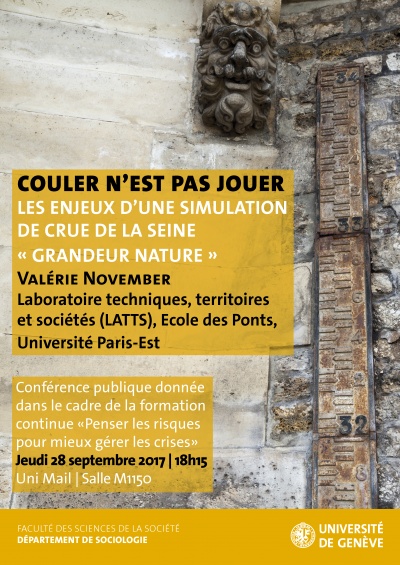
Valérie November will speak on Thursday, September 28, 2017, at the University of Geneva during a public lecture given as part of the continuing education program "Thinking about risks to better manage crises."
François-Mathieu Poupeau will speak on Monday, September 18, in Ajaccio before the Corsican Energy, Air, and Climate Council as part of a seminar on sustainable mobility. His presentation will be entitled "The concept of governance: origins and implications for local public action."