Thesis supervisor(s)
: Sylvy Jaglin, Claude Cohen (more…)
This postdoctoral research focuses on risk/territory relationships and territorialized major risk management processes, particularly in urban areas. It is supported by LabeX Futurs Urbains and involves three laboratories: LATTS, headed by Valérie November; LEESU, headed by Gilles Hubert and José-Frédéric Deroubaix; and Lab'Urba, headed by Jocelyne Dubois-Maury. As such, the research has an experimental dimension involving inter-laboratory work and is designed to address the issues faced by operational stakeholders.
In this context, the EPA ORSA (Etablissement Public d’Aménagement Orly-Rungis, Seine-Amont) and the project it is carrying out in the context of the metropolization of the Ile-de-France region (Grand Paris project, express metro, CDT, new metropolitan authorities) and in a territory subject to numerous risks, appear to be an ideal subject.
Identified since the 1990s as one of the sectors with high potential and challenges for the future development of the Paris metropolitan area, the ORSA territory is the subject of an OIN launched in 2007, and the EPA is responsible for the various projects spread across the territory.
Overall, the major challenges of these operations relate to economic conversion (from heavy industry to cutting-edge industry/research, upgrading logistics infrastructure), mobility (better connecting the territory to Paris (north-south axis), but above all promoting east-west travel within the territory) and the development of the housing stock. These already complex challenges are compounded by environmental issues, particularly those relating to major risks.
The Seine-Amont area in particular is at high risk of flooding, with potential repercussions for the entire metropolis located downstream. In addition, there are numerous Seveso establishments and high-risk industrial sites scattered throughout the area. One of the central questions for the EPA is therefore: "How can we build a city in a high-risk area?"
The final choice of development projects to be studied, as well as the precise scope of the research questions, are currently being developed in consultation with the EPA. However, a few points can already be made.
One avenue concerns the "effects" of the urban development process (in the broadest sense, from the first texts identifying the territory to the models presented recently, from political decisions to the establishment of bodies such as the EPA, etc.) on the risk footprint in the territory itself.
In other words, does the fact that a territory is involved in a development project (with the financing, studies, power relations, proposals, and outputs that this implies) have an impact—and if so, what kind—on the way in which the actors who will be directly affected by an event consider the risk, prepare for it, and/or organize themselves collectively? Or do these projects develop in a kind of "fictitious territoriality," with their process only impacting the "living" territory once the developments are built?
The idea is therefore to conduct a study among all the actors who would be directly affected in the event of a flood or industrial accident in order to identify the means and measures implemented to address these risks, and to analyze how the development process initiated in the 1990s (in all its forms) has intervened/is intervening (or not) in this construction of the conditions for action in the event of an incident.
This will involve surveying crisis management stakeholders (emergency services, SIDPC, etc.), companies operating in the sector (industrial sites, transport network operators), associations, etc. on how they view risks and translate them into plans/measures/tools/organizations. The analysis will then aim to identify, in these different translations of risk, traces of the urban project process in order to shed light on the extent to which and how this type of project intervenes in the process of territorialization of risks.
The Ardoines site appears to be particularly interesting in this regard, as the project is about to be implemented and the first operations are expected to begin soon. Another project site could be included in the study for comparative purposes. Its definition is still in progress.
Keywords: Major risks, Territorialization, Urban Projects, Action in context
Thesis supervisors
: Marc Barbier and Catherine Paradeise (more…)
Thesis supervisor
: Patrice Flichy (more…)
Thesis supervisor
: Olivier Coutard Large-scale (more…)
Whether individual or collective, housing has been the subject of predictions for many years about the growing role that technology will play in it. The rise of digital technology has revived the promise of a revolution in housing and lifestyles through home automation: it is no longer just robots that could take on various demanding or repetitive tasks, but digital tools that would allow remote control of automated systems, whether to adjust the temperature, activate the opening and closing of various equipment, control intrusions, or, through constantly provided measurements, enable knowledge of energy consumption practices, analyze their effects, and transform these practices. Smart homes would also help elderly people to remain in their own homes by providing them with assistance and security, enable men and women who are constantly on the move to take care of their homes from their workplace or vacation destination, and make families aware of their daily practices and the consequences, both economic and environmental, on energy consumption so that they can be better informed and optimize their use of energy.
Energy management through technology is one of the most active components of housing development. Digital technologies are combined here with those that make it possible to reduce the consumption of energy and environmental resources of all kinds. Social housing organizations are engaged in construction programs aimed at meeting the requirements of sustainable development. The buildings and housing concerned are likely to incorporate technologies and equipment whose potential (energy consumption regulation, personal and property security, home care for the elderly, etc.) adds value to the housing but also places significant demands on occupants (e.g., in terms of handling or controlling this equipment). The use of housing and equipment by residents is likely to become a key issue for project management and maintenance teams, as well as for local teams.
How do the technologies used in new buildings or renovated complexes lead to changes in the tasks assigned to the various teams and their specific work activities? How are professions affected, either profoundly or marginally? What challenges can be identified in terms of skills and skills management? These are undoubtedly the least known and least explored aspects of technological change in housing to date by social housing organizations. The research aims to conduct an initial examination of these issues and provide benchmarks for a few major job categories: project management, maintenance, and local teams. It sets out to report on how smart housing is currently manifesting itself in the work of the three categories of staff mentioned above. It seeks to determine the extent to which these more or less pronounced changes in activity are confronting these professions with shifts and reorganizations that need to be qualified: are they an extension, a shift, or a break with existing professions? At a more detailed level, it also seeks to identify skills that are beginning to emerge as challenges because they are little or not at all developed in the traditional configuration of each profession.
Keywords: Social housing; smart housing; professions; skills.
Method: The research is based on a qualitative survey approach and involves interviews and observations with representatives of three groups of professions: project management, maintenance, and local teams. Additional interviews are also conducted. They aim to document and understand:
a) the reality of the activity and how work situations confront staff with problems related to new-generation buildings and equipment;
b) how agents view these issues and incorporate them—to a greater or lesser extent, with ease or with difficulty—into their professional practices, and how they interpret them in terms of their representations and practices of the profession;
c) the scenarios and specific professional situations in which issues of mastery of the activity to be carried out and, therefore, of skills development arise. This research work provides a learning support for action research for master's level students and/or engineering students.
For several years now—often four or five years—social housing organizations have been experimenting with new programs and renovations designed to improve energy performance through building construction and installations. They are now in a position to take stock, draw conclusions, and formulate lessons learned from the acceptance and operation of the new housing and its equipment, as well as from energy management in a context that is not theoretical but based on technical realities and the behaviors and habits of residents. But what about the effects, consequences, and implications for the staff of these organizations in the performance of their jobs? How are their jobs evolving, and what skills may they need? Should training be provided to address these needs? These are the questions that inspired a study conducted on behalf of the Union Sociale pour l'Habitat (Social Union for Housing) by Pascal Ughetto, with students from the Master's program in Skills and Organizations at the University of Paris-Est Marne-la-Vallée and the consulting firm Habitat et Territoires Conseil, using two social housing organizations in the Paris region as case studies.
Low-energy buildings (BBC) are designed to be energy efficient and comply with the latest regulatory standards. In the organizations studied, important lessons are being consolidated, and the study focused on what they imply for the work of the organizations' staff, their jobs, professional representations and practices, and any skills development needs. At this stage, the effects have mainly been felt in the efforts required by maintenance staff to deal with technical setbacks, which are largely due to a lack of coordination across the entire chain of actors, including manufacturers, construction companies, and maintenance companies. Assigning responsibilities to the various players, improving coordination, and encouraging feedback and its use, by mobilizing both program managers and local staff, are among the most crucial challenges for organizations. Staff seem to need answers on these issues more than they seem to be exposed to upheaval in their professional benchmarks. More than a lack of training, the sector is therefore facing a challenge in terms of the quality of organization and management to facilitate the collective learning that social landlords must undertake. If there are any actors who will need to be successfully recruited and promoted in the future, and who will need to be supported so that they can become effective organizers of collective learning, it is the members of management.
The report is available here in the form of a USH Cahier.
Eric Verdeil defended his Habilitation à diriger des recherches (HDR) on November 23, 2015
Location: Lyon 3 University, Caillemer Room, 15 quai Claude Bernard, 69007 Lyon (more…)
This work aims to examine the process of centralization that took place in France between 1870 (major decentralization laws at the beginning of the Third Republic) and 1970 (the height of a more Jacobin Fifth Republic). In the space of barely a century, local authorities have gone from being new democratic forces, some of which offered a potential political alternative to the central state, to playing a supporting role, attempting to resist the centralization movement that has been gaining ground since the interwar period. This simple observation, born of the confrontation between two key dates that mark an important sequence in the construction of the French political and administrative system in the 20th century, is at the origin and heart of the reflection carried out in this HDR thesis. It focuses on the study of intergovernmental dynamics from 1870 to the early 1970s and what can be considered the slow "closure" of the institutional game that had been opened by the Third Republic. This process has ultimately been little studied in the long term and in all its complexity, both by historians and political scientists. It is often attributed to a vague movement of "nationalization" and "centralization," which is usually associated with the regime changes that affected France (the transition from the Third to the Fifth Republic), to a general context favorable to the state (world wars, the economic crisis of the 1930s, reconstruction and modernization), and the establishment of a functional social organization at the expense of territorial structuring. Without dismissing these broad but overly simplistic explanations, the aim here is to take a closer look at this process of reshaping intergovernmental relations, questioning the sometimes paradoxical role that local authorities may have played in it.
To this end, the thesis draws on an original manuscript, the subject of the second volume, entitled "Electricity and local authorities in France (1880-1980). Another history of public service." Capitalizing on several personal research projects, it offers a new interpretation of the formation of the French model of public electricity service, starting not from the state and the various actors or institutions that comprise it, but from local authorities, which played an important, albeit little-known, role in the centralization process. Volume 1 compares this unique history with other public policy trajectories (social action, hygiene and health, urban planning, etc.) to renew the classic historiographical interpretation of the evolution of the French political and administrative system during the 20th century. It defends the hypothesis of a two-sided centralization, an expression of Jacobinism that was both "tamed" by local authorities (the traditional thesis of political scientists and historians) but also "tamed" them (a new perspective highlighted in volumes 1 and 2), then outlines some programmatic areas of research.
Sylvy Jaglin J
. and Dubresson A.
Eskom. Electricity and Power in South Africa
Editions Karthala, 2016, 228 p. (Coll. Terrains du siècle)
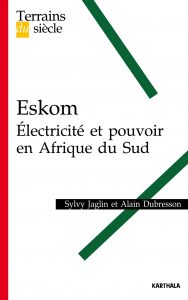 Africa's leading electricity producer, Eskom Holdings SOC Ltd is a vertically integrated public monopoly wholly owned by the South African government. Shaken in 2008 by local power outages, then forced to implement rolling blackouts, this national champion was, in early 2015, on the brink of technical disaster and financial ruin. This book attempts to understand how and why a company emblematic of South African state capitalism is now in such dire straits.
The so-called electricity crisis is first and foremost a crisis for Eskom as an organization. Its origins can be found in the relationship between the construction of state power before, during, and after apartheid, and that of Eskom, which was established as a commission in 1923, corporatized in 1987, and converted into a public enterprise in 2001. Beyond the technical malfunctions of the network, which are real, Eskom's neopatrimonial technopolitical regime is reaching its limits.
Deprived of an industrial strategy in the 2000s, Eskom has instead become a powerful tool for Black Economic Empowerment and the redistribution of coal revenues, but the weakening of its technical system is shaking the entire political edifice. The public company, now inefficient, is increasingly contested, and its monopoly, and even its existence, are being called into question.
With the participation of Renaud Epstein from the University of Nantes
The Service du Pilotage et de l’Evolution des Services (Service for Steering and Development) of the General Secretariat of the Ministry of Ecology, Sustainable Development, and Energy asked LATTS to organize a seminar to inform senior executives at the ministry about research on topics that directly concern them. For several years, this ministry has been engaged in a series of cultural reforms (merger of ecology, infrastructure, and industry in the late 2000s, elimination of competitive public engineering) and organizational reforms (RéATE) and a continuous evolution of missions and resources. These changes are set to continue with the upcoming territorial reform, which may lead to organizational changes for the ministry's departments.
The seminar was aimed at an audience of directors and deputy directors of decentralized services as well as administrative managers, and brought together around 30 people for each of the four days. The presentations by researchers were followed by responses from civil servants from this ministry or other relevant public organizations.
The first session, on July 10, 2015, focused on the issue of agencies and decentralized services. It provided an opportunity to discuss the contrast between the considerable autonomy granted to agencies in recent years and the control and limited resources allocated to decentralized services. Researchers presenting: Renaud Epstein, University of Nantes; François Mathieu Poupeau, LATTS.
The second session, on November 20, 2015, presented the ongoing debates on the new geography of public intervention, focusing on three contrasting contexts: metropolitan areas, peri-urban areas, and declining cities. This session highlighted that the state can still intervene effectively in these different types of territories, but under very different conditions. Participating researchers: Daniel Behar (Paris Institute of Urban Planning), Anne Lambert (INED), Yoan Miot (LATTS), Daniel Florentin (LATTS).
The third session, on February 5, 2016, addressed the evolution of public management through two quantitative surveys on the use of management tools in French administrations and on the perceptions of reforms by senior executives in Europe. The issue of careers for engineers, starting with the question of feminization, completed the picture. In particular, the session made it possible to position the Ministry of Ecology within the general reform movement. Participating researchers: Gilles Jeannot (LATTS École des Ponts), Philippe Bezes (CNRS Science Po), Konstantinos Chatzis (LATTS École des Ponts), Catherine Marry (CMH CNRS.
The fourth session on May 13, 2016, focused on the issue of remote government. First, a management issue reinforced by the creation of large regions was raised: how to manage services located several hundred kilometers away? Then the issue of distance was addressed in a more metaphorical way. Can the state, through competitions or labels, guide the actions of private companies or local authorities more effectively than through dialogue and proximity enabled by decentralized services? Participating researchers: François Hubault (Paris 1), Alexandre Mathieu Fritz (LATTS, UPEM), Renaud Epstein (University of Nantes), Grégoire Mallard (CSI École des Mines), Aurélie Tricoire (CSTB).
Thesis supervisor(s)
: Sylvy Jaglin, Claude Cohen (more…)