Conquering the seas, planning for offshore wind power (2009–2026)
The project at a glance
Start year : 2022
End year : 2025
Scientific Director : François-Mathieu Poupeau
Area of research : Govern, organize, work (GOT)
in progress
Overview
Project overview
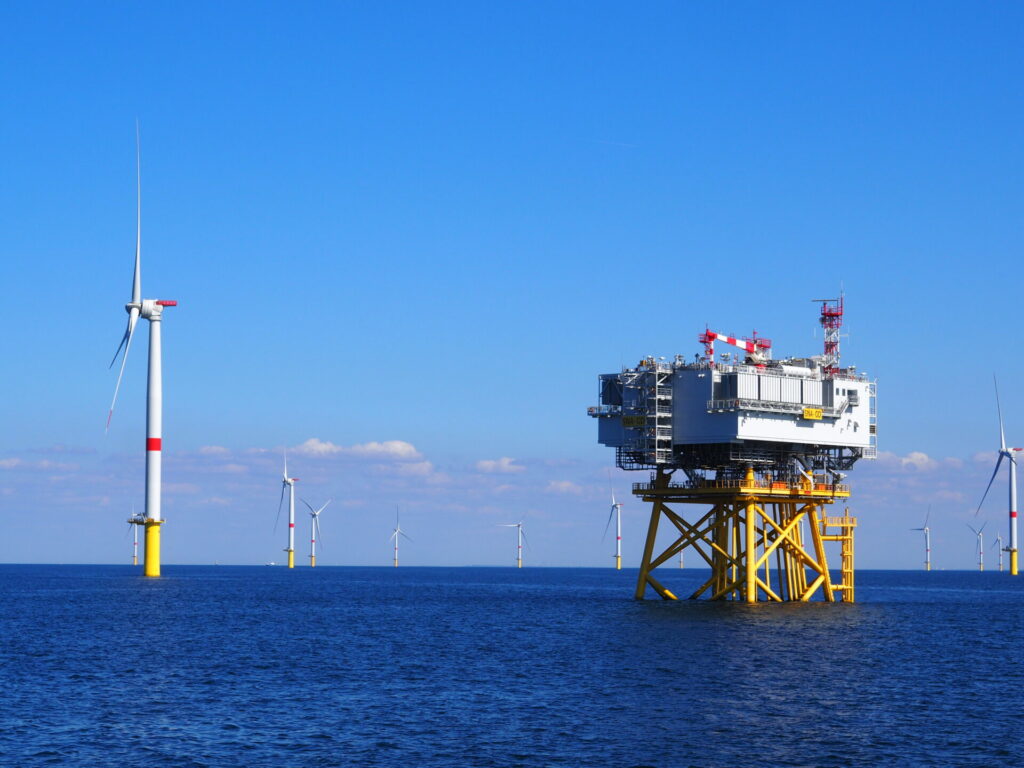
This thesis tells the story of a conquest: the conquest of energy at sea. Since the early 2000s, offshore wind power has been seeking to expand in France, evolving from a supplementary technology geared towards export to a major pillar of the electricity mix (45GW by 2050). The electricity sector has developed, structured around stakeholders and institutions that share common standards, values and a very specific objective: to make French offshore wind power a reality within the context of an increasingly urgent energy transition.
But the fact is, the sea is not an empty space: largely overlooked by the energy sector, it is home to a diverse range of activities, from transport and fishing to the navy and porpoises: it is a whole range of sectors that have existed there for decades, even centuries, and with which we must now contend on a daily basis. And the maritime sector, which is particularly involved in maritime planning, has no intention of standing idly by whilst the fifty or so planned offshore wind farms are established: from direct action to negotiations over corridors and appeals to the President of the Republic, public action on offshore energy must therefore cooperate with another sector whose values, standards and balance of power are substantially different.
At the heart of the analysis lies the planning of offshore wind power, which was placed on the political agenda in the early 2020s and keeps the government and stakeholders working daily towards two objectives: developing wind power (1) and establishing it at sea (2). In this context, one factor is essential: no one claims exclusive use of the sea. Consequently, the conquest is not a trench war: on the contrary, it is negotiated, interpreted and (re)politicised. Far from being confined to a single technical-economic lens – a ‘resource’ – offshore wind planning is also a matter of governance and of mobilising heterogeneous networks of stakeholders. To understand how, in 2022, 40GW could be announced and how the issue of access to space could be institutionalised to become the defining challenge of the first half of the 2020s, we examined the state’s capacity to organise itself internally and externally to meet its objectives. What emerges is the gradual emergence of a coalition of ‘builders’ – from the energy and maritime sectors – working to promote the conditions for specific planning and to implement it across the territory.”
The thesis, in the field of political sociology of public action, is based on 137 interviews conducted at national level (ministers, ministerial departments, central government bodies, service providers, industry representatives, environmental organisations) and at regional level (decentralised government departments, elected representatives, fishermen, environmental organisations). It also draws on several field studies (public debates; central government).
Project Team
Coordinator
Scientific Director
Participants
Funding and partnerships
Funding sources
- RTE – Electricity Transmission Network (2022–2025), monitored by Jordane Provost and David Game (RTE R&D)
Valuation
Activities:
- Organisation of a series of seminars in July 2024: ‘The resurgence of the planning state’ with François-Mathieu Poupeau and Charlotte Marcilliere
- Coordination of a journal issue (Revue française d’administration publique) with Charlotte Marcilliere and François-Mathieu Poupeau
Articles:
- “Positioning itself as an arbiter and regulator of local conflicts: the decentralised state and the development of renewable energies” with François-Mathieu Poupeau, Droit et Société journal (forthcoming)
- ‘Spatial planning: an opportunity for government coordination of maritime affairs’, Revue française d’administration publique (forthcoming)
- ‘Introduction to the journal issue’ with François-Mathieu Poupeau and Charlotte Marcilliere, Revue française d’administration publique (forthcoming)