‘Public Issues’ is a new series of books in the humanities and social sciences aimed at a wide readership, edited by Stève Bernardin, a lecturer and researcher at LATTS (Laboratory for Techniques, Territories and Societies), a joint laboratory of the École nationale des ponts et chaussées, the CNRS and Gustave Eiffel University. Providing a forum for researchers in the humanities and social sciences, the series examines and analyses current debates, prioritising the essential dialogue between the humanities, social sciences and engineering. It would not have been possible without the support of Anthony Briant, Stéphanie Rivoire and Pierrine Malette from the École nationale des ponts et chaussées. The series has also benefited from the scientific and pedagogical advice of Antoine Picon, Nathalie Roseau and Gilles Jeannot of the LATTS.
“Faced with the major issues affecting our societies, this series encourages readers not to succumb to the temptation of ready-made thinking, by questioning assumptions that are sometimes misleading. Are there other perspectives from which to approach these societal challenges? What would be the economic, democratic and political consequences of such approaches? The books in the series draw on the latest findings in the social sciences to explore these questions. They prioritise accessible and direct language to foster the widest possible debate, whilst outlining new forms of action – at both the individual and collective levels – for those concerned with the public issues at the heart of our lives. ‘Public Issues’ aims to foster a dialogue between scientific research and public debate on the major contemporary challenges.”
Sociological imagination is an ecological imperative
The first book in the series was published in September 2026. It is Sociological Imagination: An Ecological Emergency by Léo Magnin.
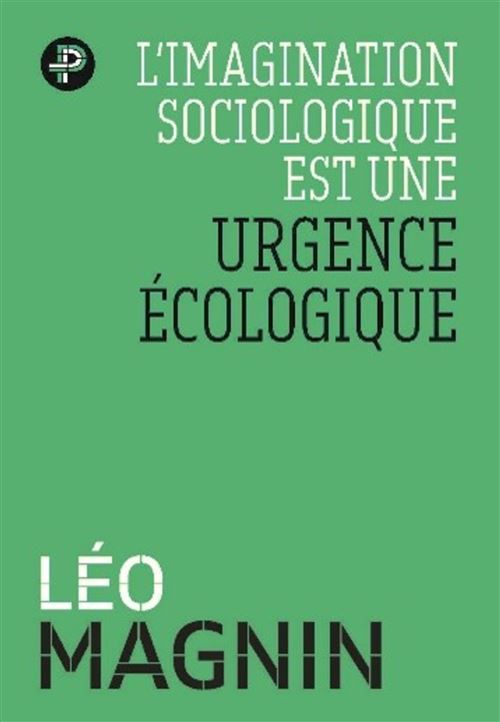
“The ecological emergency has a thousand faces: global warming, the collapse of biodiversity, desertification, water and air pollution, the depletion of resources… Yet the destruction of the environment continues unchecked. Why is the ecological emergency not a concern shared by everyone to the extent that it brings about change? Léo Magnin answers this question by inviting us to sharpen our sociological imagination. Through the portrait of a sixty-something environmental police officer, the sociologist enthusiastically takes us on a quest for vanished partridges, little-known statistics and rapeseed pollinators. Enriched by a wealth of anecdotes and underpinned by a rigorous approach, this original and accessible little book teaches us that environmental issues are also, and always, social issues. This book launches a series of short essays in the humanities and social sciences, aimed at the general public who are curious about current debates and seeking tools to analyse and make sense of their society. Short in length and written in an accessible, educational style, the books in this series aim to provide a platform for researchers in the humanities and social sciences, whilst making their reflections and scientific research available to a wider audience, with a view to sharing knowledge beyond academic circles alone. The aim is to provide insights and tools for reflection and understanding, enabling readers to think differently and make sense of our society at a time when media and political debates are becoming increasingly prevalent and tense.”
Author: Léo Magnin is a sociologist, a research fellow at the CNRS and a member of the Interdisciplinary Laboratory for Science, Innovation and Society (LISIS). He is the author of The Social Life of Hedges. An Inquiry into the Greening of Social Practices (La Découverte, 2024) and Environmental Polices under Constraints (Rue d’Ulm, 2024), co-authored with Rémi Rouméas and Robin Basier.
Artistic direction and layout: François-Xavier Delarue