End : 23 February 2026 à 17:00
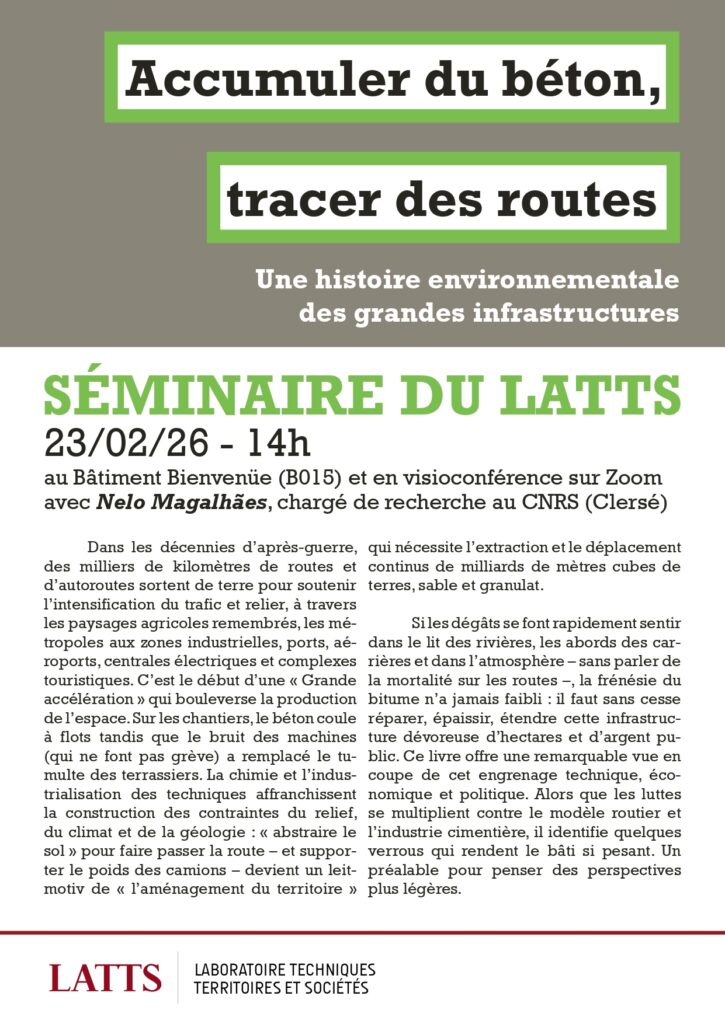
LATTS is pleased to invite you to the next session of its general seminar, which will take place on Monday, 23 February 2026, at 2 p.m. The session will focus on the book Accumuler du béton, tracer des routes. Une histoire environnementale des grandes infrastructures (Accumulating Concrete, Tracing Roads: An Environmental History of Major Infrastructure), La Fabrique Éditions, 2024.
Nelo Magalhães will present his book, followed by a discussion led by Nathalie Montel, before opening the floor to questions from the audience.
Seminar location
This session will take place in room B015 (Bienvenüe Building) and will be broadcast via videoconference. Zoom
link: https://univ-eiffel.zoom.us/j/87987869978
Meeting ID: 879 8786 9978
Password: LATTS2026
In the post-war decades, thousands of kilometres of roads and motorways were built to support the increase in traffic and connect cities to industrial areas, ports, airports, power stations and tourist complexes across the reclaimed agricultural landscapes. This marked the beginning of a “Great Acceleration” that revolutionised the production of space. On construction sites, concrete flowed freely while the noise of machines (which did not go on strike) replaced the clamour of diggers. Chemistry and the industrialisation of techniques freed construction from the constraints of terrain, climate and geology: “abstracting the ground” to build roads – and support the weight of lorries – became a leitmotif of “land use planning”, requiring the continuous extraction and displacement of billions of cubic metres of earth, sand and aggregate.
Although the damage is quickly felt in riverbeds, around quarries and in the atmosphere – not to mention road deaths – the frenzy for asphalt has never abated: this infrastructure, which devours hectares of land and public money, must be constantly repaired, thickened and extended. This book offers a remarkable cross-section of this technical, economic and political machinery. As the fight against the road model and the cement industry intensifies, it identifies some of the obstacles that make the built environment so cumbersome. A prerequisite for thinking about lighter alternatives.
Nelo Magalhães holds doctorates in mathematics and economics. He is currently a postdoctoral researcher at the Institute for Environmental Transition. His research focuses on the materiality of capitalism, from a perspective that combines political economy and environmental history.
Book Piling up concrete, tracing roads. An environmental history of major infrastructure projects