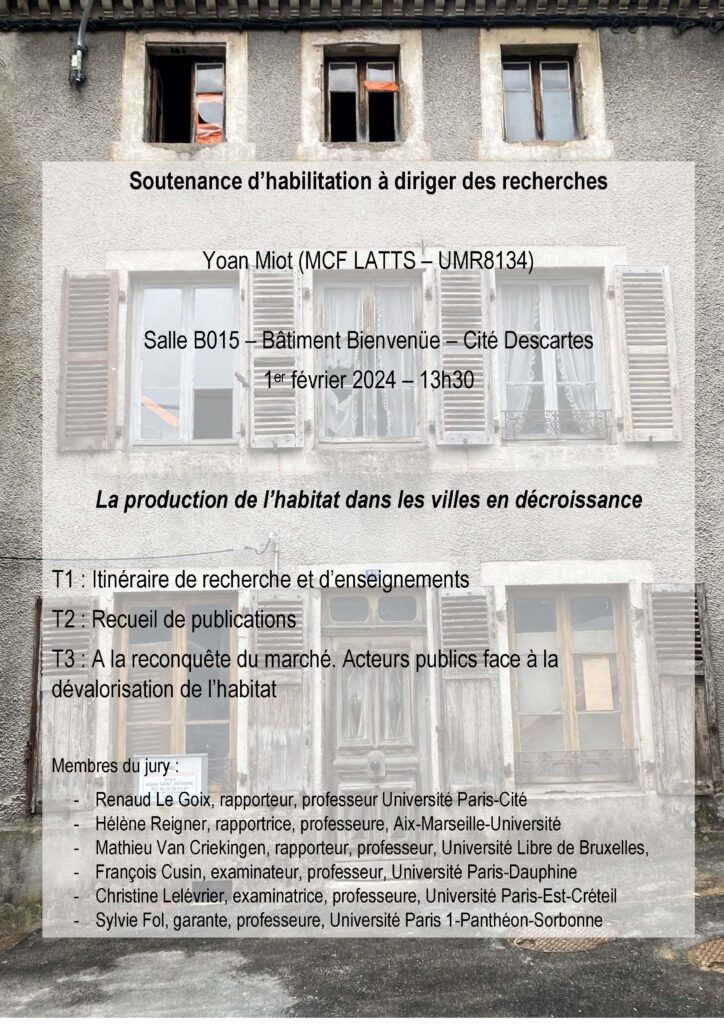
The habilitation thesis is entitled "Housing production in declining cities." It consists of three volumes:
- – T1: Research and teaching itinerary
- – T2: Collection of significant publications
- – Volume 3: Original thesis – Recapturing the market. Public actors faced with the devaluation of housing.
The jury is composed of:
- – Renaud Le Goix – Rapporteur – Professor at Paris Cité University
- – Hélène Reigner – Rapporteur – Professor at Aix-Marseille University
- – Mathieu Van Criekingen – Rapporteur – Professor at the Free University of Brussels
- – Christine Lelévrier – Examiner – Professor at Paris-Est-Créteil University
- – François Cusin – Examiner – Professor at Paris-Dauphine University
- – Sylvie Fol – Guarantor – Professor at Paris 1 Panthéon-Sorbonne University
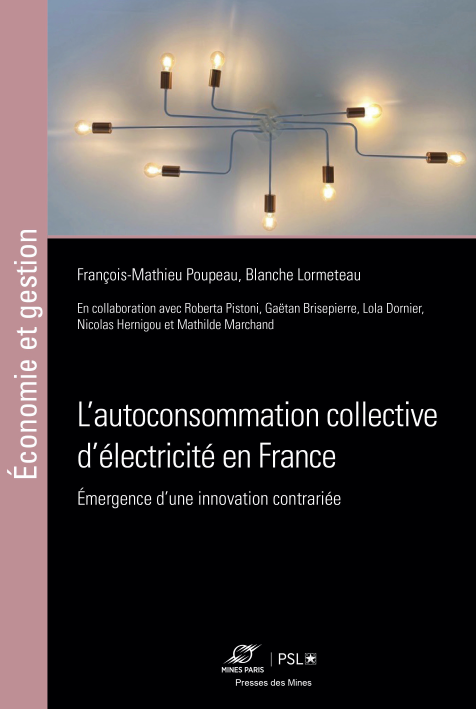
Collective electricity self-consumption in France: the emergence of a thwarted innovation
François-Mathieu Poupeau, Blanche Lormeteau
In collaboration with Roberta Pistoni, Gaëtan Brisepierre, Lola Dornier, Nicolas Hernigou, and Mathilde Marchand
Presses des Mines, 2024, 324 p.
Collective electricity self-consumption (ACCE) was introduced in France by the 2015 Energy Transition for Green Growth Act (TECV). As part of a general movement to restructure energy systems, this new mechanism, which consists of connecting consumers to one or more producers via the public electricity distribution network, responds to several types of expectations: contributing to the development of renewable energies, responding to citizens' aspirations to produce and consume locally (the concept of "short supply chains"), encouraging individuals to become more aware of the challenges of energy efficiency and conservation, etc. Driven by these various motivations, the ACCE has since spread and is now part of the range of mechanisms that local project leaders can mobilize. The aim of this book is to report on the dynamics behind the emergence of this new public policy tool, by articulating two levels of analysis: national on the one hand (changes in the regulatory framework between 2015 and 2022, under the influence of sometimes complex interactions between actors), and local on the other (study of five operations). The result of interdisciplinary work, the study shows that the "promise" of the ACCE (to work towards more decentralized energy management) has never really been fulfilled, as this mechanism has gradually been stripped of its transformative potential to become an instrument that continues the historical forms of regulation in the electricity sector, marked by a strong centralism.
Publisher's website
OpenEdition website (free access)
François-Mathieu Poupeau will speak on Friday, January 26, 2024, at the seminar "Energy Networks as a Common Good" organized by the University of Rennes and the University of Pau and Pays de l'Adour, under the auspices of ADEME, CNRS, and PUCA, among others. His presentation will focus on the socio-history of geographical equalization of domestic electricity rates in France.
Claire Le Renard is co-organizing a study day entitled "The Cycle of Nuclear Futures
," which will take place on:
Monday, January 22, 2024
(9 a.m. to 5 p.m.) in Paris (Villa Lemons, 5 impasse Mousset, Paris 12th arrondissement).
Through the presentation and discussion of a series of recent theses on nuclear power, this study day aims to understand and put into perspective the restructuring of the nuclear industry in France. How does the current situation, between revival and aging infrastructure, affect visions of the future? How do materialities come into play in the nuclear issue and its analysis? How does historical depth shed light on past and present promises? Applied to the nuclear case, these questions open up more broadly to imagined futures and the material infrastructures that support our societies' relationship to energy.
Program and registration: https://cyfu.sciencesconf.org/
Presentations
by Martin Denoun (Spiral, University of Liège), Maël Goumri (LAMSADE, Cermes 3, Paris Dauphine University), Claire Le Renard (LATTS, Ecole des Ponts ParisTech) and Ange Pottin (University of Vienna)
Discussants
: Ulrike Felt (University of Vienna), Jean-Baptiste Fressoz (CRH, CNRS-EHESS), Dominique Vinck (University of Lausanne).
This event is supported and funded by IFRIS (https://ifris.org/
).
This session will focus on the book:
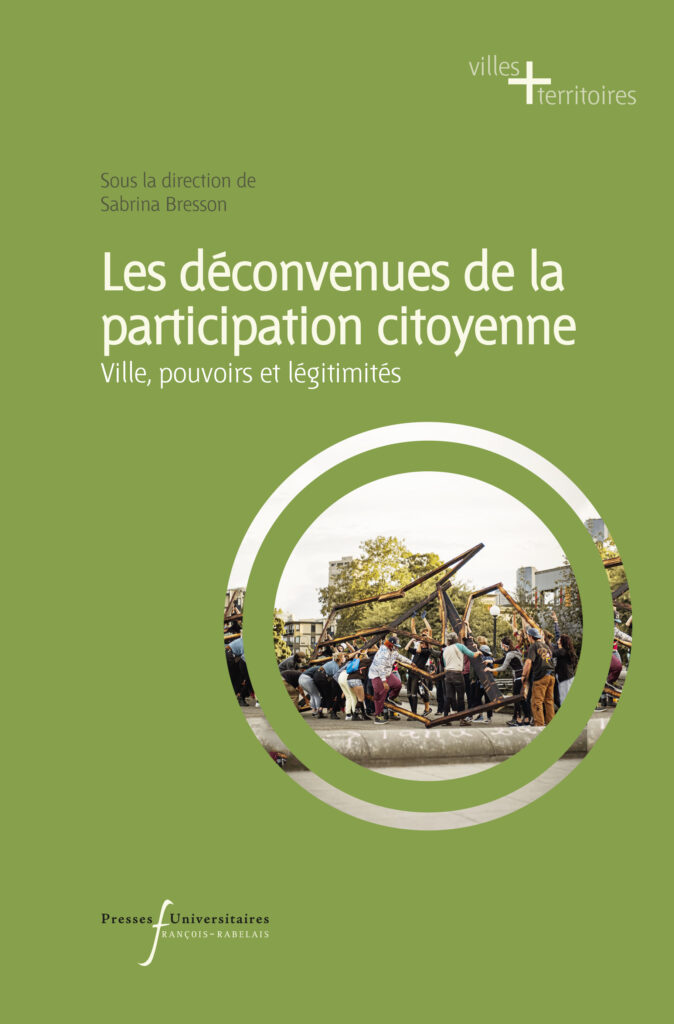
Les déconvenues de la participation citoyenne : pratiques urbaines, pouvoirs et légitimités (2022)
Sabrina Bresson (ed.)
PUR, 2022, 256 p.
Summary of the book and practical information about the seminar
 The Urban Empire of Finance: Power and Inequality in Asset Management Capitalism.
Antoine Guironnet and Ludovic Halbert Editions Amsterdam, 2023, 320 p.
In recent decades, a major upheaval has taken place quietly: a new incarnation of financialized capitalism has emerged, the asset management sector. Offices, shopping centers, student and senior residences, logistics warehouses… A growing proportion of these everyday places are now in the hands of little-known owners who see real estate as a way to grow savings from financial markets around the world.
This book, the first of its kind, takes us behind the scenes of real estate asset management in France. It shows how investment funds and real estate companies seek to impose their financial logic and criteria on the state, local elected officials, developers, and real estate promoters, and reveals how these giants have managed to build a veritable empire in major cities. Above all, it sheds light on the effects of this transformation: as asset managers capture land rents, social and spatial inequalities widen. These lessons raise questions about the place of finance in the debate on the ecological transition of cities.
Julien Salingue will defend his doctoral thesis in spatial planning and urban planning entitled: "Longitudinal analysis (1978-2013) of the French housing system: continuity and disruptions" on January 12, 2024, in the Bienvenüe building, room B017-B020, at 2 p.m.
The jury is composed of:
Rapporteurs:
Marc Dumont, University Professor at the University of Lille
Yankel Fijalkow, Professor of Social Sciences at ENSAPVS
Examiners:
Jean-Claude Driant, Professor Emeritus at the Paris School of Urban
Planning Véronique Flambard, Professor of Economics at the Catholic University of Lille
Arnaud Simon, Senior Lecturer at Paris-Dauphine University (PSL)
Thesis supervisor: Jean-Pierre Lévy, Director of Research at the CNRS
Guest: Manuel Domergue, Director of Studies at the Abbé Pierre Foundation
Abstract:
This thesis is based on the observation that poor housing conditions have persisted over the last 30 years. By adopting an economic approach based on supply, public policy has been unable to respond to successive "crises." An interdisciplinary review shows that few studies address the issue of housing in terms of the joint dynamics of households (residential mobility) and housing (construction-demolition-renovation). Drawing on the concept of filtering processes and the vacancy chains method, our thesis proposes to overcome this obstacle by creating new concepts (social position, function, and demographic profile) that enable a comprehensive and dynamic analysis of the housing system. To this end, we have developed the Housing Systems Analysis (ASHA) model, which simulates the impact of variations in housing supply on the entire system based on household mobility (turnover rates) between housing types (vacancy chains).
This model was used to analyze, in a retrospective, prospective, and experimental approach, the evolution of the housing system over a 35-year period, using data from eight Housing Surveys (INSEE, ENL, 1978 to 2013). Through simple empirical observation, the initial analysis identified the functioning of the current system (2013), which is structured into residential sectors that reproduce the hierarchy of society as a whole. Simulations of the continuation of successive supply policies (between 1978 and 2013) showed that the real break with the system lies in the continuation of the programming logic of the 1977 reform (promulgated in the context of the Trente Glorieuses) until 2013. Far from completely abandoning housing assistance, the reform established a system of subsidized home ownership for the upper, middle, and working classes with sufficient means, to the detriment of low-income households, which are often young.
The prospective analysis simulated the extension of the 2013 system until 2050. The results show its high instability. The collapse of the private rental stock is leading households into early home ownership, which weakens them and excludes them from the system. On the other hand, it reveals strong tensions in the social sector. The ASHA model also offers the possibility of carrying out experimental prospective simulations of alternative housing policies: massive construction of social housing and attempts to build housing with a view to making the system more fluid (adaptation to residential logic). The results do not fundamentally change the organization of the system, which remains highly unequal in social terms. In this sense, they show that solving the problem of poor housing requires recognizing that supply-side policies alone cannot address residential vulnerability caused by the effects of the overall precariousness of society. In this context, an overhaul of the system will likely require a reform that integrates the profound transformations of the current and future social context.

James Christopher Mizes is a postdoctoral researcher working on the ANR-Access ERC project entitled "Securitizing City-Building." His research focuses on the governance of cities and financial markets in the Global South, analyzed on the basis of ethnographic studies in West Africa (Senegal and Côte d'Ivoire). In his thesis, completed at the University of California Berkeley (2019), he focused on the emergence and exercise of municipal authority in Dakar, Senegal, particularly its fiscal and financial relations with the state, investors, and urban citizens.
His current research analyzes African financial markets with a focus on financial risk knowledge. He studies how the introduction of this knowledge into these markets provokes—or circumvents—political disputes, and how it transforms the framing of certain public issues. As part of the ANR project, he aims to develop a comparative research project focused on the emergence of financial centers in cities in the Global South. He also co-organizes a collective project, "Flow/Overflow/Shortage: measuring and managing extreme urban conditions," which explores infrastructure problems such as flooding and power outages.
Matthias Heinrich will defend his doctoral thesis in urban engineering entitled "Habitats, inhabitants, and energy practices: Integrating housing situations into quantitative modeling of domestic energy consumption" on January 16, 2024, in a hybrid format at the Ecole des Ponts ParisTech building (Caquot 1 amphitheater).
The jury will be composed of:
Marjory Musy, Director of Research, CEREMA, Rapporteur
Fateh Belaïd, Researcher, KAPSARC, Rapporteur
Faïcel Chamroukhi, University Professor, University of Caen, Examiner
Béatrice Roussillon, Senior Lecturer, University of Grenoble-Alpes, Examiner
Jean-Pierre Lévy, Director of Research, CNRS, Thesis Director
Latifa Oukhellou, Director of Research, Gustave Eiffel University, Co-director of thesis
Abstract:
This thesis takes an interdisciplinary approach to produce a quantitative model of energy consumption based on "housing situations" (household-housing relationships), domestic practices, and residential contexts. It is divided into three parts.
First, a review of the literature on the main models in engineering and human sciences identifies the theoretical frameworks for an approach combining households and housing ("housing situation"). The second chapter discusses methods for modeling domestic practices in order to determine the most relevant ones for studying the links between housing situations and residential lifestyles. In the final and third chapter, based on a logistic proportion regression mixture model, a hierarchical model of domestic energy consumption based on housing situations is proposed.
Situated between typological and regression approaches, one of the contributions of this thesis is to propose, within the same method, a typology of housing situations and a regression model. The estimation performance of the results is equivalent to that of the main models but, on the other hand, they have greater explanatory power by associating domestic practices with energy consumption. This method also makes it possible to integrate a segmentation of domestic practices into a model of energy consumption at the housing level. The thesis also has a heuristic dimension. First, it shows the links between housing situations and practices related to equipment, occupancy, and regulation actions. In addition, it presents ideal-typical housing situations based on household characteristics, housing, behavior, and total domestic energy consumption per person and per square meter. Finally, in terms of future prospects, it paves the way for the development of other interdisciplinary approaches to the transformation of housing situations.
Link to follow the defense: https://teams.microsoft.com/l/meetup-join/19%3ameeting_ZGNlMTUxYTItMTY2NS00N2E4LWI4ZDktYWQ5ZGQyOGFhOTQz%40thread.v2/0?context=%7b%22Tid%22%3a%22cbc292d3-d274-4204-9169-16847b678004%22%2c%22Oid%22%3a%22a85d78cf-2fb3-47e6-ae91-2bb75cdb5cd4%22%7d Meeting
ID: 328 115 885 44
Passcode: XtCw7H
This session will focus on the book:
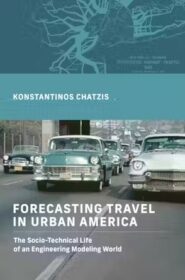
Forecasting Travel in Urban America: The Socio-Technical Life of an Engineering Modeling World
Konstantinos Chatzis MIT Press, 2023, 416 p.
Summary of the book and practical information about the seminar
Dear colleagues,
The Techniques, Territories, and Societies Laboratory (LATTS, UMR 8134, CNRS, École des Ponts ParisTech, Gustave Eiffel University) invites candidates for the CNRS competition (sections 36, 39, and 40, CID 52 and 53) who wish to obtain its support to contact the laboratory's management: Elsa Vivant (elsa.vivant@univ-eiffel.fr
) and Jonathan Rutherford (jonathan.rutherford@enpc.fr
).
Please send us a document presenting your CNRS project (working version), along with a brief CV and a letter explaining your reasons for requesting support, by Friday, December 15 at the latest
.
Applications will be reviewed by the laboratory council in early December in order to issue a letter confirming their suitability for the LATTS scientific project. Then, for those who are eligible and wish to be assigned to LATTS, support will be offered in preparation for the interview, as well as an opportunity to meet with members of the laboratory.
For information or a reminder about the laboratory's areas of research, please visit the following website: https://latts.fr/
Good luck to everyone!
The LATTS management team
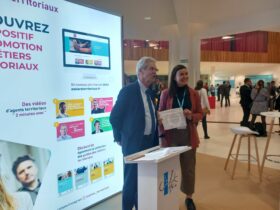
Cassandre Rey-Thibault is the winner for her thesis, recognized as a remarkable contribution to the advancement of management and administration.
The award was presented during the ETS, the meeting place for local government managers, on December 6 in Strasbourg.
Information about Cassandre Rey-Thibault's thesis