During the French President's visit to Marseille, the media focused on urban policies in France's second largest city and the multifaceted crisis it is experiencing. Nicolas Maisetti, a postdoctoral researcher at LATTS and author of several books and articles on local government in Marseille, was asked by a number of journalists to put the issues surrounding this visit into perspective, as he is publishing a book co-edited with Cesare Mattina (Meshoplis, AMU) entitled "Maudire la ville" (Presses du Septentrion) at the end of September. Above is an interview he gave to the newspaper Libération (September 1), below is the interview he gave to France Culture's 10 p.m. news program (August 31), and below that is his analysis of the president's announcements on France TV Info (September 2).
Article in Libération, "In Marseille, a guardianship that does not say its name"
Recently adopted global sustainability agendas such as the Sustainable Development Goals (SDGs) and the New Urban Agenda (NUA) consider cities and urban regions as key sites and vantage points of societal transformations to more sustainable, low-carbon, and resilient futures. Furthermore, government strategies for transformative urban change often have a strong infrastructural dimension, with policies targeting energy supply, water management, transportation systems, and the development of smart infrastructure within and across all policy domains. Urban infrastructures thus become a powerful lens to critically explore the dynamic, relational, and situated processes and controversies of urban change and to reveal the profound complexity behind infrastructure-based "urban solutions."
Indeed, increasingly interdependent infrastructure systems mediate and constitute crucial pathways toward urban futures that go far beyond technical innovation and involve questions of finance and investment, scales of governance, issues of organization and ownership, resource flows, user practices, and socio-spatial solidarities. They are laced with incumbent practices of public administration, production, consumption, and land use, while embedded in these systems are political interests and epistemic cultures. But how are infrastructures actually being changed in practice and how can we critically analyze and advance our understanding of infrastructural futures and "transformative approaches" that address urban sustainability challenges?
Our aim with this workshop is to broaden our knowledge on systemic transformations and to bring into conversation empirical work in infrastructure, urban, and transition studies to critically reflect on emerging modes of governing and reshaping urban transformations through infrastructures.
Urban infrastructure scholarship has, for a long time, primarily interpreted urban transformations as being framed by infrastructural inertia and path dependencies. Over the last decade, however, the malleability of infrastructures and cities and the urban dynamics of socio-technical change have attracted increasing attention. More attention has been paid to how actors trigger significant urban changes by challenging dominant technical designs, as well as established socio-technical orders of knowing, using, operating, and governing urban infrastructures. While much of the debate has focused on ways to promote socio-technical transitions, understood as systemic "regime" shifts, recent scholarship in Science and Technology Studies (STS) has drawn attention to infrastructural change that results from many slow, gradual changes instead of from extensively planned system shifts. Rather than focusing on path dependencies or radical transitions from one system to another, scholars have thus argued for more focus on continuous and emergent infrastructural change and the incremental layering of "old" and "new" socio-technical components of infrastructures over longer periods, during which core parts of incumbent systems persist.
Since infrastructure choices have far-reaching impact on urban futures, they impose correspondingly high requirements in terms of transformative knowledge on how to introduce change and address vested interests, how to anticipate future risks and opportunities, and how to envision and enact pragmatic pathways to more desirable urban futures. Our explicit aim in this workshop is thus to critically identify and explore potential ‘urban infrastructural solutions’ in the light of available accounts and analyses of important sustainability challenges
. By foregrounding socio-technical pathways that are claimed to enhance urban sustainability as an entry point, we seek to reflect urgency in the need for change, and to investigate the extent to which wider lessons for research and practice can be drawn from concrete ongoing examples of potentially transformative approaches to urban infrastructures.
Contributions may focus on, but are not limited to:
- Construction of infrastructural and urban futures: how are (un)desirable futures being constructed, e.g. through which socio-technical imaginaries or prospective approaches such as foresight, modeling, contingency planning, "future-proofing" or "future-orientation" and by which specific constellations of actors? How are the gaps between such desired futures and the anticipated, projected, or observed change processes being discussed and addressed? Which rationales and epistemologies of urban infrastructural futures are at play in nexus, design, resilience, circularity, or transitions thinking?
- Progressive approaches and practices of transforming infrastructures and cities: how can approaches such as experimentation, incrementalism and/or strategic governance approaches, new methods in assessing and co-designing transformations, innovative finance mechanisms, user-driven innovations contribute to urban change? How could such approaches and practices overcome or reshape path dependencies in order to accelerate/consolidate urban and infrastructural change?
- Governance capacity and dilemmas, styles, and practices: how can governance capacity be increased or improved to accelerate urban change? Which pitfalls and dilemmas of sector governance need to be taken into account and how can “siloed” governance arrangements be addressed in different contexts? How can the coordination challenges of multi-sectoral interventions be addressed?
- Politics of infrastructure transformations: how do infrastructure networks and artifacts "come to matter" politically in controversies on urban development? What political rationales are implicit in unfolding urban transformations and how might they be mobilized practically? How do social movements, civil society, or innovative entrepreneurs carve out spaces for progressive politics in infrastructural transformations?
We particularly invite empirical papers with conceptual, methodological, and critical ambitions. We welcome case studies focusing on urban contexts in the global North or South, as well as studies of urban and infrastructural transformations in historical and contemporary contexts. We also invite critical reflection on scholarly practice, including shifting identities and roles of academic researchers as facilitators of sustainability transitions, and the search for "impact" through these engagements and modes of knowledge production.
This international roundtable workshop will bring together scholars from different disciplines to reflect together on urban infrastructure transformations during 3.5 days, from September 20 to 24, 2021, at the 16th-century country estate Winselerhof in the Southern Netherlands (near Maastricht and Aachen). The submitted papers will be distributed in advance to be discussed at the conference in a roundtable format with commentators and open floor debates (approx. 40 minutes per paper). Participants will not present their individual papers. Instead, the papers will be summarized and commented on by a discussant in each session in order to allow for creative discussion. Participants are expected to have read all the papers prior to the workshop. The roundtable workshop will result in the publication of a selection of papers in an edited volume or a themed issue of an international peer-reviewed journal.
Please send us a 300-word paper proposal by June 14, 2021, for initial feedback and confirmation of attendance by mid-June 2021. The deadline for submission of full draft papers is September 10, 2021. Accommodation will be provided for all participants, and the conference language will be English. In individual cases, we are able to offer travel stipends to early-career scholars.
If you have any further questions, please do not hesitate to contact:
Jochen Monstadt (Utrecht University)
Olivier Coutard (LATTS)
Jonathan Rutherford (LATTS)
LATTS members involved:
Félix Adisson
Ludovic Halbert
Nicolas Maisetti
Partners:
Gustave Eiffel University, LATTS
Paris Est Créteil University, LAB'URBA
University of Perpignan, CDED
University of Avignon, ESPACE
Ecole des Mines, ISIGE
Aix-Marseille University, TELEMME
Open University (London)
InveST analyzes the implementation of sustainable development requirements in local public action in a context of increased financial rigor. To this end, it tests two hypotheses: first, that the rationales, instruments, and practices associated with this austerity influence the selection of priorities and the content of local public action in terms of sustainability; second, that public action carried out under financial constraints accentuates disparities between and within territories. To this end, InveST questions the ways in which financial austerity is represented and mobilized by actors as both a constraint and an opportunity for the implementation of local sustainability policies. It also analyzes financial practices and power relations in territorial political systems in order to qualify the role of austerity in transforming political agendas, objectives, and the conditions for the production of public action on sustainability. These issues are studied through two complementary objects. The first describes the evolution of central government policies and its relations with local authorities in the application of the austerity agenda. The second is a comparison of six urban inter-municipal groups. The analysis of financial discipline is carried out for five areas of public action selected for their financial weight and sustainability challenges: local authorities' land and real estate assets, water networks, social housing, urban and economic development, and sustainable mobility.
LATTS researchers: Valérie November (project director), Alice Azémar (project manager)
Alexandre Geffroy: website updates and data analysis
Other LATTS researchers involved: Stève Bernardin, Kostas Chatzis, Geneviève Zembri
Funding: French National Research Agency (ANR), via the I-SITE FUTURE special grant
Duration: 4 years (2018-2022)
Academic partners outside LATTS: around 100 researchers, mainly from Gustave Eiffel University, but also from other institutions (Telecom Paris, Paris-Dauphine University, Mines d'Albi, etc.)
UrbaRiskLab (URL) is a project that aims to create a multidisciplinary center on the theme of risk/crisis in urban environments. It was founded on the observation that all crises (whether natural, climatic, chemical, pathogenic, economic, cyber, societal, etc.), whether planned or unplanned, exceptional or chronic, slow or fast-moving, generate significant scientific, technical, organizational, and political uncertainties. They raise crucial questions in terms of preparedness, monitoring and detection, modeling tools, anticipating cascading effects, emergency response, decision support, and post-crisis management. Taking an interdisciplinary approach to the dynamics of risks and crises in urban environments is a scientific challenge that must be addressed in order to provide strategic, political, technical, economic, and social responses to these problems and make cities safe and resilient. URL was designed as a research center offering innovative, multi-risk, multi-scale thinking and solutions that represent a technological breakthrough. From the outset, the project was designed to be scalable and experimental.
The process of creating the multidisciplinary center required several steps: on the one hand, a bottom-up approach to analyzing the expertise available within the consortium. URL brings together around 100 researchers from more than 30 different disciplines who, together, offer expertise and scientific coverage of all categories of risks affecting urban areas. Thus, without listing them exhaustively, natural and environmental risks, climatic and meteorological risks, risks related to infrastructure and technical networks, health risks, risks related to social inequalities, risks related to major events and crowd movements, and road safety issues are an integral part of the research carried out within the consortium. The project draws on expertise in the hard sciences (applied mathematics, statistics, geosciences, analytical chemistry), engineering sciences (mechanics, biomechanics, civil engineering), environmental sciences (hydrology, hydraulics, metrology, new sensors, (eco)toxicology) and social sciences (sociology, geography, urban planning, economics, management sciences, architecture, psychology).
While mapping the skills available within the consortium, URL has developed a methodological framework to encourage the creation of interdisciplinary projects. As an experiment, "MiniLabs" were set up to function as "research incubators" within the project. They are run by pairs of researchers from the SPI and SHS. Their titles cover a wide variety of risks and disciplines and provide food for thought across the board. There are currently four of them:
- The "Data Analysis and Processing" MiniLab focuses on the two overarching issues of data optimization and reliability. It also reflects on how to measure the uncertainty generated by unreliable data.
- The "Sensors and Uses" MiniLab focuses on innovative sensor technologies, automated data processing, and new societal uses.
- The "Visualizations" MiniLab focuses on the extraction and exploitation of information (textual and image), the representation of complex data, and the design and co-creation of interfaces with end users.
- The "Information Circulation in Adverse Conditions" MiniLab focuses on the need for and quality of data for target users, problems with interpreting and transferring information in crisis situations, and even the societal impact of degraded information (fake news, etc.).
Héléne Ducourant, Jean-Michel Denis, Dilara Trupia, and Alexandre Mathieu-Fritz will participate in this conference, which will be held July 6-9, 2021, in Lille.
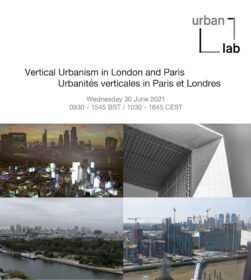
This event will take place on Wednesday, June 30, 2021, via videoconference.
These online workshops will explore the main drivers, technologies, and motivations behind the dynamics of postwar urban verticality in Paris and London.
LATTS will participate in these various workshops through presentations by several of its researchers: Martine Drozdz, Nathalie Roseau, Jonathan Rutherford
As part of the seminar series "Activity and Professionalism" organized by Pascal Ughetto, this session will focus on smart work environments with three presentations:
- Alicia Albert on connected objects and the challenges of implementing them in offices;
- Marie Bourget-Mauger on the representation of connected objects in commercial real estate; and
- Félix Traoré on occupancy measures in the redevelopment of offices into flex-offices.
The fourth session of the workshop on partnership theses at LATTS will take place on Monday,
June 28, from 4:00 p.m. to 6:00 p.m. via videoconference. The theme will be professional life after the thesis (whether in partnership or not), methods of professional integration, and the pursuit of research activities outside of ESR. LATTS will welcome three young doctors pursuing research outside the ESR:
Anna Dewaele (Agence Phare), Alexandre Blein (Alphaville), and Arthur Jobert (Grets (Edf)).
The round table discussions will focus on the professional integration trajectories of young PhD graduates; how research activities are coordinated with other tasks in their respective organizations; and what, in their opinion, potential employers look for when recruiting young PhD graduates in the social sciences.
This workshop is not open to the general public
.
 Setting the City to Music
Myrtille Picaud
Presses universitaires de Vincennes, 2021, 304 p. (Coll. Culture et Société)
Combining cultural sociology, urban sociology, and occupational sociology, Myrtille Picaud analyzes the hierarchies and transformations of the contemporary music scenes in Paris and Berlin.
One of the few works in music sociology to study different musical genres together, this book also stands out by approaching its subject through its venues, music halls, and professionals, the programmers who select the artists. It also sheds light on how cultural phenomena contribute to urban dynamics by transforming the representations and frequentation of different neighborhoods in these two capitals.
A launch event will take place on June 20, 2021, from 5:00 p.m. to 7:30 p.m. at the Monte-en-l'air bookstore in Paris (see attached flyer), to which you are all invited.

The eighth session of the LATTS Seminar will take place on Monday, June 14, 2021.
It will focus on the book:
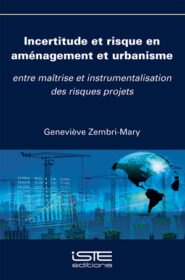 Uncertainty and Risk in Land Use Planning and Urban Development: Between Risk Management and Instrumentalization
Geneviève Zembri-Mary
ISTE Editions, 2020, 314 p.
Associations, elected officials, experts, residents, and project owners involved in development and urban planning operations and transportation projects face an uncertain context in which they must understand, manage, or take advantage of risk. The risks are many and varied, and can be social, political, institutional, financial, environmental, or archaeological.
This book examines the origin and nature of uncertainties and risks, as well as the practices implemented to mitigate or take advantage of them. Paradoxically, these practices generate new risks and power relationships between actors that differ from the standard collaborative planning model.
These paradoxes require us to rethink practices such as the territorialization of projects, risk-taking in planning and implementation, and the societal and political choices that must be made between project implementation and the protection of the natural and human environment.
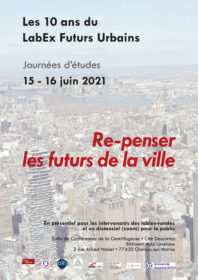
This event will center around a symposium entitled "Rethinking the Future of Cities," which will take place on Tuesday, June 15, and Wednesday, June 16, starting at 9:30 a.m., at the Cité Descartes in Champs-sur-Marne in the Centrifugeuse Conference Room (Ada Lovelace Building: 2 rue Alfred Nobel, 77 420 Champs sur Marne).
The round tables will bring together speakers in person and the public remotely.
ZOOM link:
https://univ-eiffel.zoom.us/j/84516278887
Meeting ID: 845 1627 8887
Password: 10YLab1516
LATTS will participate in the various round tables through presentations by several of its researchers: Alexandre Coulondre, Olivier Coutard, Martine Drozdz, Sylvy Jaglin, Valérie November, and Nathalie Roseau.
Program for the
conference