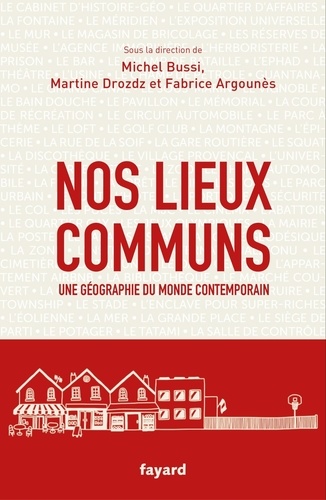
Our common places. A geography of the contemporary world
Edited by Michel Bussi, Martine Drozdz, and Fabrice Argounès Fayard
Publishing, 2024, 576 p.
Did you know that the 10,000 data centers that store our data consume as much energy as the United Kingdom? That 600 million of us visited a zoo in 2023? That a political party headquarters could be a showcase for a fashion show? That in some Asian countries, gallo dromes and cockfighting are as popular as our stadiums? Could you spend eighteen years in an airport if you became stateless? Or plan your next vacation destination without consulting Instagram? Have you ever looked at your house and imagined that it could be a refuge from the climate crisis?
Alongside Michel Bussi, who swaps his novelist's hat for that of a geographer, Martine Drozdz and Fabrice Argounès have invited around a hundred authors to embark on a surprising and playful Grand Tour, an inventive geography at the heart of our relationship with the world. From Airbnb apartments to village squares, schoolyards to nightclubs, submarines to world fairs, they invite us to explore these common, intimate, or exceptional places, whether mundane or inaccessible.
An adventure that tells our story, from the corner of the street to the ends of the earth.
Publisher's website: here
The book will be presented in the presence of the editors at the Institute of Geography on Friday, September 20, 2024, at 6:00 p.m.
For online reservations: here
Alix Chaplain, assistant professor at LATTS, is co-organizing this study day with Bérénice Girard (researcher at IRD/CESSMA).
The aim is to discuss the link and interactions between transformations in energy systems (infrastructure, public policy, markets, etc.) and political change at various levels (local, national, and international) and in various contexts in the Global South. To this end, several papers will be presented by their authors and discussed by guest researchers in order to reflect on the diversity of issues and political contexts surrounding the management of energy infrastructure, particularly the transformations associated with the introduction of renewable energies.

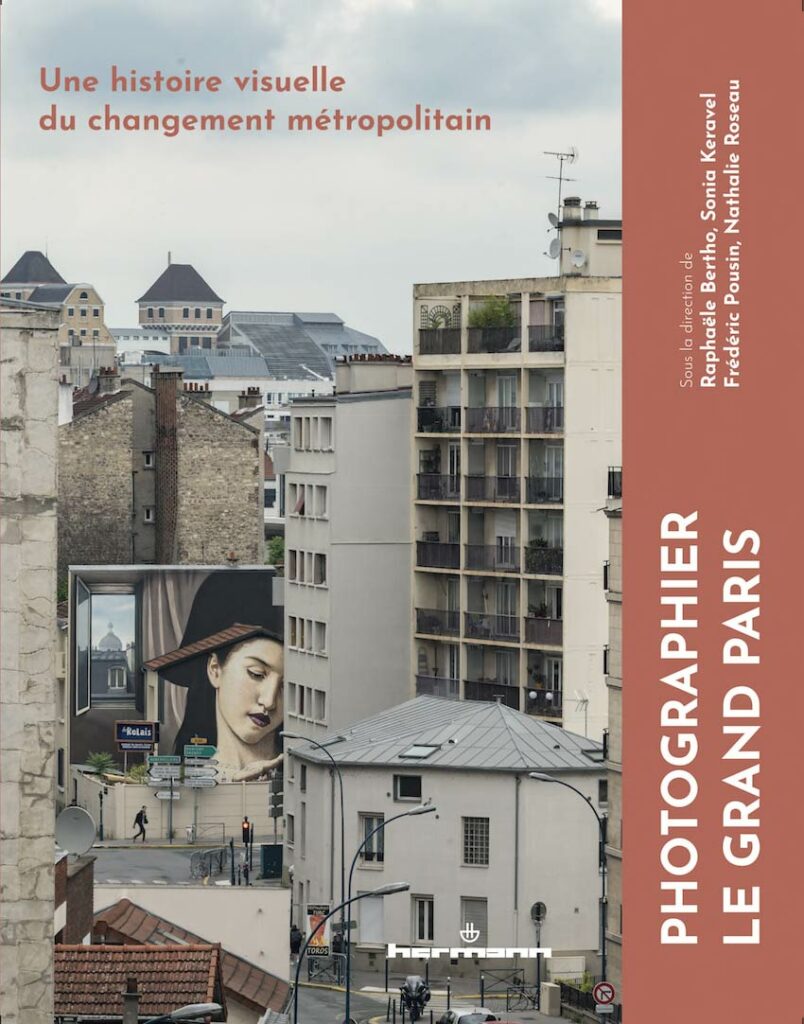
Photographing Greater Paris: A Visual History of Metropolitan Change.
Raphaële Bertho, Sonia Keravel, Frédéric Pousin, Nathalie Roseau
Editions Hermann, 2024, 330 p.
If capturing the big city is no easy task, putting it into images is even more difficult. How can we capture the dynamics of time as it shapes space? How can we grasp something that is in motion, multifaceted, and immense? This book posits that we cannot understand the history of Greater Paris—social, architectural, urban, landscape, political—and its development without understanding the images that this history has produced and the various purposes for which they were created, interpreted, publicized, and preserved. At the crossroads of several segments of the history of the big city, the 13 studies that make up this book contribute to writing a history of photography of metropolitan change while questioning the representability of a metropolis in perpetual evolution.
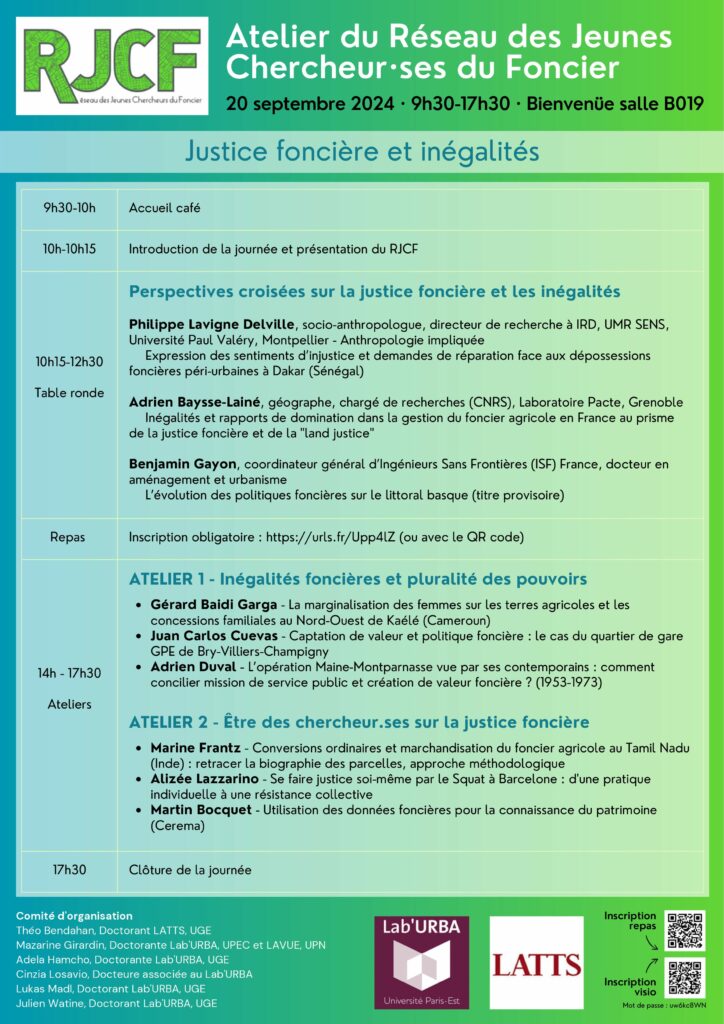
The Network of Young Researchers in Land Issues (RJCF), of which Théo Bendahan, a doctoral student at LATTS, is a member of the organizing committee, is organizing a new workshop on land issues on Friday, September 20, 2024, at the Cité Descartes (Paris School of Urban Planning, Marne-la-Vallée), on the theme of "land justice and inequalities."
The objective of this nineteenth study day is twofold. On the one hand, it will seek to understand land issues in relation to the concept of justice: how can we define "land justice" and what are its different dimensions (Baysse-Lainé and Perrin, 2021)? How can we articulate, or conversely distinguish, land justice from the concepts of spatial justice and environmental justice? What are the links between property regimes and the (re)production of land injustices? How can we understand the concept of land justice beyond mere rights of use and access, including, for example, rights to rent and rights of alienation (Baysse-Lainé, 2020)?
On the other hand, we propose to examine the impact of public intervention on land inequalities, particularly on the dynamics of "land dispossession" (Lavigne Delville and Diagne, 2023). By examining land policy "in action" (Jobert, 1985), we will seek to move beyond a monolithic conception of the state in order to understand how relations between public administrations and private interests at different levels contribute to the production of land injustices: to what extent are the legal frameworks of land policy mobilized and instrumentalized in the logic of "accumulation and political clientelism," and what are the consequences (Lavigne Delville and Diagne, 2023)? By producing an "alternative land action system," is civil society helping to redraw the contours of land regulation and address injustices (Gayon, 2018)?
From a methodological point of view, the workshop will enable young researchers to:
- Adopt a multi-scale analytical framework to shed light on the "discrepancies commonly observed between the formal content of land policies and their results in terms of practices in access to and use of land resources" (Léonard and Lavigne Delville, 2022);
- Overcome the fragmentation of existing research on land issues (North/South, urban/rural), by questioning the relevance of certain concepts for understanding the French context: politicization and informalization of land policy (Lavigne Delville and Diagne, 2023), bundles of land rights (Baysse-Lainé, 2020), etc.
To view the poster: here
To view the full program: here
To register for in-person attendance: here
To register for videoconference attendance, write to the following address: rjcf2024@proton.me
Hélène Ducourant and Aminata Coly are co-organizing this event, "Digital Money: Practices and Challenges," on Wednesday, September 25, 2024 (on-site at the Banque de France or remotely via Teams).
Program and registration link.


Elodie Gibault is defending her doctoral thesis in sociology under the supervision of Jean-Michel Denis and co-supervision of Cécile Guillaume, entitled:
Freelancers on assignment in banks: Work experiences and career paths of experts
The defense will take place on Friday, October 4, at 2:30 p.m., in room V003 (Vicat Wing), ENPC building in Champs-sur-Marne.
The jury will be composed of:
Sophie BRETESCHE, Professor of Sociology, HDR, Institut Mines Telecom Atlantique
Martine D'AMOURS, Professor Emeritus, HDR, Laval University, Quebec
Jean-Michel DENIS, University Professor, Director of ISST (director)
Yannick FONDEUR, Researcher, LISE-CNAM
Cécile GUILLAUME, Sociologist, Senior Lecturer, HDR, University of Surrey, Great Britain (co-director)
Pascal UGHETTO, Professor of Sociology, HDR, UGE, LATTS
Researcher Nadège VEZINAT, Professor of Sociology, HDR, University of Paris 8, CRESPPA Researcher (UMR 7217)
Thesis summary:
This thesis focuses on the freelance work of experts on assignment for banks, within organizations heavily impacted by digital transformation. Increasingly digitized, the banking sector is facing a renewal of professions and skills, with a corollary need for expertise and recourse to freelance "tech" professionals. Referred to as "self-employed workers," these freelance professionals are defined by their expertise and professional skills "offered" in a specific market, that of services to businesses and banks. This highly dynamic field of activity allows many experts, particularly in the IT sector, to become self-employed. This thesis explores the ecosystem that supports and organizes the activity of these professionals, the conditions of their entry into expert careers, and the experience of this form of employment within the specific context of Bank M. We will show how freelance trajectories are socially situated. From a professional and biographical point of view, they are the result of individual actors, qualified experts, who choose independence in a given state of the labor market.
KEYWORDS:
Banking, career, digital, freelance, expert, self-employed worker, trajectory
At the limits of major infrastructure. African transport at a turning point in mobility.
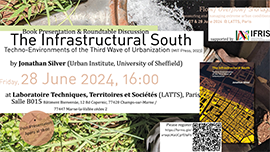
Chris Mizes is co-organizing a book talk with the Flow/Overflow/Shortage Research Collective for the recent publication, The Infrastructural South by Jonathan Silver (Urban Institute, University of Sheffield).
Here is the review of the book published in Trialog, and a companion piece in Antipode (French version to be published in Métropoles).
The conference will be followed by a cocktail reception.
FRIDAY, JUNE 28, 2024 — Book Presentation: The Infrastructural South
4:00-6:00 p.m. @LATTS (Room B015, Bienvenüe Building, 12 Bd Copernic, 77420 Champs-sur-Marne)
Author: Jon Silver (University of Sheffield)
Chair: Moritz Kasper (TU Dortmund)
Roundtable: The F/O/S Editorial Collective
The theme of this session will be: "Digital technology: between object and research method."
Antoine Courmont and Paul Gourdon will present their approaches and work on this topic:
- Antoine Courmont, Assistant Professor in Urban Planning and Development, LATTS: The battle for "Places": the digitization of local commerce by Google Maps
- Paul Gourdon, research engineer, LATTS: A "quanti" DIY approach to building a panorama of transnational cooperation between European cities.
Find out more about the Politics, Markets, and Urban Worlds research area
This session will be devoted to the presentation of the book:
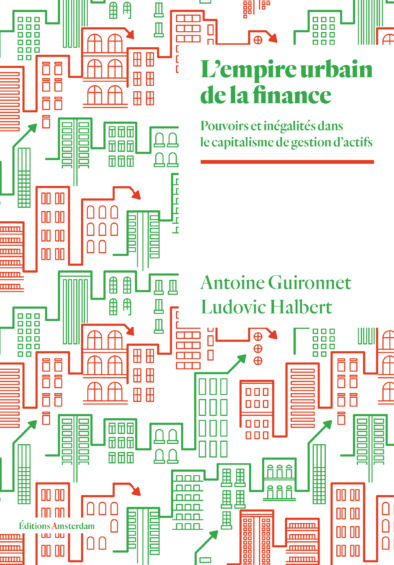
The Urban Empire of Finance: Power and Inequality in Asset Management Capitalism.
Antoine Guironnet and Ludovic Halbert
Editions Amsterdam, 2023, 320 p.
The Urban Empire of Finance: Power and Inequality in Asset Management Capitalism.
Antoine Guironnet and Ludovic Halbert
Editions Amsterdam, 2023, 320 p.
In recent decades, a major upheaval has been quietly taking place: a new avatar of financialized capitalism has been born, the asset management sector. Offices, shopping centers, student and senior residences, logistics warehouses… A growing proportion of these everyday places are now in the hands of little-known owners who see real estate as a way to grow savings from financial markets around the world.
This book, the first of its kind, takes us behind the scenes of real estate asset management in France. It shows how investment funds and real estate companies seek to impose their financial logic and criteria on the state, local elected officials, developers, and real estate promoters, and reveals how these giants have managed to build a veritable empire in major cities. Above all, it sheds light on the effects of this transformation: as asset managers capture land rents, social and spatial inequalities widen. These lessons raise questions about the place of finance in the debate on the ecological transition of cities.
Sofia Guevara was nominated on June 5, 2024, for an article on her thesis published in the journal Flux in 2023:
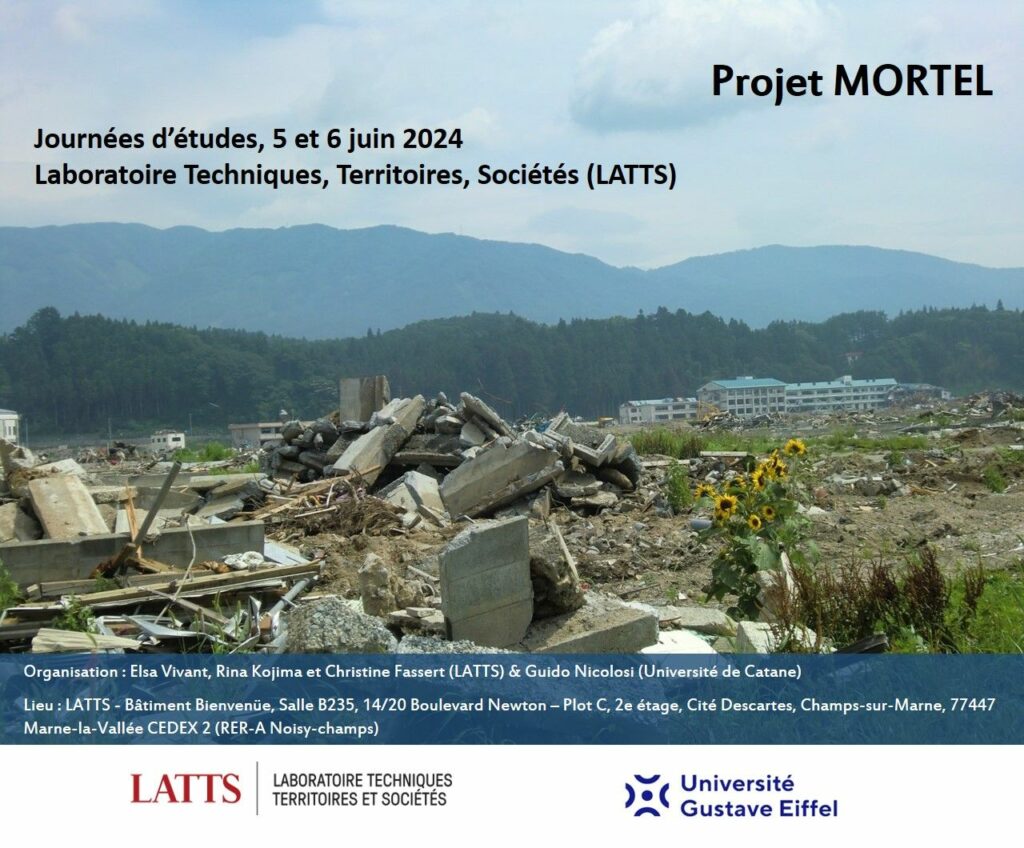
Elsa Vivant, Rina Kojima, Christine Fassert (LATTS), and Guido Nicolosi (University of Catania) invite you to attend the study days organized as part of the MORTEL project, which will take place on June 5 and 6 at LATTS (room B235).
Please find attached the program and below the registration link (in person or via video conference): https://framaforms.org/inscription-aux-journees-detudes-projet-mortel-1715952956