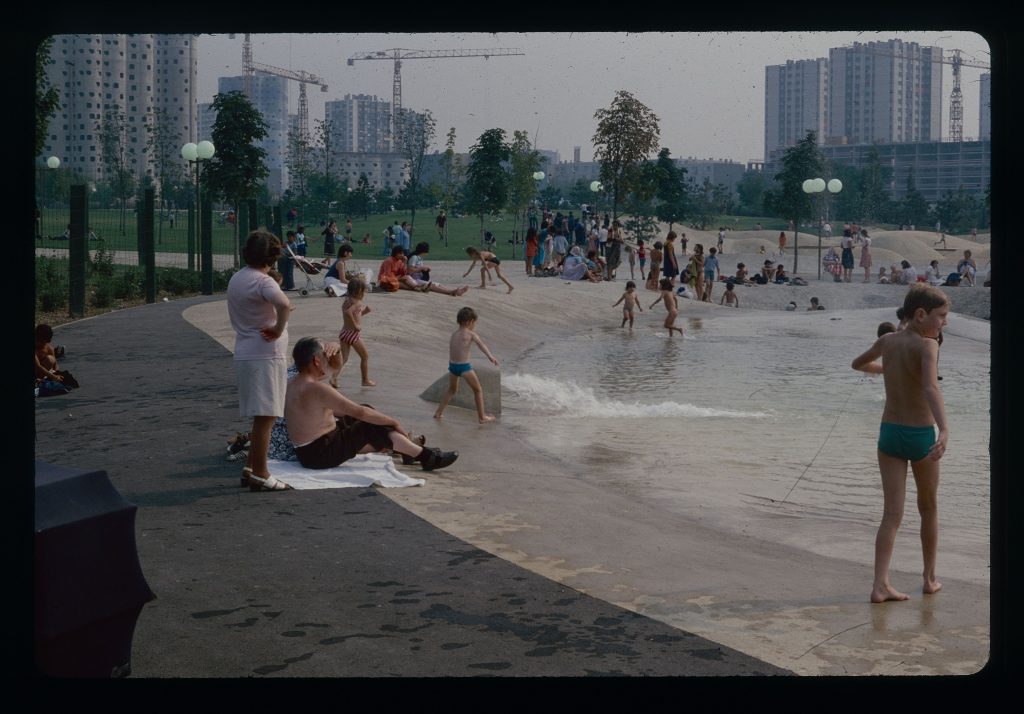
Mathilde Moaty will defend her doctoral thesis in Spatial Planning and Urbanism, entitled:
Conflict and Urban Production:
Mobilizations, Materialities, and Heritage-Based Social Forms in Vila Leopoldina (São Paulo).
The defense will take place on Tuesday, June 4, at 2 p.m., at the Ecole des Ponts et Chaussées (room P303 – 3rd floor of the PRONY wing), in Champs-sur-Marne.
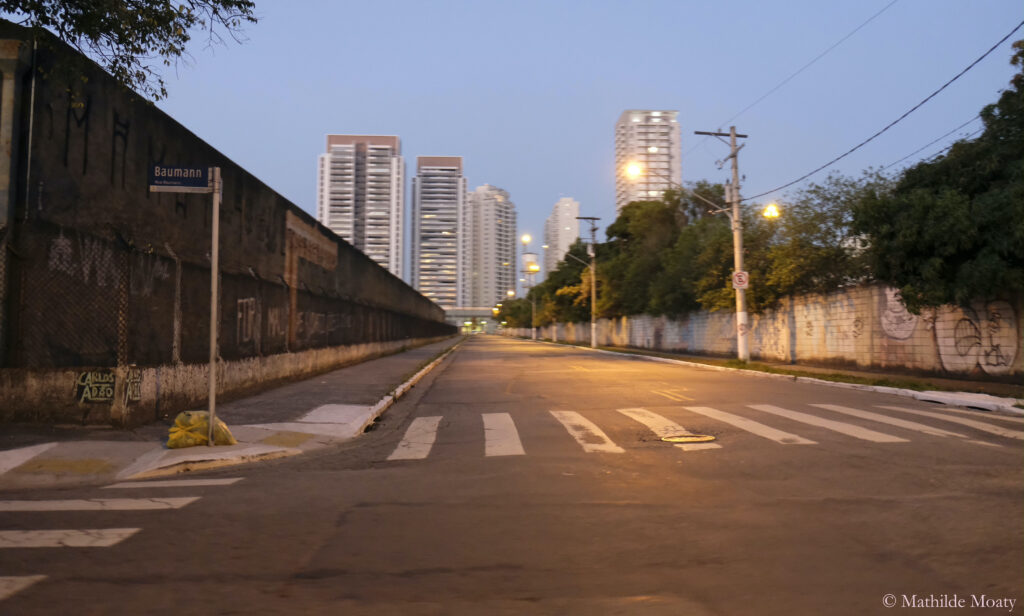
Thesis summary: Since the late
1980s, São Paulo has been a prime testing ground for urban planning instruments. Successive municipal teams from various political backgrounds have implemented vast urban renewal projects, delimiting exceptional perimeters within which specific regulations apply. Flexible construction parameters and facilitated private investment are some of the principles intended to leverage the rapid rehabilitation and transformation of land and its uses, as well as the financing of affordable housing. These measures have proven ineffective in countering the immense socio-spatial inequalities that characterize Brazilian cities. On the contrary, they contribute to conflictual situations and the exclusion of part of the population from access to decent housing.
In 2016, a new urban intervention project (PIU) was proposed to the municipality by a Brazilian multinational company that owns land in the Vila Leopoldina neighborhood in the western part of São Paulo. This urban renewal project immediately sparked a conflict between three groups of actors rooted in the neighborhood: the private company, the historical economic and financial elite, which shapes Brazil's patrimonialist social structure; upper-middle-class residents, a small local elite that has more recently moved into secure high-rise condominiums; and poor communities, excluded from access to decent housing.
Based on field research in São Paulo and an online analysis of social networks and public consultations, the thesis traces the origins of the conflict and studies the forms of mobilization and their spaces, with a particular focus on built materiality. It hypothesizes that this territorialized conflict around an urban instrument (the PIU) reveals both the social structures of Brazilian society and the patrimonialist urban production characteristic of large cities in Brazil. To demonstrate this, the thesis analyzes and compares the territorialized moral economies of the three groups of actors in conflict.
Keywords: conflict; urban development; urban materiality; heritage; moral economy; São Paulo.
The jury will be composed of:
- Marie-Hélène Bacqué, Professor, Paris-Ouest University (Rapporteur)
- Agnès Deboulet, Professor, University of Paris 8 (Examiner)
- Ana Fernandes, Professor, Federal University of Bahia (Rapporteur)
- Sylvy Jaglin, Professor, Gustave Eiffel University (Co-supervisor)
- Ozan Karaman, Research Fellow, CNRS (Thesis Co-supervisor)
- João Sette Whitaker Ferreira, Professor, University of São Paulo (Co-supervisor)
The defense will be held in person and will be broadcast on Zoom. If you would like to attend the defense or receive practical information, please contact Mathilde Moaty by email (mathilde.moaty@enpc.fr).
A study day will be held at EHESS on May 31, 2024, in the Humathèque auditorium on the Condorcet campus, focusing on issue 240 of the journal Réseaux, entitled "Ethics of Artificial Intelligence: Field Studies."
The day is free to attend upon prior registration (by May 15 at the latest) via this link: Registration
PROGRAM
8:30 a.m. Welcome
8:45-9:00 a.m. – Romain Huret (President of EHESS), "Social Sciences and Artificial Intelligence"
9:00-9:15 a.m. – Patrice Flichy (Gustave Eiffel University, Director of the journal Réseaux), "The role of journals in structuring scientific debates"
9:15 a.m. – 9:30 a.m. – Valérie Beaudouin and Julia Velkovska, "Investigating the ethics of AI," presentation of the issue
9:30 a.m. – 10:30 a.m. – Lecture by Raja Chatila (Sorbonne University): "Artificial Intelligence and Robotics: Scientific Foundations and Ethical Questions"
10:30 a.m. – 11:00 a.m. – Break
Part I: Controversies (11:00 a.m. – 12:30 p.m.)
11:00 a.m. – 11:45 a.m. – "Artificial intelligence in the public sphere: from the scientific domain to the public problem. Investigation into a controversial publicization process" by Anne Bellon (UTC) and Julia Velkovska (Orange Labs and EHESS)
Discussant: Nicolas Dodier (EHESS, INSERM)
11:45 a.m. – 12:30 p.m. – "Risk prediction in criminal justice in the United States: the ProPublica-Compas case. The ethics of AI in action" by Valérie Beaudouin (EHESS) and Winston Maxwell (Télécom Paris)
Discussant: Liora Israël (EHESS)
12:30 p.m. – 2:00 p.m. – Lunch
Part II: AI and work (2:00 p.m. – 4:45 p.m.)
2:00 p.m. – 2:45 p.m. – "But the algorithm will mimic our mistakes!" Constraints and effects of annotating AI training data" by Camille Girard-Chanudet (EHESS)
Discussant: Alexandra Bidet (CNRS)
2:45 p.m. – 3:30 p.m. – "The emergence of ethical issues during artificial intelligence software experiments" by Gérald Gaglio (Université Côte d'Azur) and Alain Loute (Université Catholique de Louvain)
Discussant: Janine Barbot (INSERM)
3:30 p.m. – 4:00 p.m. – Break
4:00 p.m. – 4:45 p.m. – "The principle of AI explainability and its application in organizations" by Louis Vuarin (Télécom Paris and Ecole Polytechnique) and Véronique Steyer (Ecole Polytechnique)
Discussant: Marie Benedetto-Meyer (UTT and DARES)
4:45-5:30 p.m. – General discussion, coordinated by Claude Rosental (CNRS)
5:30 p.m. – 7 p.m.: Closing cocktail reception
This event was supported by the EHESS Interdisciplinary Research Program in Social Sciences and AI.
The journal Flux awards a prize to young researchers who have published in its columns. This prize is intended for young researchers who are currently working on their thesis or who defended their thesis no more than five years prior to the year of the award. The prize is awarded the year after publication.
For 2024, this means an article published in 2023. The selection committee is composed of members of the journal's editorial board. The evaluation is based on criteria of scientific originality, quality of writing, commitment to the field (in the broad sense: case studies, archives, quantitative data corpus, literary corpus, etc.), and contribution to the journal. Articles based on theses will be particularly appreciated, with attention paid to empirical material (fieldwork, archives, and others).
The prize is worth €1,500.
The 2024 prize is awarded to Étienne Dufour, holder of a thesis in regional planning prepared at the Laboratoire Géographie-Cités (UMR 8504) under the supervision of Sabine Barles and defended on May 21, 2024, for his article entitled: "Between renewal and fire: the forgotten stage of industrial composting, the abandoned middle ground of household waste treatment (Île-de-France, 1940s–1990s)" published in issue 131 (New perspectives on the history of off-grid technologies) in 2023 of the journal Flux.
The article is a contribution to the historiography of urban organic waste treatment. The research, which is based on the use of administrative archives (particularly those of the Ponts-et-Chaussées) and specialized journals in the fields of agriculture, hygiene, and urban engineering, focuses on alternative and "off-grid" agricultural recycling techniques in the Paris region between the 1940s and the 1990s. This research thus contributes to an "alternative" environmental history, before the "all-network system destined all waste for destruction and dispersion in incineration plants or burial in landfills."
A joint presentation of the DEPS publications "Culture & Emotions" and "Emotions Through the Lens of Culture" from the journal Réseaux will take place on Monday, May 27, from 1:30 p.m. to 5:30 p.m. at the National Book Center or via videoconference.
Register to attend the meeting at the Centre national du livre: contact.deps@culture.gouv.fr
Location: 53 rue de Verneuil, 75007 Paris (Michel de Certeau room)
Link for the videoconference: here


"Going green through digital technology?" This issue is coordinated by Sylvain Parasie and Sébastien Shulz.
Available online at Cairn.info: https://www.cairn.info/revue-reseaux-2024-2.htm
Summary of the dossier:
- Digital technology at the service of ecological transition? An overview of social science research.
Sylvain Parasie, Sébastien Shulz - Challenging pollution around the corner. Forms of criticism within a network of micro-sensors for air pollution.
Jean-Baptiste Garrocq - Soil carbon and its audience. The Aldo tool in the service of local climate policy?
Robin Leclerc - Precision agriculture and environmental change. An investigation into the epistemology of a digital data-driven agricultural model.
Jeanne Oui - Peasant e-commerce platforms in China. An ethnographic investigation into a digital "return to the land."
Jean Tassin - The commercialization of carpooling in France. How policies to make mobility greener are promoting platform capitalism.
Sébastien Shulz - The politicization of the smallest part. Tensions between low-tech and high-tech in small, self-built wind turbine
communities. Aurélien Béranger
Miscellaneous
- Dissemination and reception-appropriation of body standards on the internet. The case of yoga on Instagram.
Eléonore Affre-Garcia, Pierre Bataille, Mélie Fraysse, Delphine Rizzardi - Being part of Twitter. Political communication by members of the 15th legislature.
Camille Beaurepaire, Yvan Boude, Avner Bar-Hen
Reading notes
- Anaïs THEVIOT (ed.), Governing by data? Towards a political sociology of digital technology, Lyon, ENS Éditions, coll. "Gouvernement en question(s)", 2023, 286 p.
Serge Proulx - Cross-reviews. Claudio F. GONZÁLEZ, El gran sueño de China. Tecno-socialismo y capitalismo de Estado, Madrid, Tecnos, 2021, 324 p. Lulu Yilun CHEN, Influence Empire: The Story of Tencent and China’s Tech Ambition, London, Hodder & Stoughton, 2022, 232 p.
Jean-Paul Simon - Claire FLÉCHER, À bord des géants des mers. Ethnographie embarquée de la logistique globalisée, Paris, La Découverte, 2023, 221 p.
Victor-Manuel Afonso Marques
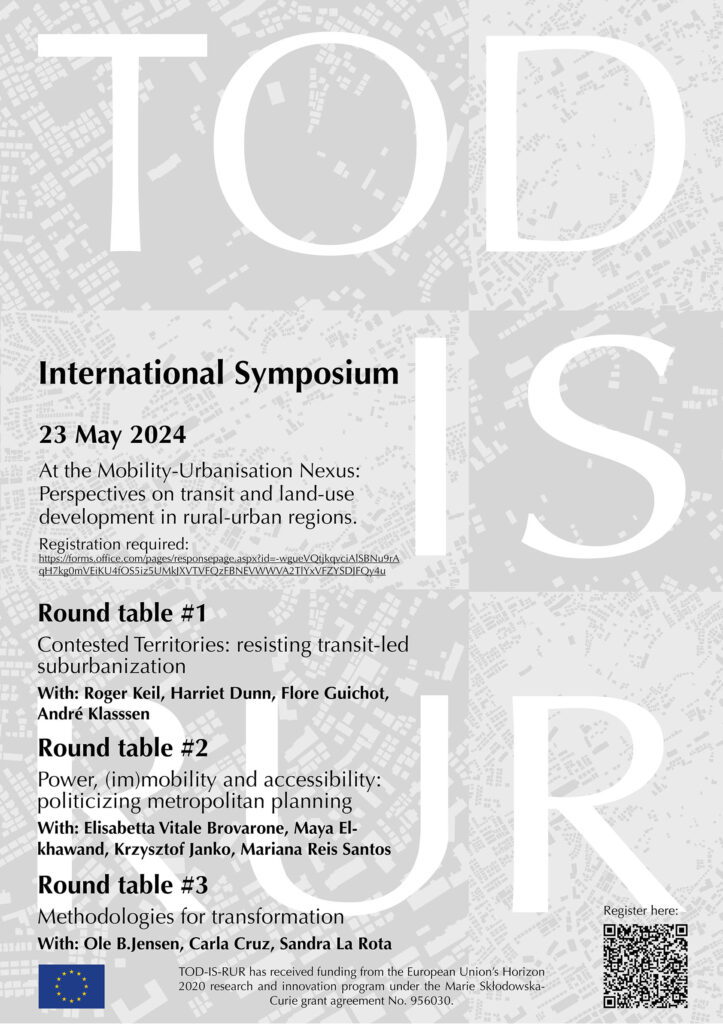
At the mobility-urbanization nexus: perspectives on transit and land-use development in rural-urban regions. The European training network TOD-IS-RUR (Transit Oriented Development for inclusive and sustainable rural and urban regions), of which LATTS and LVMT (Ecole des Ponts, Université Gustave Eiffel) are members, is organizing an international symposium on:
Thursday, May 23, 2024,
from 9:00 a.m. to 5:45 p.m.
at Cité Descartes (Carnot Building, Navier Amphitheater).
The day will be devoted to critical approaches to coordination between transport, mobility, and urban planning in areas of diffuse urbanization. It will be organized in the form of three thematic round tables led by doctoral students from the network. Discussions will be held in English.
- #1 – Contested territories: resisting transit-led suburbanization
- #2 – Power, (im)mobility, and accessibility: politicizing metropolitan planning
- #3 – Methodologies for transformation
With the participation of three guests:
- Roger Keil from York University, Toronto
- Elisabetta Vitale Brovarone from Politecnico di Torino, Italy
- Ole B. Jensen from Aalborg University, Denmark
The symposium is free and open to all.
Labex Futurs Urbains presents the thirty-third Young Researcher Lunch hosted by the Transversal Group "City, Tourism, Transport and Territory" on the theme "The neglected object: reflections on the continuum of hospitality, security, mobility and services in stations," presented by Arina Rezanova, PhD student in urban planning and development (LVMT UMR-T 9403 – IFSTTAR / LATTS UMR 8134 – CNRS, École de Ponts ParisTech), Transversal Group "V3T"
Monday, May 13, 2024 – from 1:00 p.m. to 2:00 p.m
. (via Zoom videoconference)
– Welcome: Loïc Vadelorge, Scientific Director of Labex Futurs urbains
– Introduction: Nacima Baron, Professor of Human Geography at UGE, researcher at the LVMT laboratory, co-facilitator of the V3T
working group – Moderator: Damien Carrière, Assistant Professor of Urban Geography at EUP, affiliated with the Lab'Urba laboratory and associate researcher at the CESSMA laboratory
Poster for the 33rd Young Researcher Lunch
Subject: 33rd Young Researchers' Lunch of the Labex Futurs urbains
Time: May 13, 2024, 1:00 p.m. Paris
Join the Zoom meeting: https://univ-eiffel.zoom.us/j/87311666136 Meeting
ID: 873 1166 6136
Password: Q7Ep5kmp
One touch on mobile device:
+33186995831,,87311666136#,,#,66657473# France
+33170372246,,87311666136#,,#,66657473# France
Victor Maghin will defend his doctoral thesis in sociology entitled "The blind spots of the smart camera. Scientific filters, confined debate, and the discreet market" on March 28, 2024, in the Bienvenüe building, room B017/B020, at 2 p.m.
The jury will be composed of:
Gilles JEANNOT, ENPC, Thesis Director
Anne-Cécile DOUILLET, University of Lille, Rapporteur
Sylvain PARASIE, Sciences-Po Paris, Rapporteur
Valérie NOVEMBER, CNRS, Examiner
Clément MABI, UTC, Examiner
Abstract: Surveillance
cameras have been part of our urban and even rural landscapes for several years now. However, these devices have not solved all the problems that led to their deployment in many public spaces. One of the solutions proposed to address this shortcoming of video surveillance is to add automatic detection software to the existing system. These additional components come in various forms: people counting, vehicle type detection, illegal dumping detection, abnormal situation analysis, facial recognition, etc. The first uses of these new forms of video surveillance took place in France, although they are not as widespread as in other countries.
This thesis seeks to provide initial reflections on these new surveillance tools and the context surrounding them by addressing three main aspects. The first of these aspects concerns the scientific developments that contribute to the construction of these new surveillance solutions. The second aspect focuses on the public debate surrounding automated video surveillance and the particular form that this debate takes. The third and final aspect examines the uses, most of which are experimental, that are taking place in France, as well as the objectives and conditions of these uses.
For the first aspect, this work aims to show the particular importance of infrastructure in the success of these artificial intelligence tools. Whether at the development or usage stage, artificial intelligence relies heavily on all the tools and materials mobilized in its operation. Data, networks, and sensors are all filters through which the software's work passes and which impose technical limitations. For the second aspect, the research explored the question of how these technical solutions are presented, promoted, or criticized as a problem in public debates or economic spaces. It shows that despite widespread criticism in society, economic arguments dominate in official reports. For the third aspect, while there is no consensus on the subject of automated surveillance, the thesis analyzes all the strategies and resources mobilized to build a market for automated video surveillance despite this.
The Greater Paris Planning Chair at the Paris School of Urban Planning is recruiting a contract researcher to conduct research on the value of undeveloped land (without allocation or project) in the medium to long term or with alternative uses in the traditional field of urban planning (biodiversity reserves, urban farms, etc.).
Registered with LATTS, the successful candidate will join the Chair's collective work program on "Economics of Development" under the supervision of two researchers and will carry out the following activities:
1 – Economic characterization of undeveloped land
2 – Identification of scientific fields and economic approaches dealing with the subject
3 – Development of critical and analytical syntheses of the contributions of each scientific field
4 – Contribution to the debate on critical and analytical
syntheses 5 – Promotion of critical and analytical syntheses
** Application:
A detailed CV should be sent by April 4, 2024, to the scientific coordinator of the Chair
** Profile: Doctorate in Economics (or primarily economic approach)
** Desirable education and professional experience:
- Experience in research and scientific production
- Experience working in a social sciences and humanities research laboratory and within an educational team
- Experience working with practitioners and operational staff, particularly in the fields of urban planning or real estate
** Contract proposal:
Contract duration: twelve months starting in early June 2024
Location: Marne-la-Vallée Campus, Champs-sur-Marne (77) Contract
domicile: LATTS–UPEC Laboratory
** Further information:
The "Aménager le Grand Paris" Chair is an observatory and resource center on changes in urban planning practices in Greater Paris and, more generally, in metropolitan contexts. It brings together the Paris School of Urban Planning (EUP) and a network of public and private partners involved in urban planning and development.
This session will focus on political economy approaches to urban issues. It will be held on March 22 at 2 p.m. in room B235.
We will have the pleasure of hearing three presentations:
- Julie Chouraqui, PhD in Urban Planning and Development, Géographie-Cités (Paris 1 Panthéon-Sorbonne University), "Understanding the decline of medium-sized cities through the lens of urban studies and critical geography"
- Ludovic Halbert, research fellow (CNRS) at LATTS, Antoine Guironnet, associate researcher at CEE (Sciences Po Paris): "The urban empire of finance. A perspective on urban political economy"
- Hugo Périlleux, Doctor of Geography, IGEAT (Free University of Brussels), "Synthesis of rent theory and its application to the residential rental market"
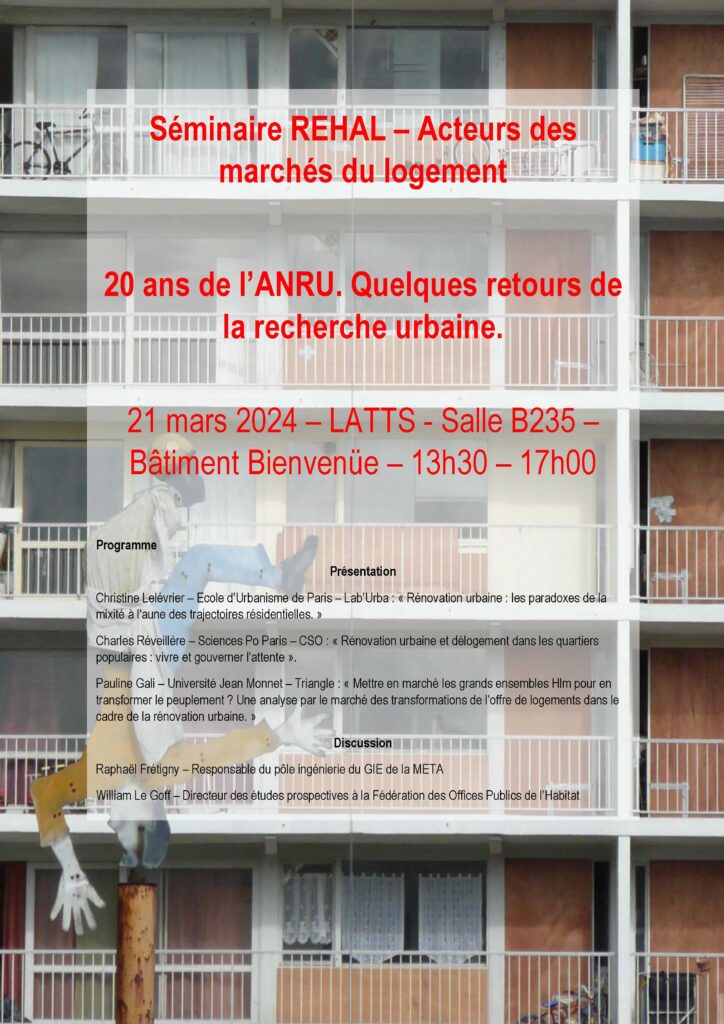
Yoan Miot is part of the "Housing Market Players" group coordinating the upcoming REHAL seminar "Housing Market Players," which will be held on March 21 from 1:30 p.m. to 5:00 p.m. in the Bienvenüe building on the Gustave Eiffel University campus (room B235).
It is entitled "20 years of ANRU. Some feedback from urban research."
Three presentations will be given:
- Christine Lelévrier – Paris School of Urban Planning – Lab'Urba: "Urban renewal: the paradoxes of diversity in the light of residential trajectories."
- Charles Réveillère – Sciences Po Paris – CSO: "Urban renewal and displacement in working-class neighborhoods: living with and managing the wait."
- Pauline Gali – Jean Monnet University – Triangle: "Marketing large social housing complexes to transform their population? A market analysis of changes in housing supply in the context of urban renewal."
This will be followed by a discussion led by:
- Raphaël Frétigny – Head of Engineering at GIE de la META
- William Le Goff – Director of Prospective Studies at the Federation of Public Housing Offices
It will be offered in hybrid mode.
To facilitate organization, please register via the following link: https://docs.google.com/spreadsheets/d/1i0_oBDhcGUMN6QgWv7ChcAJB4UOJ0mtvHVB6s8oVB1E/edit?usp=sharing
This international symposium proposes to draw on both the insights of the "Inventing Greater Paris" research program and the renewal of historiography. The single object of study, or one placed in a comparative perspective, has been replaced by a pluralistic reading of Greater Paris, which the symposium will explore through a range of research questions. The rise in political and media discourse, as well as in academic disciplines, of environmental concerns, heritage awareness, attention to residents and actors whose role has hitherto been downplayed, and interest in situated history, are all invitations to shift our perspective in order to grasp the metropolitan reality. The word "reverse" associated with "invent" therefore explores the potential for research renewal in the dual sense of "reversing perspective" and "changing order and value."
Organized by the Inventing Greater Paris Cross-Disciplinary Group (LabEx Futurs Urbains), this conference will take place on Thursday, March 14, and Friday, March 15, at the Ecole Nationale Supérieure d'Architecture de Paris-Belleville, in the Bernard Huet amphitheater.
Detailed program available at this link.