Lény Patinaux will present part of his research work as part of the RUE seminar on:
Thursday, April 15, 2021, at 10:00 a.m. via videoconference.
To connect:
https://univ-eiffel.zoom.us/j/84687722343
Meeting ID: 846 8772 2343 Password:
AxeRue2021
One touch on your mobile device
+33170950103,,84687722343#,,#,5707544967# France
+33170950350,,84687722343#,,#,5707544967# France
Dial a number based on your location
+33 1 7095 0103 France
+33 1 7095 0350 France
+33 1 8699 5831 France
+33 1 7037 2246 France
+33 1 7037 9729 France
Meeting ID: 846 8772 2343
Password: 5707544967
Find your local number: https://univ-eiffel.zoom.us/u/kdldn0D8jl
Join using SIP protocol
84687722343@zoomcrc.com
Join using H.323 protocol
162.255.37.11 (United States (West))
162.255.36.11 (United States (East))
213.19.144.110 (Amsterdam, Netherlands)
213.244.140.110 (Germany)
Password: 5707544967
Meeting ID: 846 8772 2343
LATTS members involved: François Mathieu-Poupeau, Guillaume Fournier
Under the scientific supervision of François-Mathieu Poupeau (LATTS) and Virginie Boutueil (LVMT), the "Mobility as a Service" research program was launched in October 2020 as part of the "Regulating the City of Tomorrow" Chair signed between École des Ponts ParisTech and RATP. Led with the help of Julia Janke (post-doctoral researcher) and Thomas Quillerier (research engineer at LVMT), it focuses on the development of "Mobility as a Service " (MaaS), which can be broadly defined as a service for users, offered via an app or website, that combines several modes of transport with route calculation, fare estimation, and payment features. MaaS is now known under brand names such as Whim, Citymapper, and Waze, to mention only the most widely used and popular worldwide.
Appearing in the 2000s against a backdrop of digital technology development and the rise of new shared mobility modes and services, this tool, which can be likened to a digital platform, was notably promoted in France by the Mobility Orientation Law of December 24, 2019, which strengthens the powers of mobility organizing authorities. It has several objectives: economic (to boost the transport and mobility offer, particularly alternatives to the car), environmental (to reduce air pollution and greenhouse gas emissions through reduced use of private vehicles), and social (to promote better accessibility for people who do not have a private car or public transport near their home or work).
The introduction of MaaS raises many challenges for public authorities, particularly for French regions and inter-municipal authorities, in their capacity as mobility organizers. What position should they adopt with regard to this tool (let the market do its work, encourage, support or supervise its deployment, etc.)? What skills and forms of regulation should be developed to control its use (contractualization, public-private partnerships, modes of governance, etc.)? What links with traditional transport operators need to be rethought? What coordination arrangements between territories are needed to avoid fragmentation? These are some of the questions addressed in this research project, which draws on a multidisciplinary team of humanities and social sciences researchers drawing on work in sociology, political science, geography, and socioeconomics.
To answer these questions, the project is built around three complementary areas of research.
The creation of a global observatory of MaaS platforms aims to provide an accurate and comprehensive description of the tool's dissemination, based on a standardized definition (what scope of transport and service offerings qualifies as MaaS? What are the minimum features that must be included?). In order to understand the dynamics of the deployment of these platforms, in space and time, the data produced at the start of the project will be updated in 2022.
The purpose of writing a number of city monographs is to provide a more detailed and qualitative analysis of how local public authorities are adopting MaaS in practice. In particular, it will address issues such as the choice of economic models, forms of governance and regulation, and the implementation of public policies (in terms of the environment, social inclusion, etc.), depending on local contexts.
The final aspect of the project, which is more "operational" in scope, is the establishment of a methodology for evaluating the effects of MaaS. It responds to a stark observation: the lack of a reliable tool for evaluating what these platforms produce for the community. At the very end of the project, the aim will be to develop a methodology enabling public authorities to better measure and understand the impacts that MaaS can have in relation to the various objectives that may be assigned to them.
In addition to regular meetings between the LATTS-LVMT and RATP teams, the project is organized around a biannual seminar entitled "The mobilization of MaaS by cities: models, governance, effects." Bringing together an audience of researchers and practitioners, it aims to structure a community for discussion around MaaS and its uses.
Guillaume Fournier, who is writing a thesis at LATTS on the deployment of MaaS in French cities, is also involved in this work.
 Nathalie Roseau, Frédéric Poussin, and Yoko Mizuma are coordinating the research seminar of the Transversal Group Inventing Greater Paris, which will resume in June 2021 with four new sessions. It will be inaugurated by an international workshop devoted to the development of Greater Moscow in the post-Soviet period. This first session is part of a series of workshops on metropolises. The following session will introduce a new case study format for a representative development in contemporary Greater Paris, exploring the historical tension that weighs on the architectural, urban, and landscape heritage of a suburban city, as well as its social history. This will be followed by a new day devoted to the visions generated by or accompanying metropolitan construction. It will look at experiences other than those of Greater Paris, from a transnational perspective, questioning the status of the visual cultures concerned. Finally, a session will return to the urban policies and actors involved in local strategies developed in response to the Greater Paris projects.
The seminar venues (on-site and/or digital) will be specified at a later date. A publication of the oral presentations will be posted online at www.inventerlegrandparis.fr
. Section: IGP Seminar.
Cross-disciplinary research group Inventing Greater Paris.
Laurence Bassières (Ensa La Villette, Ipraus-Ausser); Emmanuel Bellanger (Paris 1, CHS), Frédéric Bertrand (ENSAPB, Ipraus-Ausser), Florence Bourillon (UPEC, CRHEC), Laurent Coudroy de Lille (UPEC, Lab Urba), Cédric Feriel (Rennes 2, TEMPORA), Beatriz Fernandez Agueda (EHESS, Géographie-Cités); Corinne Jaquand (ENSAPB, Ipraus-Ausser), André Lortie (ENSAPB, Ipraus-Ausser), Yoko Mizuma (LATTS, CRCAO), Clément Orillard (UPEC, Lab Urba), Alessandro Panzeri (ENSAL, LAURE) Frédéric Pousin (ENSAPB, Ipraus-Ausser), Nathalie Roseau (ENPC, LATTS), Loïc Vadelorge (UPEM, ACP).
Contacts
Yoko Mizuma (yoko.mizuma@enpc.fr); Frédéric Pousin (frederic.pousin@wanadoo.fr); Nathalie Roseau (nathalie.roseau@enpc.fr)
Seminar program for the cross-disciplinary group Inventing Greater Paris 2021
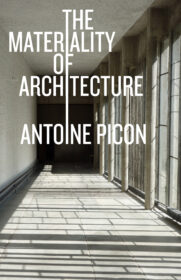 The Materiality of Architecture
Antoine Picon Minneapolis, London, University of Minnesota Press, 2020, 192 p.
Digital tools have launched architecture into a dizzying new era, one in which wood, stone, metal, glass, and other traditional materials are augmented by pixels and code. In this ambitious exploration, an eminent thinker examines what, exactly, the building blocks of architecture have meant over the centuries and how technology may—or may not—be changing how we think about them.
Antoine Picon argues that materiality is not only about matter and that the silence and inscrutability—the otherness—of raw materials work against humanity's need to live in a meaningful world. He describes how people define who they are, in part, through their specific physical experience of architectural materials and spaces. Indeed, Picon asserts, the entire paradox of the architectural discipline consists in its desire to render matter expressive to human beings. Through a retrospective review of canonical moments in Western European architecture, Picon offers an original perspective on the ways materiality has varied throughout centuries, demonstrating how experiences of the physical world have changed in relation to the evolution of human subjectivity.
Ultimately, Picon concludes that computer-based design methods are not an abrupt departure from previous architectural traditions but rather a new way for architects to control material resources. The result reinforces the fundamentally humanistic nature of architectural endeavor with an increasing sense of design freedom and a release from material constraint in the digital era.
Ludovic Halbert is co-organizing, in collaboration with the Local Finance Network, a workshop on "affordable" housing policies under budgetary constraints.
Tuesday, April 13, 2021, 10:00 a.m. to 1:00 p.m. (video conference)
The affordable housing sector, which explicitly aims to offer rents below those of the "free" market (social housing, intermediate housing, etc.), is at the crossroads of urban, social, and environmental issues. The goal is to ensure the development of a large stock of accessible housing while contributing to environmental transition. However, various financial constraints are overlapping to hinder the construction and renovation of housing. The cost of land and construction is rising, while the shrinking resources of occupants and housing applicants are forcing rents down. Against a backdrop of public sector consolidation, there are also budgetary constraints. These are leading to profound changes in the public financing system, which is relying less and less on direct state aid and more on the financial capacity of the organizations that produce and manage housing. Local authorities, which play a central role in housing production (through subsidies, the provision of land, loan guarantees, etc.), are also facing cuts in their funding and local tax reforms as part of policies to restore public finances.The workshop aims to review the ways in which these various financial constraints are being implemented, describe the changes they are bringing about in the sector and in public policy, and, above all, explore different scenarios for resolving the tensions between budgetary constraints and the continuing demands for the development and greening of affordable housing stock.
Program and access codes for the videoconference
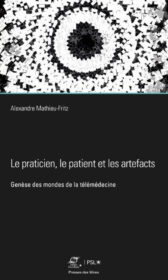 The practitioner, the patient, and the artifacts. Genesis of the worlds of telemedicine
Alexandre Mathieu-Fritz Paris, Presses des Mines, 2021, 324 p. (Social Sciences Collection)
Remote healthcare is the promise of telemedicine, which suddenly became a reality for many healthcare professionals during the COVID-19 pandemic. Until then, its implementation had seemed difficult, even hampered by unambitious health policies: it was not until September 2018 that teleconsultations became reimbursable by the French national health insurance system. But the slow development of telemedicine can also be explained by the accompanying upheavals in professional practices and the organization of healthcare. For many practitioners, telemedicine still enjoys an unclear status and raises new questions and practical problems that need to be clarified. This book offers a unique sociological analysis of the development of telemedicine since the 2010s, adopting the point of view of the healthcare professionals who are experimenting with it. Alexandre Mathieu-Fritz draws in particular on two areas of research: a telemedicine system linking a geriatric hospital to a university hospital, and an outpatient teleconsultation system for mental health. He lifts the veil on the conduct of remote consultations, during which practitioners are deprived of crucial clinical elements usually based on touch, close-up vision, and keen hearing, and are thus confronted with profound changes in the therapeutic relationship, but also in the dynamics of cooperation between professionals.
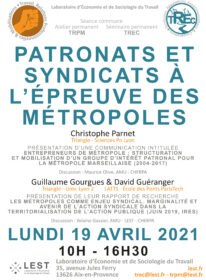 Guillaume Gourgues (Triangle – University of Lyon 2) and David Guéranger will present their research report on Monday, April 19, 2021, 10:00 a.m.-4:30 p.m. (LEST Laboratory
, Aix-en-Provence):
Metropolises as a trade union issue. Marginality and the future of union action in the territorialization of public action (June 2019, IRES)
 The sixth session of the LATTS Seminar will take place on Monday, February 8, 2021.
Romain Garcier Romain Garcier (Ecole normale supérieure de Lyon, Laboratoire Environnement, ville, société (EVS, UMR 5600)), will present the theme: "The metabolism of societies. Genealogy, uses, and pitfalls." "
LATTS Seminar poster_ session of 03/22/2021
Photo: The "Nord" factory in New Caledonia, which refines nickel on the shores of the lagoon in the Vo-Koné-Pouembout area.
The second session, "The 'commission' and managing the expectations of the funding structure: a bias or a lever for scientific research?" will be held via videoconference on Monday, March 15, 2021, from 4:00 p.m. to 6:00 p.m.
One of the specific features of a partnership thesis is the existence of an initial, a priori explicit "commission" for research, issued by a company, association, or public administration. This immediately introduces a third party between the doctoral student and the thesis supervisor: a third-party organization that has its own interests and logic, and which sometimes lacks understanding of the world of research and its challenges.
This second session will explore the influence of this "third actor," the sponsor, on the thesis process, addressing the following questions in particular: Are there forms of influence that can be anticipated in the management of the thesis that are specific to a type of funding structure (local authority, design office, large company, R&D department, etc.)? How can the expectations of each of the stakeholders (doctoral student, partner organization, laboratory) with regard to the research be defined in advance of the thesis? How can these expectations be managed over time, particularly when changes occur within the third-party organization (strategic reorientation, turnover of managers, departure of the supervisor, etc.)? What should be done when the doctoral student and the research are directly involved in the economic and political issues of the funding structure? What are the differences between the thesis manuscript, which must be written in an academic style and format, and the various "deliverables" expected by the company? How can these two aspects of research promotion be reconciled? Where does the doctoral student's contribution to the structure come into play?
While these questions inevitably arise in the context of partnership theses, they may not be specific to this type of funding. In fact, the majority of theses receiving doctoral grants are based on empirical surveys that require "opening up" fields and, therefore, often involve discussions with people whose agreement is a prerequisite for access to data. In this type of situation, which is very common, the doctoral student may find themselves in a position similar to that of their counterparts funded by partnership schemes, forcing them to deal with the expectations of their interlocutors. This session will also be an opportunity to share these experiences, beyond the formal thesis funding schemes.
Speakers: Mathilde Marchand, Sofia Guevara
coordinated by Nick Rees-Roberts and Fabrice Rochelandet (Sorbonne Nouvelle University)
Xu Zhumin, 2021
Citizen Participation in Shanghai's Urban Redevelopment
Working Paper, No. 21-19, March 2021
URL: https://hal-enpc.archives-ouvertes.fr/hal-03155727