Pierre Veltz, Professor Emeritus at Ecole des Ponts ParisTech and Associate Researcher at LATTS, will speak on this topic during the "Conflict & Territories" seminar coordinated by André Torre, Marianne Ehrlich, and Thierry Kirat.
The seminar will be held on Tuesday, March 9, 2021, at 1:30 p.m. via videoconference.

Martine Drozdz and Olivier Coutard will speak at this session, which will take place on Wednesday, March 3, 2021.
Thesis supervisor
: Pascal Ughetto Digital (more…)
TOD-IS-RUR (2021-2025)
Transit Oriented Development (TOD) for Inclusive and Sustainable Rural-Urban Regions
LATTS (Nathalie Roseau
) is a member of the European project H2020-MSCA-ITN, founded around a network of researchers from 9 higher education institutions and 6 European countries. This research and training project aims to question and extend the concept of TOD (Transit Oriented Development) to rural and urban regions with a context-based approach, in which the interactions between mobility and urbanization will be deepened in relation to social and environmental aspects. Based on a wide range of studies of European rural and urban regions, this interdisciplinary project mobilizes the disciplines of urban studies: urban history and sociology, transport and economic geography, landscape and environmental planning, urban planning and design, science and technology studies. This project is open to the recruitment of 10 Early Stage Researchers
who will join the network from September/October 2021 for a period of 3 years.
Beneficiaries
Ecole Polytechnique Fédérale de Lausanne
Ecole des Ponts ParisTech
Kungliga Tekniska Högskolan
Sveriges Lantbruksuniverstet
Technische Universität Berlin
Technische Universiteit Eindhoven
Université Gustave Eiffel
Universiteit Antwerpen
Universiteit van Amsterdam
Co-supervised by Nathalie Roseau (LATTS, ENPC) and Massimo Moraglio (TUBerlin), this doctoral research project will evaluate how generations of transport-urbanization planning were conceived in relation/conflict with different contexts of rural and urban regions, comparing rhetoric and plans versus outcomes. The project will focus on the rural and urban regions of Paris and Rome, analyzing both historical processes and current transport strategies and planning. Through these two case studies, the aim is, firstly, to put new developments into perspective with respect to previous experiences in order to compare and establish continuities or changes; secondly, to understand how they have or have not effectively reduced sprawl and how in particular the notions of compactness and density have been considered in this framework; thirdly, to see how the intentions behind the discourses and narratives have or have not been effective, and what have been the underlying drivers that have led to these trajectories. This doctoral research project thus brings a dynamic perspective of path-dependencies and change, as well as shows the specific driving forces and related agendas behind different TOD generations.
Thesis supervisor
: Taoufik Souami (more…)
Thesis supervisor
: Olivier Coutard (more…)
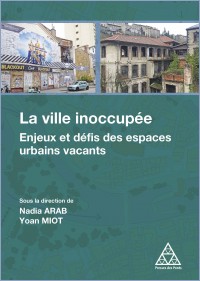
The Unoccupied City: Issues and Challenges of Vacant Urban Spaces
Edited by Nadia Arab and Yoan Miot
Paris, Presses des Ponts, 2020, 230p.
At a time when the ecological transition is increasingly imposing limits on land use, as evidenced by the recent bill aiming for "zero net artificialization" of national land, vacant urban spaces are emerging as a growing and increasingly topical issue in both France and internationally. Furthermore, the issue of vacant spaces and their reactivation goes far beyond the case of transitional urban planning, which has already been widely discussed. Unlike the issue of transitional urban planning, the treatment of vacant spaces is not only a question of temporary occupation or a precursor to an urban planning project or experimentation with uses. This book fills a gap both in its approach and in the results it produces for research and practice.
Vacant spaces refer to built or unbuilt spaces that were constructed and used for a purpose before becoming unused or underused, destroyed, or even never occupied. This phenomenon affects large cities as well as medium-sized and small towns, dynamic areas with tight real estate markets, and cities in decline, where the situation is even more alarming. This multifaceted phenomenon manifests itself in various ways, through the presence of partially or entirely vacant buildings and/or dilapidated retail spaces, in concentrated and massive forms or in a more diffuse manner. These unused spaces can be small or large; there is no standard. The same applies to their state of repair or deterioration, as well as the length of time they have been vacant. Finally, this diversity also applies to their owners. While a growing body of work is focusing on this issue, few studies take a cross-cutting approach and seek to draw lessons both from the perspective of explaining the phenomenon and from the methodological questions raised by the production of knowledge on the phenomenon, or even from the methods of reactivating and redeveloping these unused spaces.
Based on this observation and editorial choice, the book is structured in three distinct parts. The first part aims to report on approaches and measures of the phenomenon of vacant spaces by looking at different types of vacant spaces (offices, shops, service premises). Based on the work of professionals and researchers, it puts definitions and methods for approaching vacant spaces into perspective and reminds us how much the activity of measuring a phenomenon reflects representations of the problem and frames the possibilities for action. The second part focuses on the actors involved in the redevelopment of vacant spaces. Here again, a variety of situations and types of vacant spaces are analyzed: housing, ground floors, brownfield sites, and offices in both large cities and declining towns. The chapters in this section are structured around a close examination of the activities of actors involved in redevelopment, highlighting both the diversity of approaches currently being developed and certain recurring themes (influencing supply, influencing demand, matching supply and demand). Finally, the third part offers an international perspective on three countries that have long been confronted with the problems of vacant spaces. This perspective highlights the role of the national legal context concerning land ownership in how vacant spaces are approached and dealt with.
Thesis supervisor
: Valérie November (more…)
Thesis supervisor
: Sylvy Jaglin (more…)
Thesis supervisors
: Olivier Coutard and Caroline Gallez
(more…)