Dilara Trupia
will defend her thesis in sociology on Thursday, May 9, 2019, entitled:
An ethnography of open innovation
: The case of "La Cantine Numérique"
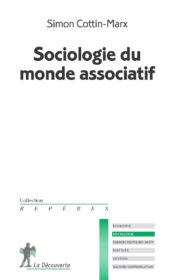
Simon Cottin-Marx
Sociologie du monde associatif
(Sociology of Associations) Paris, La Découverte, 2019, 128 p.
Since Alexis de Tocqueville, social sciences have studied associations as "schools of democracy," places of engagement and participation in civic life. Over the past twenty years, researchers have enriched these reflections by approaching the world of associations as a specific economic actor and a true world of work.
This book presents the main works in the sociology of associations and provides an insight into a profoundly diverse universe. How can we compare small volunteer associations with giants worth several million euros and employing thousands of people? What do environmental associations have in common with those in the health and social sector?
To answer these questions, this book explores the history of associations and then offers an overview of the French associative world. It then provides a summary of the main works dealing with volunteering and the changing relationship between "1901 law" structures and public authorities. Finally, it analyzes the specific nature of associative work.
 Alexandre Geffroy
is a research engineer at the Urba Risk Lab consortium (director: Valérie November; project manager: Alice Azemar).
He holds a PhD in Geography and defended his thesis entitled "The territorialization of public action in crisis situations. The case of animal meal in the context of Bovine Spongiform Encephalopathy (BSE) in France
" in November 2018
. This thesis was carried out at the CNRS IDEES 6266 research unit, under the supervision of Emmanuel Eliot, professor of geography at the University of Rouen Normandy.
This research questions the public action taken by the French government to manage animal meal, a product recognized as a health risk because it is a vector for the spread of BSE in cattle herds.
To this end, the thesis draws on various types of archives (governmental, industrial, media, and associative) and has a twofold objective.
On the one hand, it seeks to reconstruct the temporality of public action in the management of animal meal in relation to the various local actors involved and, on the other hand, to identify the levels of action and territorial strategies at play
in maintaining or resolving this crisis.
This paper tackles mechanisms of knowledge production after accidents comparing four expert reports on the last major derailment in France (at Brétigny in 2013, causing seven deaths). The purpose is not to provide a socio-technical explanation of the accident. It is to highlight how mechanisms of knowledge and ignorance production strongly depend on experts' "social position." More precisely, it shows that the extent to which certain groups of experts consider the knowledge of other groups of experts depends on their institutional and administrative base. Four types of report are examined chronologically. They differ in their framing of expertise work. Whereas the railway company experts try to impose a purely technical definition of the accident, other experts (working for the employees, the Transport Department, and the examining magistrate) highlight the conditions of maintenance work and the dilapidation of the railway network. The paper analyzes the explanatory processes at work in the reports, focusing on how some causal elements evolve, become more complex, or disappear. Depending on the data used, the definition of the accident and of the responsibilities change. Building upon works on the production of ignorance, the paper identifies two mechanisms of ignorance production: ignorance by omission and ignorance by submersion. The comparison of the four types of reports shows that what is silenced by one group of experts becomes a resource for another to criticize and contest previous analyses of the accident.
As part of the Activity and Professionalism seminar, LATTS is organizing a study day on Wednesday, April 10, 2019 (Ecole des Ponts, room B237) on the theme: Risks and Organization: The Activity Perspective.
Silvia Gherardi, professor at the University of Trento (Italy) and renowned specialist in the field of organization studies, will present her work and comment on that of LATTS.
Aude Danieli, sociologist at LATTS, spoke at the symposium "Changes in electrical systems between societal perspectives and territorial cooperation(s). Two years of action research at the heart of the RESET chair" as part of the Electrical Networks and Society(ies) in Transition(s) chair at Bordeaux Montaigne University and the University of Bordeaux. She took part in the round table discussion "Technophilia VS technocriticism: What future for innovation? Study(ies) on the reception of smart meters," moderated by Christophe Bouneau, historian of networks and innovation. She presented her research on the "Linky" phenomenon in a presentation entitled "The Linky meter: progress or scam?" Sociology of a technological promise at the crossroads of the social worlds of energy and digital technology.
Information and full program here (link: http://www.fondation.univ-bordeaux.fr/evenement/chaire-reset-avril-2019)
The 7th TRUC (Collective Utility Research) session will take place on Tuesday, April 9, 2019, focusing on the topic of data confidentiality.
Sofia Guevara and Mathilde Marchand will speak at this session to share their experiences on this subject.

Bérénice Girard
is a postdoctoral researcher with the ANR Hybridelec project (coordinators: Eric Verdeil and Sylvy Jaglin). A former student at the IEP in Rennes, she completed a sociology thesis under the supervision of Roland Lardinois and Odile Henry at the EHESS. Her thesis is entitled "Engineers, the river, and the state. The role and place of engineers in a major technical project: the management of the Ganges." As part of the ANR Hybridelec project, she is working on the district of Bhagalpur in Bihar, which is currently experiencing rapid development of the conventional electricity network under the impetus of the central and federal governments. In this context, she is studying the dynamics of the various alternative systems for accessing electricity (solar, generators, batteries). A short summary of the results of her first two field studies is available on the project website at the following address: https://hybridelec.hypotheses.org/581
Gilles Jeannot will speak at the seminar jointly organized by the "City and Digital" working group of LabeX Futurs Urbains and IFSTTAR's "Mobility and Digital Transitions" project on Thursday, April 4, 2019, in Marne la Vallée.
His presentation will focus on: Can cities integrate and control their data? The cases of user interface management and traffic regulation.
Contacts:Jimmy Armoogum and Anne Aguiléra
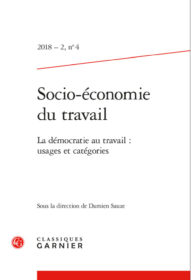
Jean-Michel Denis helped coordinate issue 4 (2018) of the journal Socio économie du travail.