Sofia Guevara Viquez will travel to Costa Rica for various missions. First, she will conduct fieldwork in San José (conducting interviews, collecting cartographic data) as part of her thesis. Then she will organize the international workshop "Spaces, Territories, and Contexts of Risk Management," which will be held in Costa Rica from July 17 to 20, 2017, at the University of Costa Rica.
Pascal Ughetto will speak at the Observatoire des Cadres symposium "Autonomy at work: why? How?" on Friday
, January 20
, 2017.
His presentation is entitled: "Autonomy, you bet! The concept of autonomy in contemporary business and the role of executives."
In 2014, Puca launched an exploratory seminar on smart cities
. The aim was to hold five sessions to initiate a discussion involving researchers, stakeholders, experts, and laypeople in order to move beyond enchanted narratives and negative preconceptions about smart cities and make them a possible object of governance or, at the very least, a shared object of research.
After an introductory session with Antoine Picon, the first person in France to develop a theoretical framework on the subject, the seminar explored the links between smart cities and sustainable development
, what they meant for the "city of networks
,"
the democratic challenges
of data in the urban sphere, and finally its "outside"
and the opportunities it offered to think about and organize it differently.
There was no assessment at the end of this first cycle, but there was a conviction that the smart city was a substantial concept
, protean certainly, but more complex than evanescent, and that it could not be limited to the extension of the digital domain to the city, the pursuit of e-administration by other means, or the ultimate stage of neoliberalism in urban services.
Borrowing, of course, from these and other registers, but not reducible to any one of them, the "smart city
" manifests itself in a way that is not fully captured by the predictive and prophetic discourse that accompanies it. That is why it was decided to continue the exercise.
But while the first cycle was led by the Puca, under the direction of François Ménard and Jean Danielou, this second cycle is part of a more cooperative and partnership-based approach. LATTS (Laboratoire Techniques, Territoires et Société)
, a partnership between the CNRS, Ecole des Ponts ParisTech, and the University of Paris-Est Marne-la-Vallée, has offered to continue the project and suggest new areas for debate. How, beyond pilot projects and demonstrations, are the new opportunities offered by communication technologies, big data, and Web 2.0 transforming urban management and life
? How do these developments "enter" politics
, how do they influence policy, between under-politicization (by its actors?) and over-politicization (by researchers?)? This will be the theme of the first session.
The other sessions will address other questions: How
are knowledge production, urban sciences
, and the use of models influenced by the new possibilities of mass statistics
, by whom, and with what consequences? How is the economic landscape of urban services being redrawn (flexible uses, disintermediation, between platform economies and dynamic pricing, etc.)? Through what means
(open data, crowdsourcing, crowdfunding, digital forums, etc.) can these new technologies enable the population to influence urban management?
Without claiming to provide definitive answers from an expert perspective, the seminar aims instead to be a moment of shared inquiry into these emerging practices.
Session 1: "Smart city" policies, Friday, January 27, 2017
Session 2: Models and big data, Thursday, May 4, 2017
Session 3: Generalized transparency, filtering, or distortion: what big and open data reveal about the city
Contact
Gilles Jeannot, professor at École des Ponts Paristech, researcher at LATTS, gilles.jeannot@enpc.fr
On Friday, January 27, François-Mathieu Poupeau will participate in the round table discussion "1947-2017: 70 years of energy or the history of SDEGM" organized to mark the anniversary of the Mayenne Departmental Electricity and Gas Union (SDEGM).
Artelia Ville et Transport, an independent engineering group and technical expert in urban development, and the Laboratoire Techniques Territoires et Société, a multidisciplinary social sciences laboratory specializing in urban, regional and spatial issues, conducted a research and innovation project aimed at exploring the challenges of the smart city for French engineering between November 15, 2016, and December 5, 2018. Various working sessions brought together a think tank and discussion group with the aim of comparing perspectives on five themes: definitions of the smart city (1), governance of the smart city (2), economic models of the smart city (3), a historical perspective: lessons from electrification in the digital age (4), the materiality of the smart city (5).
Ultimately, exploring these five themes made it possible to shift the focus away from the initial question (relating to the transformation of engineering in the smart city), before returning to it with greater clarity in the conclusion and putting forward several avenues for further exploration. The mission showed that the smart city questions the temporality of projects. In terms of engineering, the construction cycle and the maintenance/management cycle are increasingly intertwined, which raises questions for engineering groups. What timeframe should be adopted? One example studied was that of digital data. What should be done with the digital data needed to carry out projects: return it to the project owners, manage it on their behalf over a longer period of time, or act as a data aggregator in the context of missions similar to public service delegations?
The mission also demonstrated the value of decision-making support tools that can be used by engineering in a context where digital technology generates a certain amount of uncertainty (regarding the purpose of initiatives, their cost, and their social and environmental effects). The cases of scenario planning and modeling, for example, were studied.
Finally, the mission made it possible to compare the organizational difficulties, directly or indirectly related to digital technology, that challenge public administrations with those faced by their partners.
Keywords
City, digital technology, engineering.
Method
Interview with a panel of local authorities on the evolution of public procurement
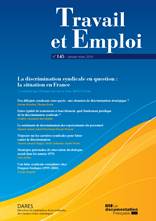
Issue 145 of Travail et Emploi (January-March 2016) is now online, featuring a report coordinated by Thomas Amossé and Jean-Michel Denis, "Trade union discrimination in question: the situation in France," and three book reviews.
This issue is available in electronic format on Cairn at http://www.cairn.info/revue-travail-et-emploi-2016-1.htm
Dominique Lorrain and Franck Poupeau
Water Regimes. Beyond the public and private sector debate.
Routledge, 2016, 228 p. (more…)
Thesis supervisor
: Olivier COUTARD (more…)
Thesis supervisor(s)
: Pascal Ughetto, Sylvain Parasie (more…)
David Guéranger
Leading Intermunicipal Cooperation: A Study of Atypical Leaders and Their Communities
Berger Levrault Publishing, August 2016 (more…)
Sylvy Jaglin and Alain Dubresson
ESKOM. Electricity and Technopolitics in South Africa
UCT Press, 2016, 196 p.
English (more…)

The upheaval in labor relations in France continues. On the one hand, the government says it wants to modernize labor relations to make them more efficient, while seeking to circumvent centralized regulations, the Labor Code, and even the unions themselves through increased use of company referendums. On the other hand, employers feel that the reforms do not go far enough in terms of deregulation, job flexibility, and labor cost reduction. Finally, there is a somewhat divided trade union movement, which has also been undermined by anti-union practices in many companies and government agencies, such as the promotion of potential union leaders, segregation of union members, and repression. In this ongoing project, where the representativeness of employee and employer trade union organizations is also being debated, a pile of texts obscures the principle of coordination between levels of negotiation and the possibility of derogating from a higher-level agreement. Finally, successive governments have shifted the focus of collective bargaining from the sectoral level—where union representation is established—to the company level, where unions are sometimes weakened or even non-existent in smaller companies. The rejection of the Labor Law in 2016 was largely based on this refusal to transfer the venue for essential negotiations: in France, company-based unionism is much less established than in Anglo-Saxon countries, for example. The Corpus section of this issue of La Nouvelle Revue du Travail provides a detailed analysis of the significance of the priority given to company-level negotiations, based on a number of emblematic cases. It also gives a voice to two legal experts in the field, before presenting a text by J. T. Dunlop and W. F. Whyte, previously unpublished in French, on industrial relations in post-war America.
The Controversy section has some links with this Corpus, as it deals with the structural situation of unemployment in France and the possible return to full employment, questioning the nature of this full employment. Three economists with very different orientations analyze the causes of unemployment and propose solutions: from liberal solutions to those accompanying a different kind of growth, via Keynesianism, the reader is confronted with an impossible dialogue. The Champs et contrechamps section also focuses on employment, dissecting two documentaries (Pôle emploi ne quittez pas and Les Règles du jeu) on two services that help people return to work. Two models, one public, the other private, both funded by the public service, with two different approaches and unequal resources: enough to perceive the ongoing "modernization" of public services and the resulting failures for both agents and users.
The Varia section returns, in two articles, to the issue of precariousness, focusing on its foundations and then its management in two very different sectors: airport runway maintenance work, which is increasingly outsourced, and the growth of self-employment in road transport in Spain, which leads the author to defend the concept of self-exploitation. In Materials, we interview Jean, a former executive who became a cabinetmaker: what is it like to be a manager in a multinational company? With a Gadzarts education, how can you deal with the daily difficulties in the field and face CEOs and shareholders at the same time? Finally, some fifteen reviews or reading notes present books that we have enjoyed discussing.
-
Corpus – What kind of "social dialogue"?
-
Towards an administered "social dialogue"? [Full text]Presentation of the Corpus
-
Controlling time when announcing collective redundancies: the effect of the Renault Act in Belgium [Full text]Controlling time when mass redundancies are announced: impact of the "Renault Act" in BelgiumControl del tiempo al anunciarse despidos colectivos: el efecto de la "ley Renault" en Bélgica
-
A universal right to representation? [Full text]Half a century of institutionalization of territorial social dialogue for very small enterprisesA universal right to representation? 50 years of institutionalized local social bargaining in SMEs¿Un derecho universal a la representación? Medio siglo de institucionalización del diálogo social territorial para las Muy pequeñas empresas
-
Negotiations hampered [Full text]The ambivalent drivers of the institutionalization of collective bargaining in companiesHampered negotiations: Ambivalent determinants of institutionalized collective bargaining in companiesStalled negotiations: Ambivalent determinants of institutionalized collective bargaining in companies
-
Ryanair or the refusal of institutionalized social dialogueRyanair or the refusal of institutionalized social dialogue
-
Promoting "social dialogue" in the workplace. The Rebsamen Law and the Combrexelle Report [Full text]Interview with Sylvaine Laulom and Cécile NicodTo promote "social dialogue" in companies. Rebsamen law and Combrexelle report
promoting "social dialogue" in companies. Rebsamen law and Combrexelle report
-
John T. Dunlop and William F. Whyte (text published in 1949)Framework for the Analysis of Industrial Relations: Two ViewsTwo approaches to the analysis of labor relations
-
-
Controversies – From unemployment to full employment: what solutions are there in France?
-
What kind of full employment and how to get there?What kind of full employment? How to achieve it?
-
-
Miscellaneous
-
Precarious workers on airport runways [Full text]Between casualization and increasingly stringent constraints; Runway staff on the edges of the airline industryPrecarious workers on airport runways
-
Self-exploitation behind the wheel: Spanish independent truck drivers [Full text | translation]
-
-
Fields and counterfields
-
Highlighting gray areas in public employment serviceLuz sobre las zonas oscuras del servicio público del empleo
-
-
Materials
-
What does it mean to be a "manager"? [Full text]Conversations with Jean, a former executiveWhat does managing really mean? The story of Jean, a former executive¿Qué significa ser “manager” ? Jean, antiguo ejecutivo de dirección
-
-
Reviews and reading notes
-
Translated from Manufacturing Morals. The Values of Silence in Business School Education, The University of Chicago), 2013
-