Thesis supervisors: Yoan Miot and Cécile Vignal
In 2023, more than one in twelve homes in France was vacant. Within this stock of 3.1 million unoccupied homes, there is a wide variety of physical, legal, and geographical situations, reflecting a growing, complex, and multifaceted phenomenon. Among these situations, long-term vacancy is of particular concern to urban public policy, as it is seen as a symptom of a dysfunctional local real estate market. Thus, the remobilization of a pool of seemingly unused housing is an objective that serves not only public housing policy, but also public land, development, and ecological transition policy. However, public action remains emerging and unstable. Despite the mobilization of a wide variety of instruments from public housing and habitat policies since the 1990s, public and parapublic actors are faced with the difficult task of effectively combating long-term vacancy. Among the obstacles identified, the difficulty of involving owners appears to be the central issue, as highlighted in both scientific and institutional literature. However, although understanding the motivations of landlords is crucial to supporting the return to use of vacant private housing, little research has been done on this topic. This thesis therefore aims to study the phenomenon of long-term residential vacancy, considered as a process of devaluation of private housing, by examining both public policies and the recipients of the action. While housing is increasingly seen as a commodity, or even an asset, due to the restructuring of the welfare state towards an asset-based welfare regime, how can we explain the growth in long-term vacancy, which varies from region to region, as well as the difficulties in mobilizing owners to bring their properties back into use? Through a comparative study of rural and metropolitan areas, three areas are investigated. First, we question the relationships between owners, vacant housing, and public action, exploring the representations of residential vacancy and owner behavior that structure this emerging public policy. Second, we consider vacancy as a spatially heterogeneous phenomenon, part of a process of valorization and devaluation at the territorial level, influencing the socio-demographic profile of owners, the configurations of residential vacancy, and the potential for reuse. Thirdly, we analyze vacancy by re-inscribing this transitional situation within the residential and patrimonial strategies of owners: the aim is to understand how long-term vacancy questions and reshapes the social logic of property ownership.
Year of enrollment: 2024
Doctoral school: City, Transportation, and Territories – VTT
Thesis supervisor: Corinne Delmas
Year of enrollment: 2018
Doctoral school: Organizations, Markets, Institutions – OMI
Thesis supervisor: David Guéranger
The thesis project focuses on the various political dimensions of the spatial relegation of precarious forms of housing for exiled people (camps, squats, third places). It is based on the hypothesis that by geographically distancing these informal spaces from the centers of daily life and mobility of citizens, public authorities discourage local engagement. While some supporters withdraw in the face of difficulties, others, fewer in number, manage to maintain their commitment. How can we raise awareness of a cause that has become "invisible"? How can we prolong commitment in spaces of spatial and social relegation? This project aims to analyze the dual social and spatial dimensions of engagement, combining local configurations (geographical, political), the characteristics of engagement structures, and the individual trajectories of volunteers. It is based on multi-sited field surveys in Paris, on the French-British border (Calais), and on the French-Italian border (Briançon). By combining qualitative and quantitative methods, it aims to understand the processes of change in the socio-spatial conditions of engagement with exiled people.
Year of enrollment: 2025
Doctoral school: City, Transport, and Territories – VTT
Thesis supervisor: Agathe Euzen
This thesis project aims to explore the relationship between equity and ecology in the field of water, an approach that is now essential for sustainable management in a context of global change. Our main hypothesis is that the sustainability of water resources in the Adour-Garonne basin (BAG), which has been in crisis for several years, is interdependent with the capacity of water governance models to consider situations of vulnerability, both human and non-human, within their management territory. while always ensuring the principles of solidarity between upstream and downstream areas, and between surface water and groundwater. We will seek to identify equity issues that could improve sustainable water management in a context of uncertainty linked to global change. We will also look at how water governance models, depending on the context (hydro, actors, scales, uses, mechanisms), are appropriate and applied in the territory and how they can sometimes be a means of arbitrating other issues that are in the public interest.
Year of enrollment: 2025
Doctoral school: City, Transportation, and Territories – VTT
Thesis supervisors: Sylvy Jaglin and Pascal Ughetto

Over the past few decades, the range of electricity services available on the African continent has diversified considerably, particularly through decentralized solutions (solar lamps, solar home kits, mini-grids) (Guillou, 2022; Cholez & Trompette, 2022). These solutions are set to play a central role in providing access to electricity, particularly in rural areas (IEA, 2023). However, even though increasing amounts of investment are being made in the development of renewable energies, a significant proportion of solar projects in sub-Saharan Africa, particularly mini-grids, are failing, with equipment deteriorating and struggling to last more than ten years (Etienne, 2022; Cholez & Trompette, 2019; ENEA & Practical Action, 2023).
Investors, mini-grid developers and operators, and suppliers of domestic solar kits face many challenges in ensuring the sustainability of decentralized electricity infrastructure. The lack of data and knowledge is a major obstacle to the productive use of electricity generated by mini-grids, even though such use is an important condition for their profitability (ESMAP, 2022; UNIDO, 2022). The organization of stable maintenance and repair chains is another obstacle. Based on these observations, the thesis examines decentralized electrical infrastructure in sub-Saharan Africa and the obstacles to its sustainability, focusing on solar workers and their activities. The suggestion is that the sustainability of decentralized electrical infrastructure fundamentally depends on the existence of ecosystems of workers or professionals rooted in local areas. This leads to an analysis of the conditions for the emergence of such localized professional ecosystems capable of adapting this infrastructure to local contexts over the long term. Two contrasting case studies were selected for fieldwork: Cameroon, where 26% of the rural population has access to electricity, and Madagascar, where less than 15% has access (World Bank, 2023). What local maintenance and repair skills are necessary for the sustainability of decentralized electrical infrastructure? What conditions are needed to support or even encourage the emergence and structuring of an ecosystem of specialized actors? The thesis hypothesizes that skills must be examined within their territorialized professional ecosystems in order to understand the diversity of actors, the complexity of their relationships, and the vitality of local maintenance economies. The approach we propose to adopt here will allow us to focus on a wide variety of workers beyond engineers alone, including professionals of all skill levels and types. It is in line with sociological approaches that, in recent years, have encouraged attention to be paid to the less visible work of those who are referred to as "little hands" and who nevertheless participate in the ecosystem of actors ensuring the technical mastery of an infrastructure. In the context of the proposed thesis, technicians and repair craftsmen will therefore be among the populations specifically studied. Through the analysis of work "in progress " (Ughetto, 2018), the aim will be to explore the role they play in the functioning and sustainability of decentralized electrical infrastructure, particularly through the many "DIY" solutions and innovations that ensure the normal functioning of electrical infrastructure in a context of failing conventional network services (Rateau, 2022; Olivier de Sardan, 2023).
Year of enrollment: 2024
Doctoral school: City, Transportation, and Territories – VTT
Thesis supervisor: Olivier Coutard
In a context where development stakeholders are attempting to organize and equip themselves collectively to respond to multiple environmental constraints (decarbonization, climate change adaptation, renaturation, compensation, etc.), developers find themselves caught between these demands and an economic model that automatically encourages them to increasingly artificialize and build in order to finance their operations. They report difficulties, primarily economic but also in terms of tools and skills, in addressing these issues and respecting planetary boundaries in their operations. This doctoral project, at the crossroads of operational and academic questions, aims to document and examine the greening of developers' practices, i.e., how they attempt to integrate issues relating to living organisms, materials, and energy into their operations. In particular, this project will study the subject of ecological metrics: beyond indicators and benchmarks, what approaches would enable developers to question their development choices and steer decisions towards more ecological solutions? This project is part of the ECOMODAM (Ecologisation of the economic model of developers) research program, funded by the ANR. It will combine the study of existing ecological accounting systems and the consideration of planetary boundaries within an operational scope (territorial ecology, urban metabolism, etc.) in a strong sustainability analytical framework. At the same time, partnership work and immersion with volunteer developers will make it possible to question the role of ecological metrics in operational decision-making processes and the evolution of their professional practices.
Year of enrollment: 2024
Doctoral school: City, Transportation, and Territories – VTT
Thesis supervisor: François-Mathieu Poupeau
This doctoral research is conducted in a context of climate change marked by increasingly frequent heat waves and the emergence of new forms of social and territorial vulnerability. While energy poverty has long been considered from a winter perspective, focusing on heating homes and the difficulty of paying bills, summer energy poverty (SEP) has only very recently emerged as a subject of scientific debate and public action. It refers to the inability of certain households to protect themselves from excessive heat due to a lack of suitable housing, financial resources, or access to cooling devices. This situation is exacerbated in urban areas by heat islands and can have direct effects on health, quality of life, and energy budgets. While the European Commission has already broadened its definitions of energy poverty to include the summer issue, in France the national framework remains largely focused on cold weather. At the local level, various actors—local authorities, social landlords, associations, energy operators—are experimenting with measures, often motivated by the goal of summer comfort, such as the greening of urban spaces or the renovation of buildings. However, these initiatives do not yet fit into a stable definition of PEE, and their links with existing policies to combat energy poverty remain unclear. The proliferation of approaches reveals both a dynamic spirit of innovation and a fragmentation that raises issues of coordination between actors and the effectiveness of the measures. The objective of this thesis is to understand the conditions under which summer energy poverty emerges as a public problem and the processes of translation between its different frameworks. The approach is structured around three axes: (1) Identifying and analyzing national frameworks for EPI, comparing them with European frameworks and those of other countries, in order to understand how this problem is constructed and which dimensions are highlighted or left out. (2) Studying how territories appropriate and translate these frameworks, observing the definitions, instruments, and networks of actors mobilized. This analysis will focus on two contrasting local areas, allowing us to examine how socio-spatial and institutional contexts influence the structuring of responses. (3) Analyze the modes of coordination between the actors involved, whether cooperation, overlap, or competition, and the effects produced on the households concerned. To this end, the research will draw on contributions from political science and the sociology of public action. Framing concepts will be used to explore the processes by which a phenomenon becomes a recognized collective problem. The sociology of translation will help to understand how definitions circulate and transform when they come into contact with local instruments, mechanisms, and actors. Finally, approaches to energy vulnerability, energy justice, and capabilities will provide a framework for analyzing the inequalities generated by the PEE, integrating material constraints (housing, climate, resources), social constraints (status, networks, access to mechanisms), and symbolic constraints (representations of heat and comfort). This project thus aims to document and compare the forms of emergence, appropriation, and implementation of the PEE in a field that has yet to be explored by research. It will contribute to a better understanding of climate-related environmental inequalities, while questioning contemporary transformations in public action in the face of the challenges of energy transition and adaptation to heat waves.
Year of enrollment: 2026
Doctoral school: OMI – Organizations, Markets, Institutions
Thesis supervisor: François-Mathieu Poupeau
In France, 95% of Catholic churches are owned by local authorities. These buildings are therefore affected by changes in local public policy, particularly with regard to the management of public heritage. At the same time, as places of worship, churches are also affected by changes specific to the religious institution that uses them. They therefore constitute interfaces between local public action and the religious institution, revealing the restructuring of their relationships. This thesis therefore focuses on the management of municipal churches by the local authorities that own them, and in particular their use in local public action through local energy and cultural policies. It is divided into three areas: first, the analysis of the construction of national frameworks for action (financial, regulatory, organizational) concerning local action by and on communal churches. The aim is to understand how the current treatment of communal churches at the national level encourages, constrains, and shapes their use by the local authorities that own them. The second area focuses on the design of public action involving churches, studying both the characteristics of municipalities that mobilize their communal churches for local initiatives, the process of designing local action, and the influence of the building's specific characteristics on this design. Finally, the third area studies the latent effects produced by the political involvement of churches, both on public action in general and on sectoral actions in particular, as well as on church-community relations. This project therefore aims to identify the conditions and reasons that govern the inclusion of communal churches in local public action, as well as their effects, in order to identify what the management and inclusion of these buildings in public action says about the relationship between public and religious authorities.
Year of enrollment: 2024
Doctoral school: OMI – Organizations, Markets, Institutions
LATTS is pleased to invite you to the next session of its general seminar, which will take place on Thursday, March 19, 2026, at 2 p.m. The session will focus on the book Radioactive Governance: The Politics of Revitalization in Post-Fukushima Japan, published by New York University Press in 2026.
Maxime Polleri will present his book, followed by a discussion led by Christine Fassert, before opening the floor to questions from the audience.
This session will take place in room B021/B023 (Bienvenüe Building) and will be broadcast via videoconference. Zoom
link: https://univ-eiffel.zoom.us/j/81175761278
Meeting ID: 811 7576 1278
Password: LATTS2026
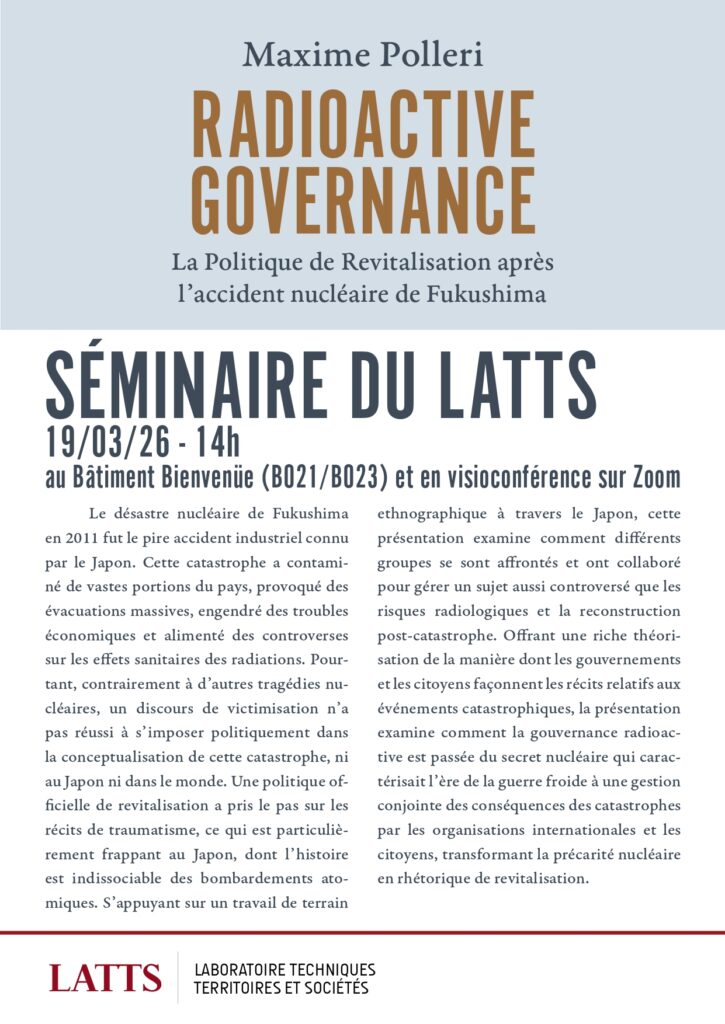
"The 2011 Fukushima nuclear disaster was the worst industrial accident ever experienced by Japan. This catastrophe contaminated large parts of the country, caused mass evacuations, led to economic turmoil, and fueled controversy over the health effects of radiation. Yet, unlike other nuclear tragedies, a discourse of victimization has failed to gain political traction in the conceptualization of this disaster, either in Japan or around the world. An official policy of revitalization has taken precedence over narratives of trauma, which is particularly striking in Japan, whose history is inextricably linked to the atomic bombings. Drawing on ethnographic fieldwork across Japan, this presentation examines how different groups have clashed and collaborated in managing such controversial issues as radiation risks and post-disaster reconstruction. Offering a rich theorization of how governments and citizens shape narratives about catastrophic events, the presentation examines how radioactive governance has shifted from the nuclear secrecy that characterized the Cold War era to joint management of the consequences of disasters by international organizations and citizens, transforming nuclear precariousness into rhetoric of revitalization.
Maxime Polleri is an anthropologist specializing in technoscience. He studies the governance of disasters, waste, and misinformation, focusing primarily on nuclear issues.
Book Radioactive Governance. The Politics of Revitalization in Post-Fukushima Japan
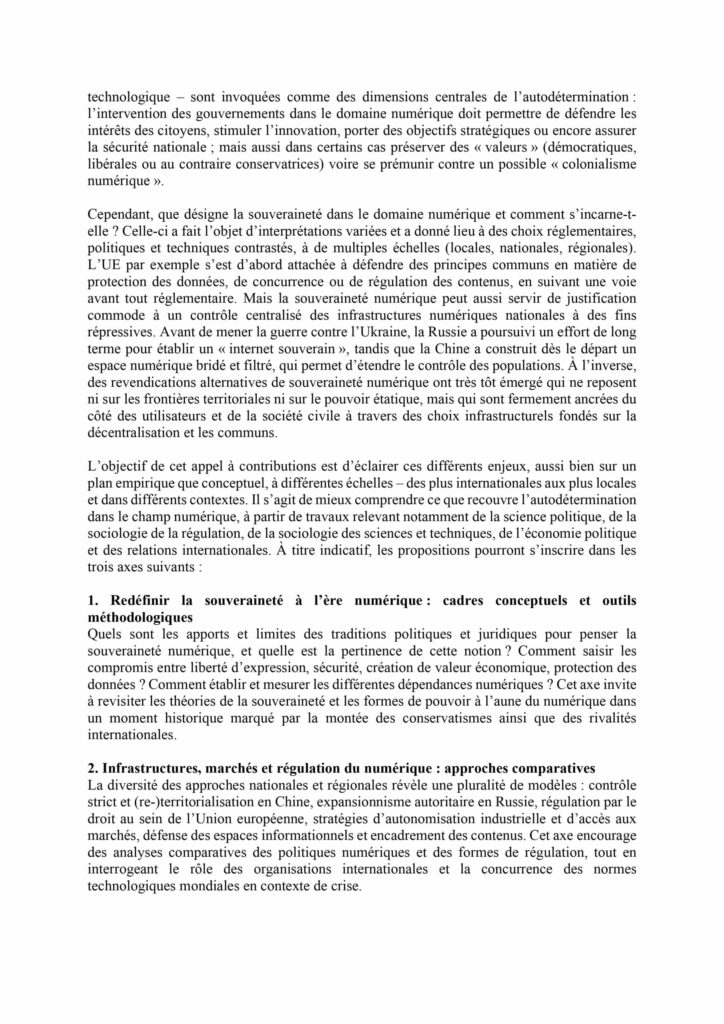
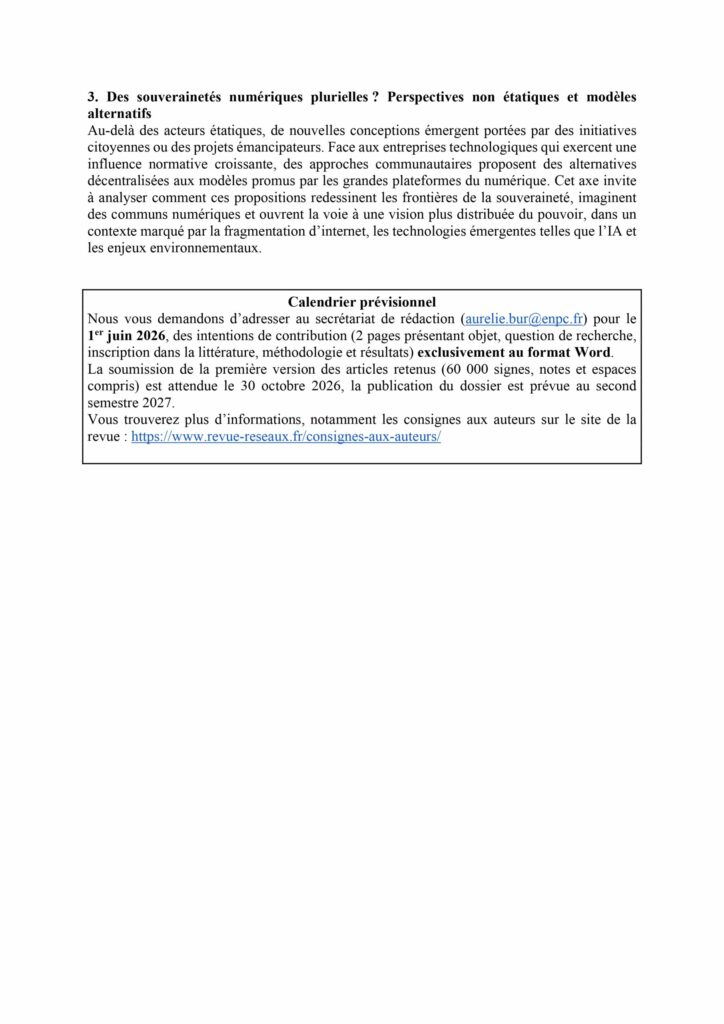
The journal Réseaux is calling for submissions for its special issue on "Sovereignty (and) Digital Technology," coordinated by Benjamin Loveluck and Françoise Daucé.
The text of the call for papers is available below and can also be found on the journal's website: Call for papers on "Sovereignty (and) Digital Technology"

Call for papers for "The Intangible" Socio-anthropology:
Coordinators: Christine Fassert and Laurence Raineau
1/ Intangibility as a driver of technical development?
2/ Making the intangible tangible: what is the role and limitation of science and technology?
3/ Making tangible: a social process?
4/ The power of the intangible
A detailed proposal of approximately 5,000 characters (including spaces and notes, but excluding bibliography) is expected by March 26, 2026. Issue 55 of L'intangible is scheduled for publication in June 2027.
Find all the information about the current call for papers at: https://journals.openedition.org/socio-anthropologie/20647#tocto1n3
The PAR(C)IMAGE project has been selected for a two-year grant by MSH Paris Nord 2026.
It is led by Raphaële Bertho, University of Tours – INTRU, Sonia Keravel from the École Nationale Supérieure de Paysage de Versailles-Marseille (ENSP) – LAREP, Frédéric Pousin, Emeritus Research Director at CNRS – UMR AAU, and Nathalie Roseau from the École nationale des ponts et chaussées (ENPC) – UMR LATTS.
Taking the Grand Chemin Metropolitan Park project as its field of investigation, the research studies the evolution of representations of eastern Greater Paris through the prism of weak infrastructure, understood as the foundation for the functioning of communities and territories whose ecological footprint would allow coexistence with living organisms. The historical and visual perspective offers a reverse history of the park's territory, focusing on representations of past projects, the unthought, the erased, but also the surviving and the lingering. The visual is privileged in order to analyze the production and circulation of representations. The aim is to build up a documentary and historical depth of the territory that can be mobilized in the operational project. The three components of the research project are the identification of archival collections, the organization of student workshops, and the planning of study days from a local and international perspective.