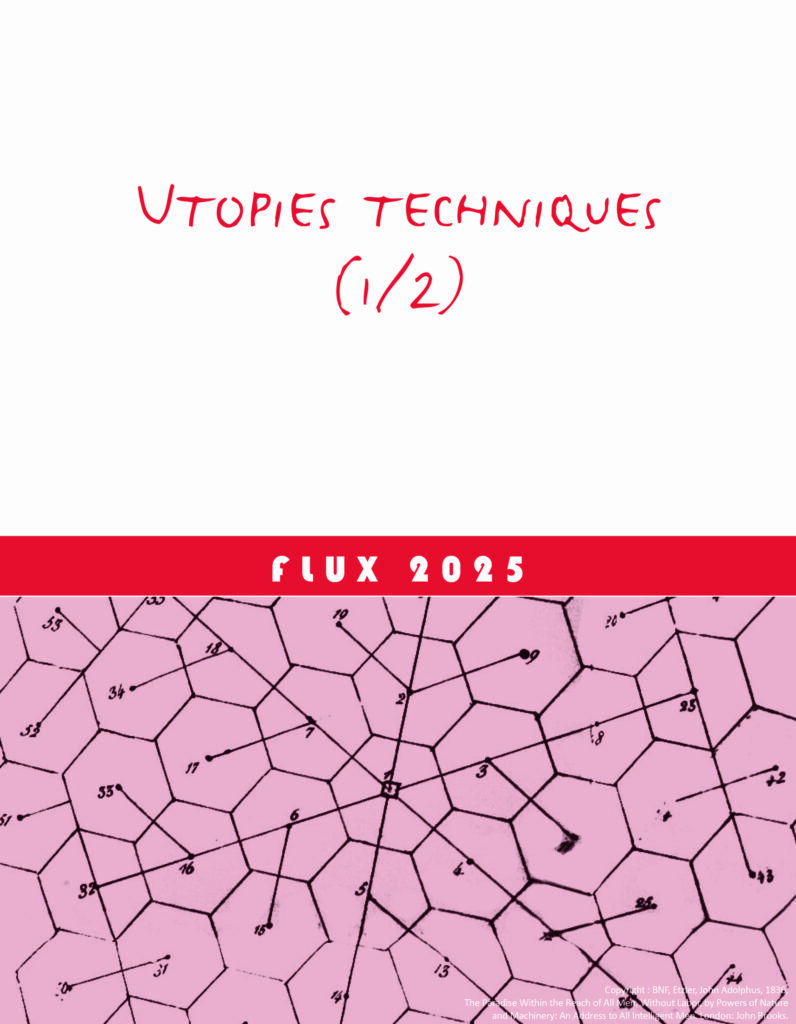
We are pleased to announce the release of issue 142 (2025/04) of Flux magazine, Technical Utopias (1/2), coordinated by Fanny Lopez, Anaël Marrec, and Olivier Coutard.
The second volume of this issue is scheduled for publication in March 2026.
Summary of Technical Utopias
Technical utopias, between political imaginaries and social mobilizations, by Anaël Marrec and Fanny Lopez
Henri de Graffigny, Electroculture and the Genealogy of Electric Utopias, by François Jarrige
The circulus in the 20th century: resurgence and metamorphosis of the ideal of agricultural recycling of excreta in the era of the Great Acceleration (France, 1930s–1980s), by Étienne Dufour
"Peace through sewers," or Mediterranean unity as an urban, geopolitical, and environmental utopia (1950s–1990s), by Samuel Ripoll
Believing in fast breeder reactors. The transformations of a nuclear utopia, by Martin Denoun, Claire Le Renard, and Ange Pottin
Bibliographical references
Martine Bartolomei, Francis Beaucire, and Arnaud Passalacqua (eds.), The Sea, Wind Turbines, and Citizens: New Territories of Energy, Paris, Hermann, 2022, 281 p., by Didier Kahn
Emmanuel Foëx (with an essay by Nicola Braghieri), Power Plants – Hydroelectric Architecture and Landscapes of the Alps, Geneva, MétisPresses, 2024, 440 p., by Elke Mittmann
Pascal Auzannet, The mobility puzzle in Île-de-France, Paris, Hermann, 2025, 212 p., by Félicien Boiron
Jean-Baptiste Butlen, Pauline Sirot, Mathurin Basile (eds.), Living Soils: Taking Soils into Account in Land Use Planning, Marseille, Parenthèses, 2024, 224 p., by Arturo Romero Carnicero
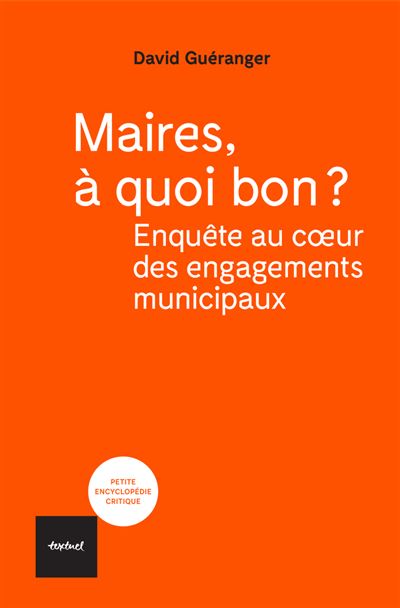
David Guéranger has just published his book “Maires, à quoi bon ? Enquête au cœur des engagements municipaux” (Mayors, what’s the point? An investigation into municipal commitments), released by Editions Textuel on January 14, 2026.
“David Guéranger explores the behind-the-scenes world of local politics through a long-term sociological study focusing on small towns and based on in-depth interviews with local officials. Far from viewing the departure of mayors as a phenomenon of exhaustion or protest, the author reveals the moral dilemmas, daily tensions, and silent compromises that structure the ordinary experience of local power. He shows that commitment is not so much a heroic impulse as a learning process of resignation, made up of sacrifices, compromises, but also loyalty to the municipal institution.
By meticulously retracing the life stories and political trajectories of these elected officials grappling with mental strain, decision-making solitude, and contradictory injunctions from the state, the author offers an intimate look at local government, at the invisible forces that drive its reproduction, and proposes an embodied reading of contemporary democratic wear and tear.“
Thesis supervisors: Elsa Vivant (Gustave Eiffel University) and Martine Drozdz (CNRS/French House of Oxford)
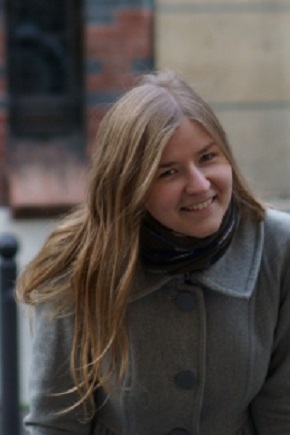
This thesis examines post-socialist urban transformations in Saint Petersburg through the lens of the renovation of Soviet architectural heritage, which reveals the rise of urban authoritarianism. Using a mixed methodology—combining interviews, observation, mapping, statistics, network analysis, and online ethnography—it explores the political, economic, and social forces that have shaped the city since the fall of the USSR. The research highlights the gradual commercialization of the "socialist city," while challenging the dominant narratives of neoliberalization, revealing in particular the clientelist and authoritarian dynamics of urban power at work in the demolition and reconstruction projects of Soviet buildings. The Narvskaya Zastava neighborhood, a former emblematic working-class area, serves as the main case study for analyzing the resulting tensions between heritage preservation and urban transformation. Based on both fieldwork and digital research, the thesis shows that heritage is becoming a strategic space for contesting authoritarianism and forced politicization. Architectural, historical, and legal expertise is mobilized as a political resource by residents, activists, professionals, and, in some cases, representatives of the authorities, revealing the internal flaws and tensions of the authoritarian state. However, the study highlights the plurality of rationales that structure residents' reactions, whether favorable or opposed to renovation projects, and reveals post-socialist social relations that are much more complex than a simple opposition between winners and losers of economic liberalization.
Defense on Friday, January 30, 2026
Year of enrollment: 2020
Doctoral school: VTT – City, Transportation, and Territories
Composition of the jury:
- Béatrice VON HIRSCHHAUSEN, CNRS Research Director, Géographie-cités/Centre Marc Bloch (Rapporteur)
- Martin MÜLLER, University Professor, University of Lausanne (Rapporteur)
- Elsa VIVANT, University Professor, Gustave Eiffel University (Thesis Director)
- Martine DROZDZ, CNRS Researcher, LATTS/Maison française d’Oxford (Co-supervisor)
- Claire CARRIOU, University Professor, University of Paris-Est Créteil (Examiner)
- Lydia COUDROY DE LILLE, University Professor, Lumière Lyon 2 University (Examiner)
- Ozan KARAMAN, CNRS Research Fellow, LATTS (Examiner)
- Perrine POUPIN, CNRS Research Fellow, CRESSON (ENSA Grenoble) (Examiner)
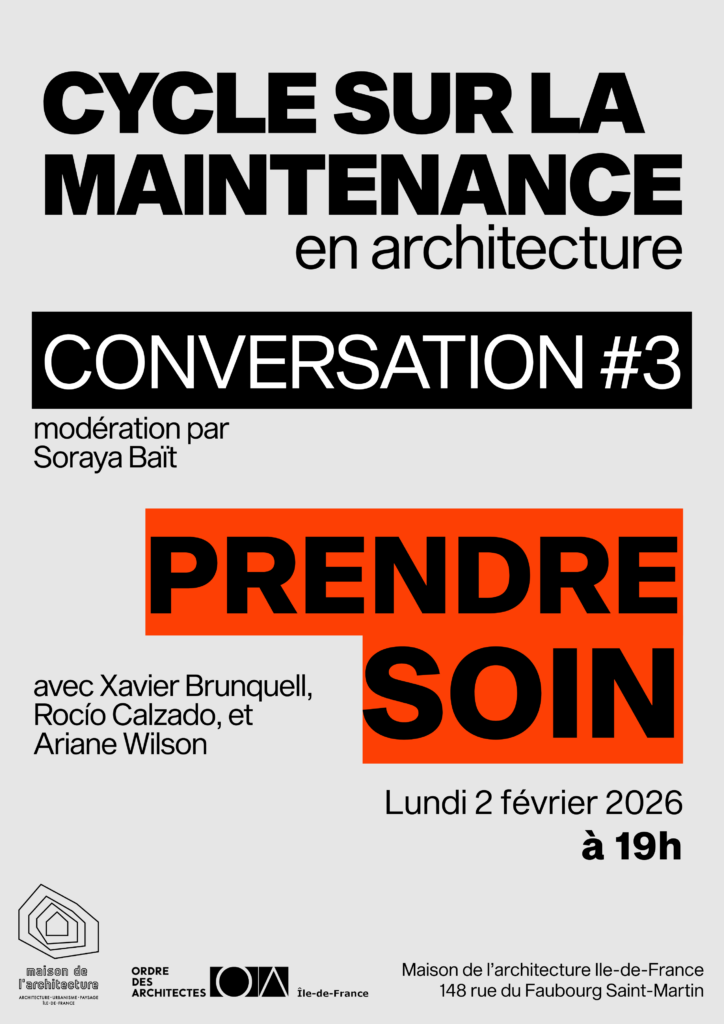
Rocío Calzado López will participate in the conference "Prendre soin" (Taking Care) organized by the Maison de l'architecture Ile-de-France and the Ordre des architectes d'Île-de-France. This conference is the third in a series of talks and conferences devoted to the issue of maintenance in architecture.
It will take place on Monday, February 2, 2026, at 7 p.m., at the Maison de l'architecture Ile-de-France (148 rue du Faubourg Saint-Martin, 75010 Paris).
"Taking Care" – Series of conferences on maintenance in architecture
LATTS is pleased to invite you to the next session of its general seminar, which will take place on Monday, February 23, 2026, at 2 p.m. The session will focus on the book Accumuler du béton, tracer des routes. Une histoire environnementale des grandes infrastructures (Accumulating Concrete, Building Roads: An Environmental History of Major Infrastructure Projects), La Fabrique Éditions, 2024.
Nelo Magalhães will present his book, followed by a discussion led by Nathalie Montel, before opening the floor to questions from the audience.
This session will take place in room B015 (Bienvenüe Building) and will be broadcast via videoconference. Zoom
link: https://univ-eiffel.zoom.us/j/87987869978
Meeting ID: 879 8786 9978
Password: LATTS2026
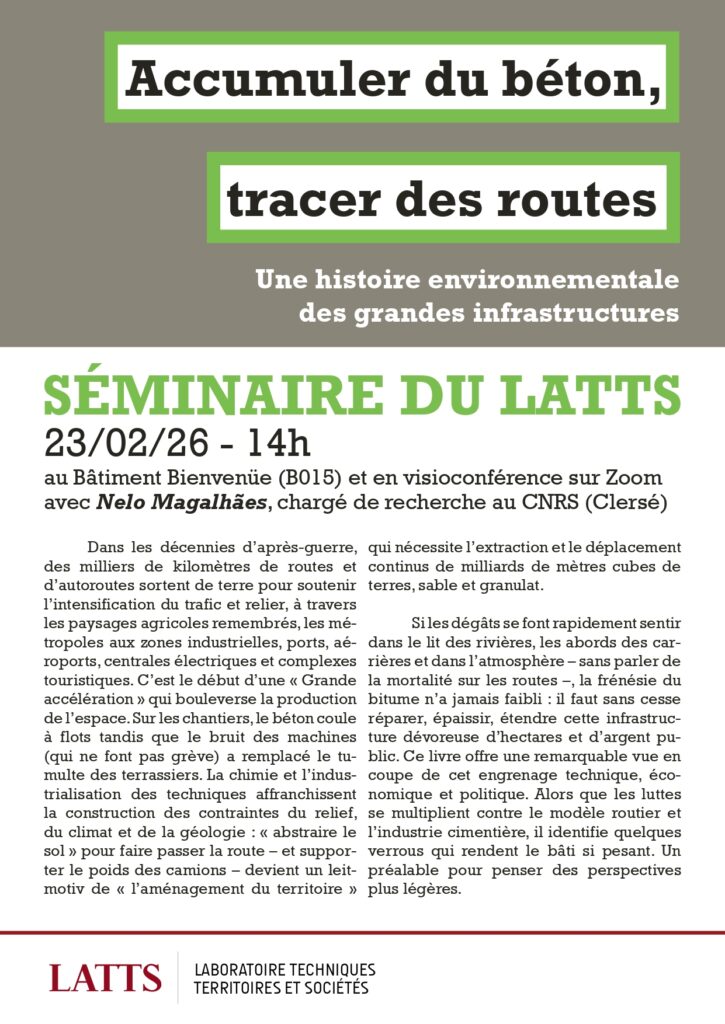
"In the post-war decades, thousands of kilometers of roads and highways were built to support the increase in traffic and connect, across the consolidated agricultural landscapes, metropolitan areas to industrial zones, ports, airports, power plants, and tourist complexes. This marked the beginning of a "Great Acceleration" that revolutionized the production of space. On construction sites, concrete flowed freely while the noise of machines (which did not go on strike) replaced the clamor of diggers. Chemistry and the industrialization of techniques freed construction from the constraints of terrain, climate, and geology: "abstracting the ground" to build roads—and support the weight of trucks—became a leitmotif of "land use planning," which required the continuous extraction and displacement of billions of cubic meters of earth, sand, and aggregate.
Although the damage is quickly felt in river beds, around quarries and in the atmosphere – not to mention road deaths – the frenzy for asphalt has never abated: this infrastructure, which devours hectares and public money, must be constantly repaired, thickened and extended. This book offers a remarkable cross-section of this technical, economic, and political machinery. As struggles against the road model and the cement industry multiply, it identifies some of the obstacles that make the built environment so burdensome. A prerequisite for thinking about lighter alternatives.
Nelo Magalhães holds a doctorate in mathematics and economics. He is currently a postdoctoral researcher at the Institute for Environmental Transition. His research focuses on the materiality of capitalism, from a perspective that combines political economy and environmental history.
LATTS is pleased to announce that Olga Suslova's doctoral thesis defense will take place on Friday, January 30, 2026, at 2:30 p.m. (doors open at 2 p.m.) in room V404 of the École nationale des ponts et chaussées (ENPC) on the Cité Descartes campus. Her thesis in urban planning is entitled:
"Post-socialist urban transformations in Saint Petersburg: The advance of urban authoritarianism through urban renewal."
This thesis was completed at LATTS, under the supervision of Elsa Vivant and co-supervision of Martine Drozdz.
Composition of the jury:
Béatrice VON HIRSCHHAUSEN, CNRS Research Director, Géographie-cités/Centre Marc Bloch (Rapporteur)
Martin MÜLLER, University Professor, University of Lausanne (Rapporteur)
Elsa VIVANT, University Professor, Gustave Eiffel University (Thesis Director)
Martine DROZDZ, CNRS Researcher, LATTS/Maison française d'Oxford (Thesis Co-supervisor)
Claire CARRIOU, University Professor, University of Paris-Est Créteil (Examiner)
Lydia COUDROY DE LILLE, University Professor, Lumière Lyon 2 University (Examiner)
Ozan KARAMAN, CNRS Research Fellow, LATTS (Examiner)
Perrine POUPIN, CNRS Research Fellow, CRESSON (ENSA Grenoble) (Examiner)
Thesis summary:
This thesis examines post-socialist urban transformations in Saint Petersburg through the lens of the renovation of Soviet architectural heritage, which reveals the rise of urban authoritarianism. Using a mixed methodology—combining interviews, observation, mapping, statistics, network analysis, and online ethnography—it explores the political, economic, and social forces that have shaped the city since the fall of the USSR. The research highlights the gradual commercialization of the "socialist city," while challenging the dominant narratives of neoliberalization, revealing in particular the clientelist and authoritarian dynamics of urban power at work in the demolition and reconstruction projects of Soviet buildings. The Narvskaya Zastava neighborhood, a former emblematic working-class area, serves as the main case study for analyzing the resulting tensions between heritage preservation and urban transformation. Based on both fieldwork and digital research, the thesis shows that heritage is becoming a strategic space for contesting authoritarianism and forced politicization. Architectural, historical, and legal expertise is mobilized as a political resource by residents, activists, professionals, and, in some cases, representatives of the authorities, revealing the internal flaws and tensions of the authoritarian state. However, the study highlights the plurality of rationales that structure residents' reactions, whether favorable or opposed to renovation projects, and reveals post-socialist social relations that are much more complex than a simple opposition between winners and losers of economic liberalization.
LATTS congratulates Daniel Florentin, who has been named one of the "100 people shaping the city" in the 2026 edition of Traits Urbains magazine. This distinction recognizes his career, his commitment, and his contribution to the city. Read his profile below.
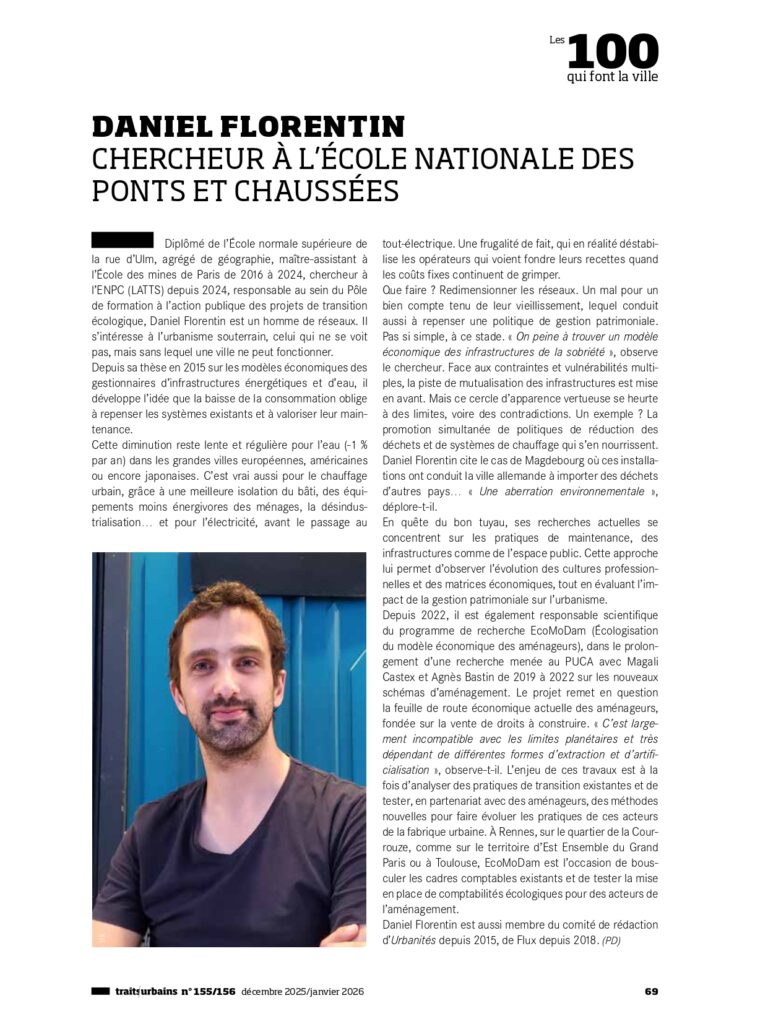
To purchase Traits Urbains magazine The "100 People Who Shape the City"
[su_spacer size="40"]

Réseaux No. 254 – "Alternative Internet(s)" – Issue coordinated by Stéphane Couture and Guillaume Latzko-Toth
[su_spacer size="40"]
SUMMARY OF THE "ALTERNATIVE INTERNET(S)" DOSSIER
Alternative Internet(s). Breaking free from the dominant Internet? By Stéphane Couture and Guillaume Latzko-Toth
[su_spacer size="20"]
Alternative Internet(s)
Bringing alternatives together. The case of the ActivityPub protocol By Stéphane Couture and Chanel Robin
Towards federated sovereignty? Mobilizing decentralized platforms for European digital autonomy By Ksenia Ermoshina and Francesca Musiani
The enterprise of the commons. The trajectory of relations between Wikimedia and Google By Nathalie Casemajor
Beyond the visible web. Underground markets and parallel digital ecosystems By Camille Roucher
What is "alternative" about alternative social media? By Roel Roscam Abbing and Robert W. Gehl
[su_spacer size="20"]
Feedback
De-Googling education? The cases of PeerTube and Celluloid as alternatives to YouTube By Laurent Tessier
[su_spacer size="20"]
Miscellaneous
Media trust: a socially and politically situated issue By Julien Boyadjian
Combating discrimination through digital technology? The promises and realities of scoring in social housing By Marine Bourgeois
[su_spacer size="20"]
Reading notes
Mathieu CORTEEL, Ni dieu ni IA. Une philosophie sceptique de l’intelligence artificielle (Neither God nor AI: A skeptical philosophy of artificial intelligence), Paris, La Découverte, 2025, 239 p. By Quentin Dufour
Hubert GUILLAUD, Algorithms Against Society, Paris, La Fabrique, 2025, 176 p. By Camille Girard-Chanudet
[su_spacer size="20"]
The PMMU research group is organizing a seminar on Friday, January 23, 2026, from 2:00 p.m. to 4:00 p.m. in room B235 (Bienvenüe Building) and via videoconference on Zoom.
On this occasion, Janaina Matoso Santos and Vinicius Nakama will present their thesis work, particularly that which they have carried out at LATTS since their arrival and as their stay draws to a close.
For those who are unable to attend in person, here is the link to the Zoom meeting: https://univ-eiffel.zoom.us/j/89170473121
Meeting ID: 891 7047 3121
Password: 94eh3Mw1
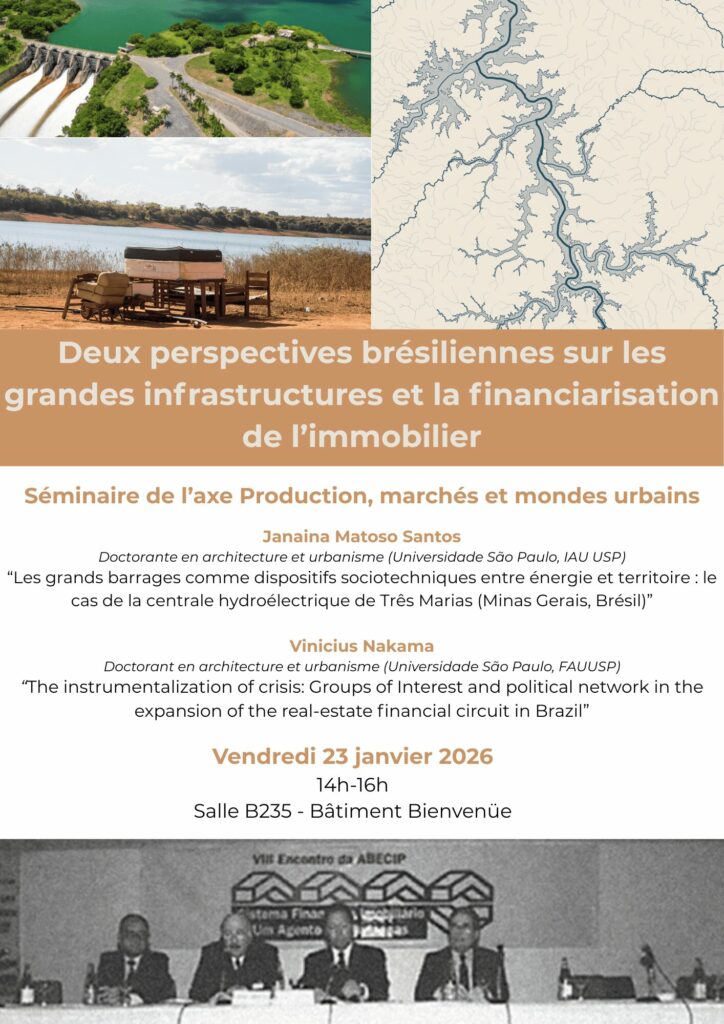
Large dams as socio-technical devices between energy and territory: the case of the Três Marias hydroelectric power plant (Minas Gerais, Brazil)
Abstract: The Três Marias Hydroelectric Power Plant (Minas Gerais State, Brazil) was built in the 1960s, at a time when Brazilian energy systems were being developed with a view to expanding industrialization. The large reservoir, covering an area of 1,040 km², flooded land that now belongs to eight municipalities with which it has had direct relations for six decades. This research examines how large dams operate over time through a dual relationship: (a) they are designed and operated as components of a large-scale energy system; and (b) once built, they function as devices for territorial reconfiguration at the local level, producing effects that are not always related to energy production. During the doctoral internship at LATTS, the aim is to broaden the theoretical and methodological basis of the ongoing research in order to refine the analyses of the effects of the Três Marias reservoir on neighboring municipalities and the ways in which these effects are linked to the energy system of which the power plant is a part. To this end, the literature on infrastructure that has developed mainly since the end of the 20th century, a period described by some authors as the "infrastructural turn" in the social sciences, will be mobilized. During the presentation at the PMMU seminar, this theoretical framework will be discussed, showing how it relates to the previous stages of the research.
The instrumentalization of crisis: Groups of Interest and political network in the expansion of the real estate-financial circuit in Brazil
Abstract: The research examines the institutionalization of real estate-based financial instruments in Brazil, with particular attention to periods of crisis. It posits that these instruments are not neutral but are shaped by situated sociopolitical processes that define their purposes. We argue that the design of these instruments, as the outcome of collective action by groups of interest within political and regulatory arenas, generates networks of influence and power in interaction with the state. At a more abstract level, these processes contribute to the assembly of a real estate-financial circuit. Methodologically, the study adopts a mixed-methods approach, combining critical literature review and documentary research with political network analysis. In doing so, it is expected to contribute to debates on financialization by showing how these instruments, anchored in the production of urban space, are crafted to circulate financial capital and overcome the limits of capital accumulation.
We look forward to seeing you for this scientific exchange.
The journal Réseaux is calling for submissions for a special issue on the topic of "Producing AI." This issue is coordinated by Olivier Alexandre and Bilel Benbouzid.
The text of the call for papers is available below and can also be found on the journal's website: Call for papers "Producing AI"
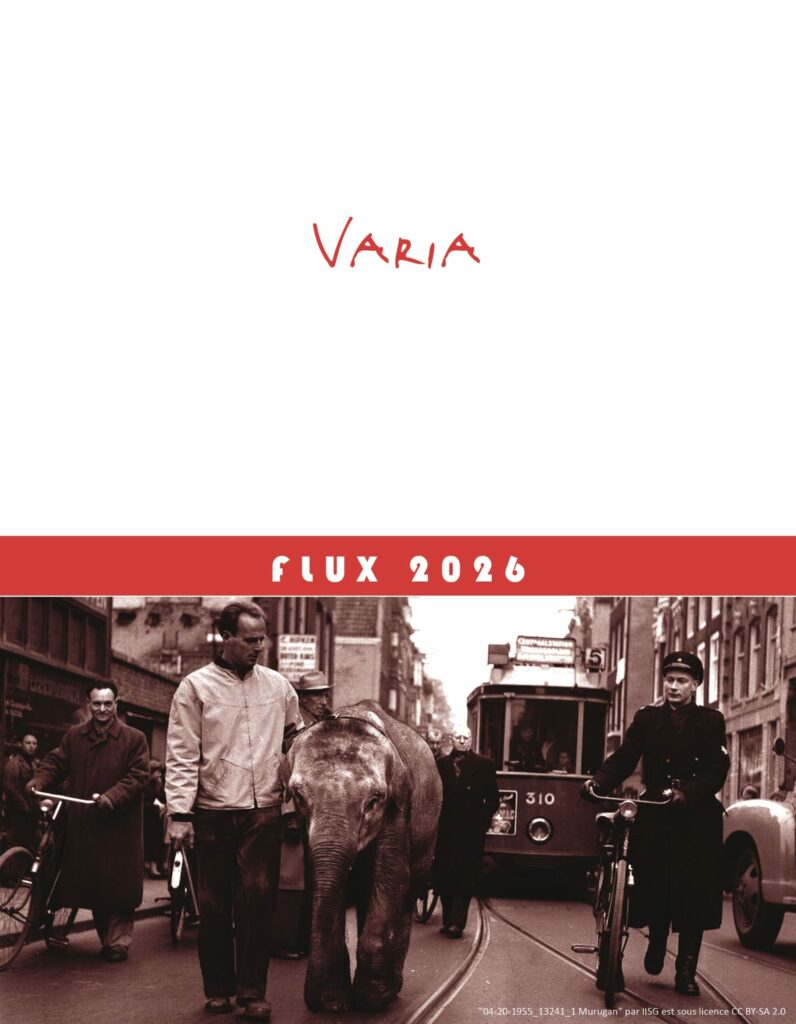
Flux Journal – "Advance Publications"
We are pleased to announce the release of a new issue of Flux magazine. This dossier, currently consisting of four articles, will be expanded throughout the year.
Summary of the "Advance Publications" section
The hinterland of French ports: dynamics and typology in a European context. By Arnaud Serry and Ronan Kerbiriou
The Grand Paris Express grapples with economic calculations. By Guillaume Louvet and Hadrien Commenges
The aesthetics of cycling and physical exertion. Materiality, affect, and the construction of gender identities in cycling magazines in Belgium, France, and Switzerland (1995-2020). By Claire Pelgrims
Spatio-temporal analysis of the return of cycling in French urban areas: the center/periphery gap in the eco-mobile transition. By Clément Dusong and Robin Puchaczewski
Reading Notes
Claire Larroque, Philosophy of Waste, Paris, PUF, 2024, 439 pp., by Kevin Caillaud
Hans Bernoulli, The City and Its Soil, Geneva, MetisPresses, 2025, 176 pp., by Petra Samaha
Stevenson Collective, Mappa Italiae, Marseille, Parenthèses, 2025, 192 pp., by Henri Desbois
Thesis supervisors: Nathalie Roseau (École nationale des ponts et chaussées) and Massimo Moraglio (Technische Universität Berlin)

This thesis examines the intertwining of transport infrastructure, spatial planning, and urban imaginaries in the production of metropolitan space, focusing on the case of Greater Paris. It argues that infrastructure is not only a technical artifact, but also a political and discursive instrument through which power, territory, and modernity are negotiated. The imaginaries of planning are understood here as collective visions and symbolic orders endowed with spatial force: they define boundaries, legitimize actions, and influence notions of justice and sustainability. Using discourse analysis, archival research, and field observation, this study traces how Greater Paris planning regimes have mobilized notions of density, compactness, and mobility to promote socio-spatial cohesion. From postwar new towns to the Grand Paris Express (GPE), these strategies have reinterpreted metropolitan integration through the transit-oriented development (TOD) model, while reproducing the persistent hierarchies between Paris and its suburbs. An in-depth case study in Bobigny shows how infrastructure interventions—metro extension, tram reactivation, new transport hubs—materialize these imaginaries while generating territorial tensions and forms of unequal development. A comparative reflection on the metropolitan region of Rome places these dynamics in a European context, highlighting the decisive role of institutional and political frameworks. Thus, justice and sustainability appear as contingent processes, resulting from historically situated struggles around territory and mobility. By highlighting the constitutive role of urban imaginaries in spatial practice, it repositions planning as a field of interpretation—a critical space that reveals both the aspirations and contradictions of contemporary metropolitan futures.
Defense on Monday, December 15, 2025
Year of enrollment: 2021
Doctoral school: VTT—City, Transportation, and Territories
Composition of the jury:
- Greet De Block, University Professor, University of Antwerp, Examiner
- Laurent Devisme, University Professor, École Nationale Supérieure d’Architecture de Nantes, Rapporteur
- Xavier Desjardins, University Professor, Sorbonne University, Rapporteur
- Martine Drozdz, CNRS Researcher, Maison Française d'Oxford / CNRS, Examiner
- Massimo Moraglio, Senior Researcher, Technische Universität Berlin, Co-supervisor
- Arnaud Passalacqua, University Professor, Université Paris-Est Créteil, Examiner
- Nathalie Roseau, University Professor, École Nationale des Ponts et Chaussées, Thesis Director