LATTS is pleased to invite you to the next session of its general seminar, which will take place on Monday, January 19, 2026, at 2 p.m. The session will focus on the book Sociologie des Gilets jaunes : reproduction et luttes sociales (Sociology of the Yellow Vests: Reproduction and Social Struggles), published by Éditions Le bord de l'eau in 2024. Antoine Bernard de Raymond and Sylvain Bordiec will present their book, followed by a discussion led by Claire Le Renard, before concluding with a Q&A session.
This session will take place in room B019 (Bienvenüe Building) and will be broadcast via videoconference. Zoom
link: https://univ-eiffel.zoom.us/j/87368732482
Meeting ID: 873 6873 2482
Password: LATTS2025
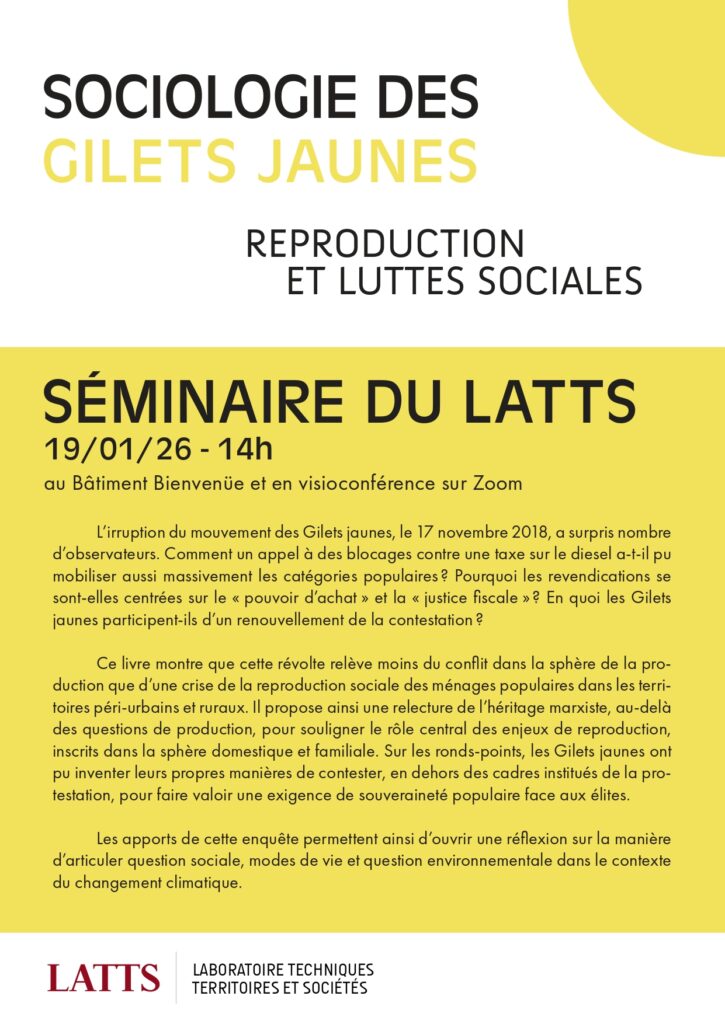
"The emergence of the Yellow Vests movement on November 17, 2018, took many observers by surprise. How could a call for blockades against a diesel tax mobilize the working classes on such a massive scale? Why did the demands focus on "purchasing power" and "tax justice"? How are the Yellow Vests contributing to a renewal of protest?
This book shows that this revolt is less about conflict in the sphere of production than a crisis of social reproduction among working-class households in peri-urban and rural areas. It thus offers a reinterpretation of the Marxist legacy, beyond questions of production, to highlight the central role of issues of reproduction, which are embedded in the domestic and family sphere. At the roundabouts, the Yellow Vests were able to invent their own ways of protesting, outside the established frameworks of protest, to assert a demand for popular sovereignty in the face of the elites.
The findings of this study thus open up a reflection on how to articulate social issues, lifestyles, and environmental issues in the context of climate change.
"This book takes a fresh look at the Yellow Vests movement and, more generally, at mobilizations in the name of purchasing power, showing how these popular revolts refer to social relations of reproduction rather than relations of production. It thus highlights the central role of the family, women, and intergenerational solidarity in the struggle against the high cost of living. Richly documented by a long-term study combining ethnography, interviews, and statistics, this book also shows the role of roundabouts in the dynamics of a movement without formal organization or official leaders. Finally, it discusses transition policies and the need to take into account the conditions of reproduction of the working classes in order to successfully green our societies."
Book Sociology of the Yellow Vests: Reproduction and Social Conditions
Thesis supervisors: Corinne Delmas (Gustave Eiffel University) and Flora Bajard (Research Fellow, CNRS)

This thesis questions the role of US universities in the division between fine art and folk art, and more specifically in the qualification and professionalization of artists. This analysis is based on the example of ceramists in the state of Georgia (in the southeastern United States), and my research is primarily based on semi-structured interviews with potters and sculptors, as well as observations of their workplaces. My research suggests a comparative dimension, highlighting the specificities of the cultural field in the United States, at the heart of which are universities.
My thesis takes a socio-historical approach, analyzing the evolution of ceramics in the context of the development of higher education in the 20th century, with the emergence of university folklore studies and art departments. It is organized into three main parts.
The first part is devoted to folk pottery, or artisanal pottery. It traces the settlement of potters in the 18th and 19th centuries in the Georgian countryside, their prosperity within this rural economy, and then their near disappearance in the 20th century. It shows how American universities helped elevate this type of pottery to the status of cultural heritage, while excluding potters who did not meet the criteria for traditional craftsmanship established by folklore specialists.
The second part focuses on the emergence of ceramic artists and their integration into universities. This development highlights the participation of women in the artification of ceramics, which gained momentum with the Arts and Crafts movement in the late 19th century. The first ceramicists joined art departments at the beginning of the 20th century, but the process of institutionalization intensified between 1945 and 1975. This latter period was marked by exponential growth in universities, largely due to a federal desire to democratize higher education. Like many other creators, ceramists working in faculties had to define their roles, outline their profession, and establish the boundaries that had to be crossed to become part of their group. Their integration into the academic world promoted their identification as artists and the recognition of their creations as works of art.
The third part is devoted to an analysis of the current structure of this professional space: with the decline in university budgets from 1975 onwards, becoming an art professor is an ideal achieved by only a privileged minority. These last two chapters seek to shed light on the diversity of positions that exist in this space, which is characterized by both close proximity between actors and fierce competition. Finally, the thesis concludes by outlining the values shared by ceramists, which originate from their common university education. It also shows how universities attract creators, who remain active thanks to campuses and their cultural institutes, staff, and students.
Defense on Monday, November 17, 2025
Year of enrollment: 2018
Doctoral school: OMI – Organizations, Markets, Institutions
Composition of the jury:
- Marc Perrenoud, Senior Lecturer and Researcher, University of Lausanne, Rapporteur
- Frédéric Poulard, University Professor, Paris Cité University, Rapporteur
- Sonia Birocheau, Associate Professor, University of Paris-Est Créteil, Examiner
- Elizabeth Browne, Assistant Professor, University of Georgia, United States, Examiner
- Alexandre Mathieu-Fritz, University Professor, Gustave Eiffel University, Examiner
- Corinne Delmas, University Professor, Gustave Eiffel University, Thesis Supervisor
- Flora BAJARD, Research Fellow, CNRS, Co-supervisor
Thesis supervisor: Sylvy Jaglin (Gustave Eiffel University)

This thesis analyzes the development of a very high-speed sociotechnical system (fiber optic network and data centers) and the urban transformations of a West African metropolis by examining the conditions and modalities of "digital urbanism" in Dakar (Senegal). The aim is to understand how digital infrastructure and urban spaces shape each other and to propose an interpretation based on materiality rather than overlooking inert materiality. Drawing on work from urban studies and social approaches to technology inspired by Science and Technology Studies (STS), the study focuses on the sociopolitical, sociotechnical, and territorial dimensions of the deployment of very high-speed broadband infrastructure, which it analyzes on three scales, corresponding to distinct spheres of action and temporalities, and in different types of intra-urban spaces. Using qualitative methodology (interviews, participant observation, mapping), the thesis demonstrates the ambivalent relationship between the privatized development of the ultra-high-speed socio-technical system and socio-spatial inequalities. At the national and metropolitan levels, it highlights the links between urban planning actors and powerful international telecommunications operators, as well as their respective influence on metropolitan digital development in a context marked by neoliberal policies. At the street level, it analyzes the role of network engineers and technicians, highlighting, through a study of construction sites and work "in situ," the role of material contingencies, informality, and sociotechnical "tinkering," but also that of "street" technical expertise, which is essential to the material development of ultra-high-speed infrastructure. The analysis of the governance of deployment, coupled with that of urban materiality and metropolitan socio-spatial developments, has made it possible to characterize a digital urbanism that differs according to urban profiles. However, while emphasizing the decisive influence of telecommunications operators and the insufficient capacity of public authorities to prescribe and regulate, the thesis identifies self-regulatory mechanisms that are sometimes beneficial to the general interest and mechanisms for partial catch-up in certain less "attractive" neighborhoods. These results lead to a nuanced view of the effects of the "privatization" of digital development on urban fragmentation and suggest areas for reflection for the public re-engagement of digital urban planning thinking and practice in Dakar.
Defense on Friday, January 31, 2025
Year of enrollment: 2019
Doctoral school: VTT – City, Transportation, and Territories
Composition of the jury:
- Olivier Coutard, Director of Research, CNRS, Chair of the jury
- Sylvy Jaglin, University Professor, Gustave Eiffel University, Thesis Director and Examiner
- Fanny Lopez, University Professor, ENSA Paris-Malaquais, Examiner and Rapporteur
- Armelle Choplin, University Professor, University of Geneva, Examiner and Rapporteur
- Elisabeth Peyroux, Director of Research, CNRS, Examiner
- Momar Diongue, Senior Lecturer, Cheikh Anta Diop University of Dakar, Examiner
Thesis supervisors: Valérie November and Olivier Borraz (CNRS)

Crisis management exercises, inherited from the military world, are now common practice in civil society. In recent history, their number and visibility have increased considerably in the context of the state's response to the 2015 attacks. They are thus one of the main tools used by crisis management organizations to prepare for events that threaten the population. To fulfill this mission, the exercises are designed to be as realistic as possible, with the dual objectives of training and identifying weaknesses in crisis management systems that need to be corrected. However, observation of the exercises organized by the General Secretariat of the Paris Defense and Security Zone—a department of the Prefecture of Police—only allows for partial verification of these objectives. To explain this apparent difficulty, it is necessary to consider the overlap of two missions assigned to the exercises. The first, official mission focuses on protecting the population. The second, latent but priority, is to protect the State, whose legitimacy and very identity – based precisely on the protection of the population – are called into question by the occurrence of crises.
Defense on Wednesday, December 18, 2024
Year of enrollment: 2015
Doctoral school: VTT – City, Transportation, and Territories
Composition of the jury:
- Pascal Ughetto, University Professor, Gustave Eiffel University, Chair of the jury
- Valérie November, Director of Research, CNRS, Thesis Director and Examiner
- Olivier Borraz, Research Director, CNRS, Thesis Director and Examiner
- Myriam Mokhtari Merad, Research Director, CNRS, Examiner and Rapporteur
- Paolo Crivellari, Senior Lecturer, University of Toulouse 3, Examiner and Rapporteur
- Marie-Léandre Gomez, Professor, ESSEC, Examiner
As part of the Tripode working group (Digital Transitions – Regulations, Infrastructure, Practices, Data), we are organizing a seminar on Thursday, December 18, 2025, from 9:30 a.m. to 12 p.m., dedicated to the theme of platformization in the mobility sector. The seminar, which will take place in room A421 (LVMT, Bienvenue Building), aims to fuel our collective thinking on the restructuring of urban services and infrastructure in the digital age.
We will have the pleasure of listening to and discussing the following three presentations:
- Guillaume Fournier (Latts): Changes in the French model of urban services in the smartphone era: towards platformization of organization?
- Timothée Mangeart (LVMT): Self-service: an observation post for changes in urban mobility services?
- Virginie Boutueil (LVMT): Growth and competition dynamics of digital shared mobility platforms on a global scale
These three presentations will analyze the gradual institutionalization of platforms in the field of mobility, exploring different facets of this process and its effects. Based on an analysis of the development of self-service in the Paris region, Timothée Mangeart highlights the dualization of mobility policies and the challenge of controlling street space in order to regulate new mobility services. By studying the case of Keolis, Guillaume Fournier focuses his analysis on the restructuring of urban service models. While this is a destabilizing factor, he demonstrates that, paradoxically, digital technology is strengthening the historic partnership between public transport authorities and private operators through a process of platformization of urban service organization. Finally, Virginie Boutueil will present the latest findings from the Global Observatory of Digital Shared Mobility Platforms, which, since 2018, has been analyzing their growth, their distribution across different geographical scales, the services offered to users, and the forms of competition at work in the markets in which they operate.
For those who are unable to attend in person, here is a Zoom link to watch the session.
https://univ-eiffel.zoom.us/j/84400668012?pwd=QO2s57RlxgvRnKnbNHQKEyU3ab5OUQ.1
Meeting ID: 844 0066 8012
Password: 897zbJ5q
LATTS is pleased to announce that Mariana Reis Santos' doctoral thesis defense will take place on Monday, December 15, 2025, at 2:00 p.m., in room V404 of the École nationale des ponts et chaussées (ENPC), on the Cité Descartes campus. Her thesis in urban planning and spatial development is entitled:
"A Region in Motion: Imaginaries of Planning, Justice, and Experienced Mobility in Greater Paris since the 1960s"
This research was conducted at LATTS and within the "City, Transportation, and Territories" doctoral school, under the supervision of Nathalie Roseau and co-supervision of Massimo Moraglio.
The jury will be composed of:
- Greet DE BLOCK, Professor, University of Antwerp (Examiner)
- Laurent DEVISME, Professor, École Nationale Supérieure d'Architecture de Nantes (Rapporteur)
- Xavier DESJARDINS, Professor, Sorbonne University (Rapporteur)
- Martine DROZDZ, CNRS Researcher, Maison Française d'Oxford / CNRS (Examiner)
- Massimo MORAGLIO, Senior Researcher, Technische Universität Berlin (Co-supervisor)
- Arnaud PASSALACQUA, Professor, Université Paris-Est Créteil (Examiner)
- Nathalie ROSEAU, Professor, École nationale des ponts et chaussées (Thesis Director)
Abstract:
This thesis examines the intertwining of transport infrastructure, spatial planning, and urban imaginaries in the production of metropolitan space, focusing on the case of Greater Paris. It argues that infrastructure is not only a technical artifact, but also a political and discursive instrument through which power, territory, and modernity are negotiated. The imaginaries of planning are understood here as collective visions and symbolic orders endowed with spatial force: they define boundaries, legitimize actions, and influence notions of justice and sustainability. Using discourse analysis, archival research, and field observation, this study traces how Greater Paris planning regimes have mobilized notions of density, compactness, and mobility to promote socio-spatial cohesion. From postwar new towns to the Grand Paris Express (GPE), these strategies have reinterpreted metropolitan integration through the transit-oriented development (TOD) model, while reproducing the persistent hierarchies between Paris and its suburbs. An in-depth case study in Bobigny shows how infrastructure interventions—metro extension, tram reactivation, new transport hubs—materialize these imaginaries while generating territorial tensions and forms of unequal development. A comparative reflection on the metropolitan region of Rome places these dynamics in a European context, highlighting the decisive role of institutional and political frameworks. Thus, justice and sustainability appear as contingent processes, resulting from historically situated struggles around territory and mobility. By highlighting the constitutive role of urban imaginaries in spatial practice, it repositions planning as a field of interpretation—a critical space that reveals both the aspirations and contradictions of contemporary metropolitan futures.
Keywords: imaginaries of planning; transit-oriented development (TOD); socio-spatial justice; metropolitan governance; Greater Paris
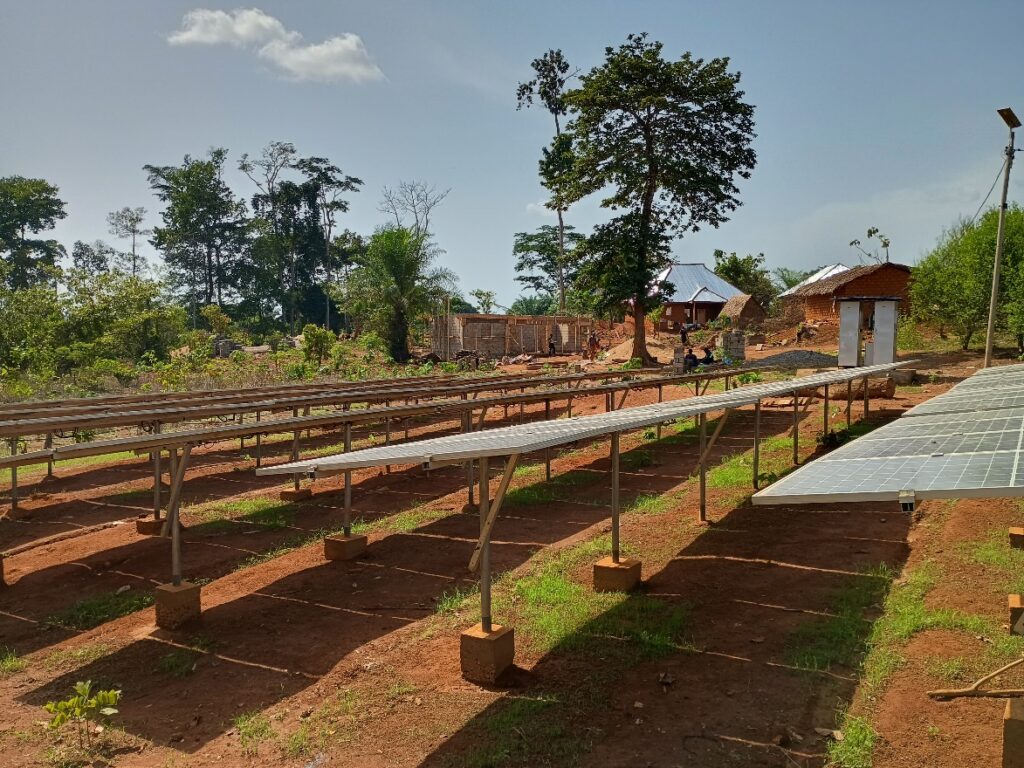
The PMMU research group is organizing a seminar on Friday, December 12, 2025, from 2:00 p.m. to 4:00 p.m. in room B235 (Bienvenüe Building) and via videoconference on Zoom.
Théo Baraillé, a doctoral student at LATTS, and Alix Chaplain, a lecturer at Sciences Po Saint-Germain-en-Laye, will present their work on the themes of the (re)deployment of the electricity grid, the energy transition, and the Global South, with two original approaches, one based on the sociology of work and the other on forms of domination and infrastructural power.
Their presentations are entitled:
- What can work tell us about electrical infrastructure in Cameroon and Madagascar?
- Infrastructural transformations and markets associated with the "energy transition" in the study of political and territorial restructuring of the Lebanese state (some post-thesis hypotheses)
For those who are unable to attend in person, here is the link to the Zoom meeting: https://univ-eiffel.zoom.us/j/83257792936
Meeting ID: 832 5779 2936
Password: xUBymyn7
We look forward to seeing you for this scientific exchange.
A review by Gilles Pinson of the book "Vers un nouvel agir métropolitain" (Towards a New Metropolitan Approach) has just been published in the journal Métropoles. This book by Yoan Miot, Nadia Arab, and Gilles Crague was published by Presses des Ponts in 2023. Link to Gilles Pinson's review in Métropoles
Link to the Presses des Ponts website – Vers un nouvel agir métropolitain
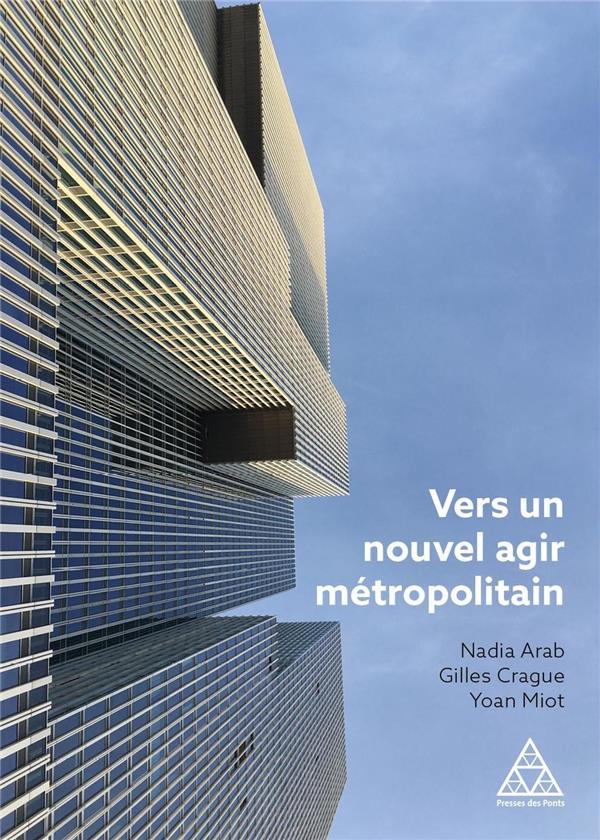
"Metropolization is not a natural phenomenon, but rather the result of private and public decisions. To this end, public actors, the operators of metropolization, have developed a metropolitan approach, i.e., a set of doctrines, public policies, and operational actions. This metropolitan action is based on convictions about the benefits of metropolitanization (creation of wealth and jobs) and its knock-on effects. However, while metropolitanization has produced many of the expected effects, cities today find themselves in a situation where metropolitanization and its benefits coexist with worsening crises. As a result, public actors are taking a different approach to metropolitan action. It is no longer (or no longer solely) a question of supporting metropolitanization, but of ensuring the sustainable functioning of the metropolitan urban areas that they have helped to create and which are now recognized as a problem. Neither a critical-normative discourse nor an alternative narrative, the book draws on a review of thirty years of actions in favor of metropolitanization to examine not what should change but what is changing in response to the problems of metropolitan areas. It argues that metropolitan public action, metropolitan action, is being (re)constructed in and from operational practices, highlighting the innovations underway but also the difficulties to be overcome in order to act. The book explores this moment of bifurcation by focusing on the issues that have been at the heart of metropolitan development and are now being re-examined: employment, living environment, commercial real estate, and economic development. The turning point that is emerging amounts to a considerable shift in perspective, objectives, planning and operational practices, as well as a shift in the classification of strategic activities and jobs, and even in what constitutes a good quality of life.
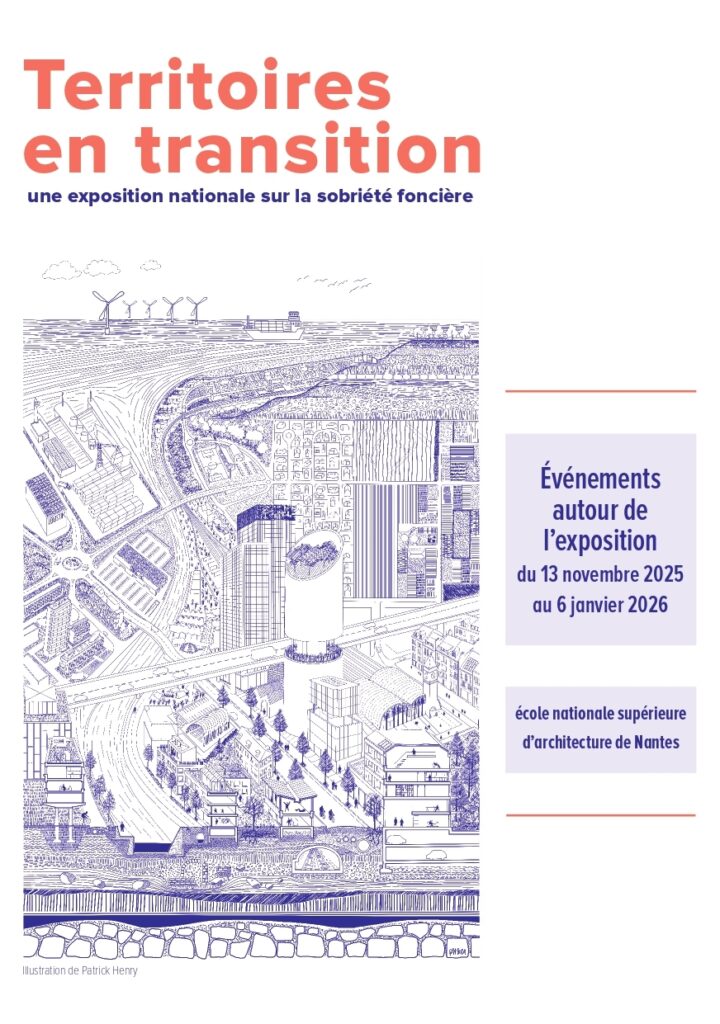
Claire Simonneau will give a lecture at the national exhibition on land use restraint, "Territoires en transition" (Territories in Transition), hosted by ENSA Nantes and the Pays de la Loire Regional Directorate for Environment, Planning, and Housing (DREAL).
The lecture will focus on the "Commodification/Decommodification of Land Rights in the South," a discussion of land use efficiency based on West Africa.
The conference will take place on Tuesday, November 9, 2025, at 6:30 p.m. in the auditorium at Ensa Nantes (access via Quai François Mitterrand).
LATTS is pleased to invite you to the next session of its general seminar, which will take place on Monday, December 15, 2025, at 2 p.m. The session will focus on the book Sociologie des circuits financiers. Les infrastructures de l'argent et leurs politiques (Sociology of Financial Circuits: The Infrastructure of Money and Its Policies), published by Presses universitaires du Septentrion in March 2025. Eve Chiapello and Alexandre Violle will present their book, followed by a discussion led by Hélène Ducourant and Ludovic Halbert, before concluding with a Q&A session.
This session will take place in room B019 (Bienvenüe Building) and will be broadcast via videoconference. Zoom
link: https://univ-eiffel.zoom.us/j/86568678333
Meeting ID: 865 6867 8333
Password: LATTS2025
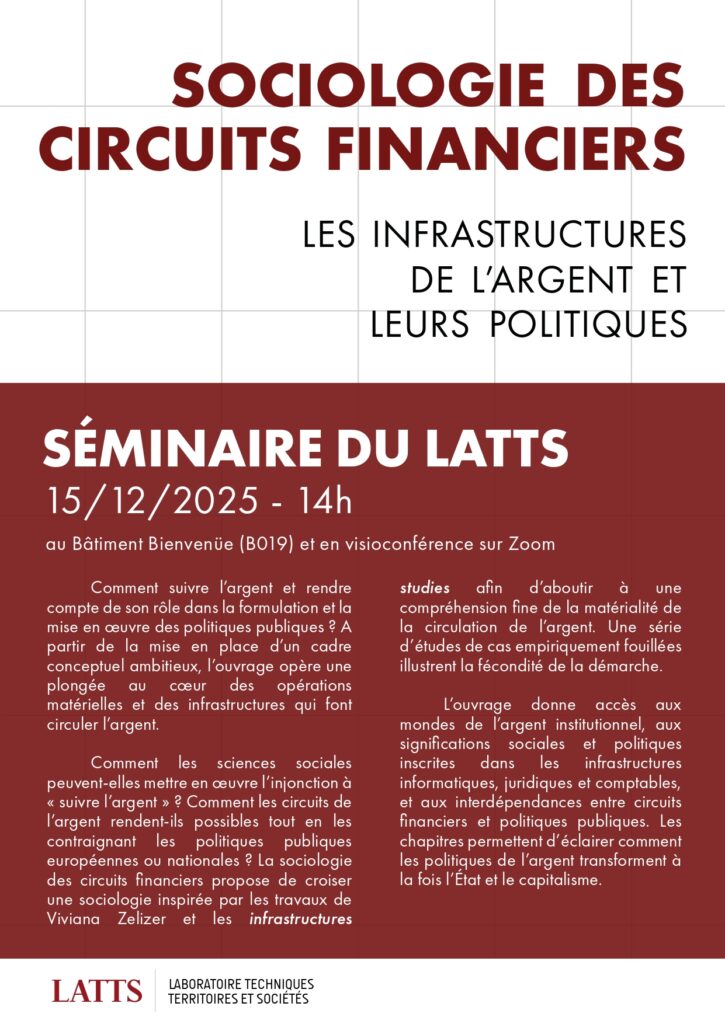
"How can we track money and account for its role in the formulation and implementation of public policy? Based on an ambitious conceptual framework, this book delves into the heart of the material operations and infrastructures that make money circulate.
How can the social sciences implement the injunction to 'follow the money'? How do money circuits enable and constrain European or national public policies? The sociology of financial circuits proposes to combine a sociology inspired by the work of Viviana Zelizer with infrastructure studies in order to arrive at a detailed understanding of the materiality of money circulation. A series of empirically researched case studies illustrate the fruitfulness of this approach. The book provides access to the worlds of institutional money, the social and political meanings embedded in IT, legal, and accounting infrastructures, and the interdependencies between financial circuits and public policies. The chapters shed light on how money policies transform both the state and capitalism.
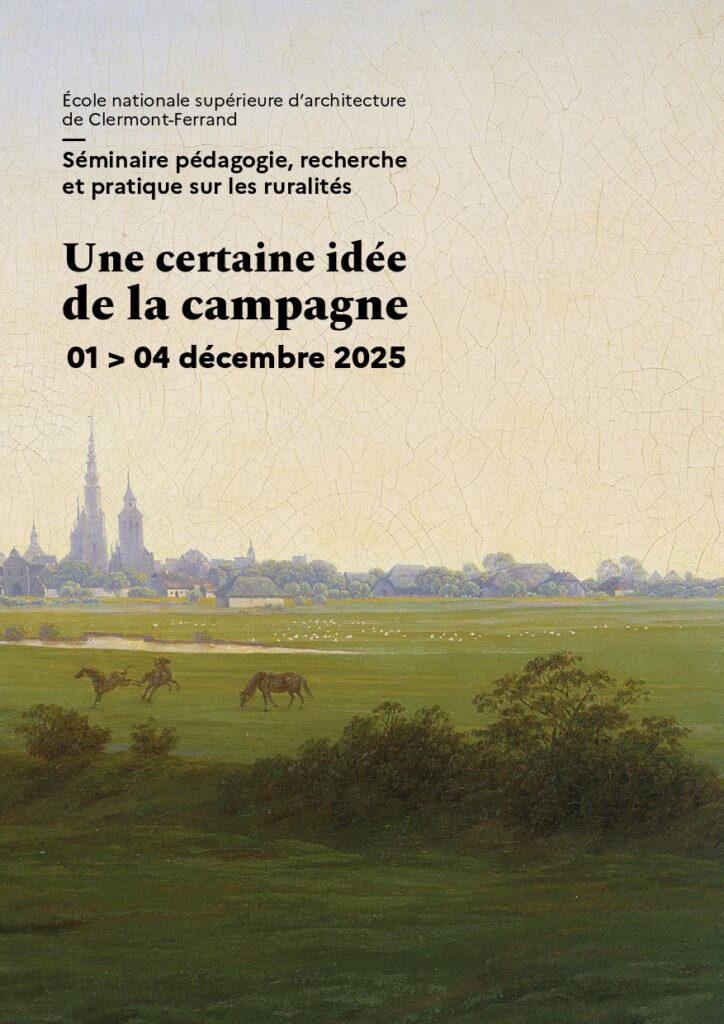
Yoan Miot will participate in the round table discussion "Transforming the Existing" to be held during the seminar on rurality "A Certain Idea of the Countryside" organized by the École Nationale Supérieure d'Architecture de Clermont-Ferrand.
He will present his work carried out as part of an action research project funded by the POPSU Territoires program with Sarah Dubeaux and Claire Butty on the treatment of vacancy in the Livradois-Forez Regional Nature Park and the Ambert Livradois Forez Community of Municipalities.
The round table will take place on Thursday, December 4, 2025, from 1:30 p.m. to 3:30 p.m. at ENSACP. To register for the seminar
Christine Fassert and François-Mathieu Poupeau contributed to the Dictionnaire d'écologie politique (Dictionary of Political Ecology), published on October 17, 2025, by Presses de Sciences Po.
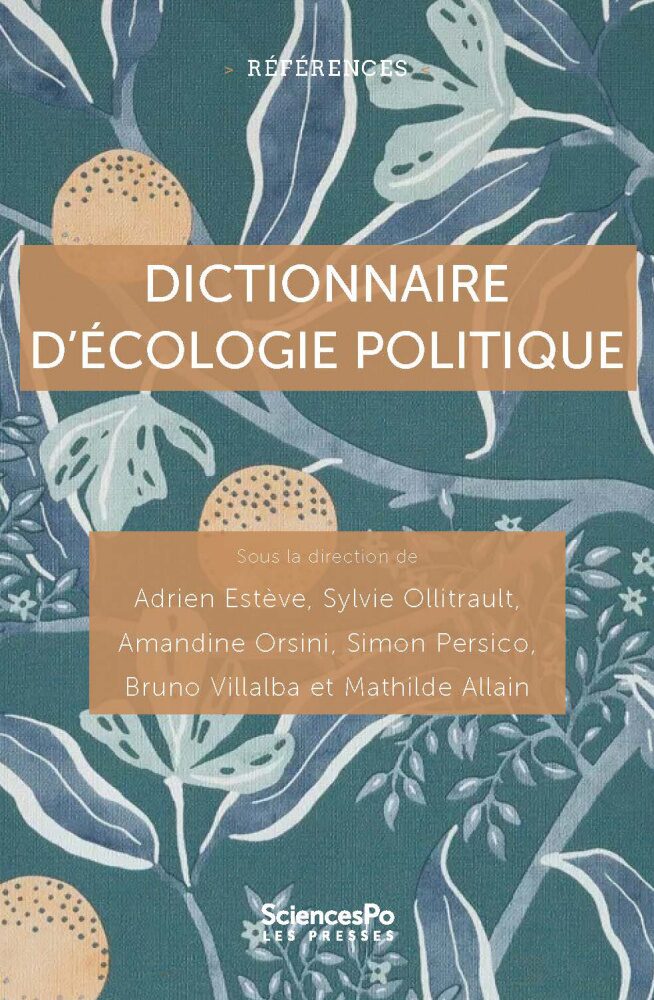
With over a hundred entries written by nearly 150 researchers, this dictionary reflects the wealth of work devoted to political ecology and its relevance in deciphering the contemporary transformations of our societies.
From "Agriculture" to "Sacrifice Zone," it presents the plurality of concepts, ideas, and findings developed by political science and related disciplines to reflect on the relationships between humans and their environment, showing their evolution and political consequences. Revealing the liveliness of scientific debates, often linked to social and political issues, it contributes to broadening the scope of reflection on ecology as we enter a period of radical uncertainty about the effects of environmental crises.
Christine Fassert co-authored the chapter "Nuclear/Anti-Nuclear" with Sezin Topçu.
The nuclear industry is one of the few techno-industrial sectors that has been the subject of sustained controversy since its inception. As a result, its history has been marked by evolving technologies of governance and constantly changing relationships between the state, industry, ecology, and society.
François-Mathieu Poupeau co-authored the chapter "Instruments" with Marie Hrabanski and Antoine Ducastel.
In their reports on the fight against climate change and the protection of biodiversity, often presented as two major pillars of environmental policy, the Intergovernmental Panel on Climate Change (IPCC) and the Intergovernmental Science-Policy Platform on Biodiversity and Ecosystem Services (IPBES) devote considerable space to public policy tools. This mobilization, often for the purposes of "good governance," should not reduce the approach to instruments to its normative dimension of collective decision-making support. As understood by many political scientists since the 1980s (Lascoumes and Le Galès, 2004), this approach also takes a more analytical, even critical, perspective, viewing instruments as markers of the relationships between rulers and ruled and of the political, economic, and social choices and effects that underlie them. In doing so, the instrument-based approach intersects with debates in political ecology. Without claiming to exhaust all the points of convergence between these two fields of study, this note seeks to outline some of the lines and axes of a dialogue that appears to be most fruitful and thus to strengthen political ecology, through instruments, in countries in the North and South.