Agathe Euzen will participate in this forum on June 5 and 6, 2018, in New York.
Information: http://www.cnrs.fr/inee/communication/STI_FORUM_2018.html
Félix Adisson is organizing this workshop, which will take place on:
June 28-29, 2018
Université Paris Est
Labex Futurs Urbains – Urban Production and Markets Working Group
Thursday, June 21, 2018, from 9:30 a.m. to 5:00 p.m. at the École d'architecture de Paris Belleville, 60 boulevard de Belleville, 75019 Paris, Room 12.
This workshop, of which Nathalie Roseau is a member of the cross-disciplinary group, proposes to examine three questions.
The first question concerns the existence of the plan. Under what conditions does the need for a plan arise? What questions and collaborations lead to its development and implementation? How does it relate to public policy?
The second question concerns the plan as a document. How can we grasp the contours of a plan? And how do they inform metropolitan development conditions? How does it circulate and what does it communicate?
The third question concerns the temporality of the plan. What is its future once it has been approved? How long does the plan last in the context of a long sequence of metropolitan development? How does the very notion of a plan change over the course of metropolitan development?
This workshop is divided into two sessions, the first on the necessity of the plan in relation to action, and the second on the materiality of the object to be read and its territorialization. The speakers—Emmanuel Bellanger, Angelo Bertoni, Denis Delbaere, Corinne Jaquand, and Arnaud Passalacqua—will revisit different moments, specific experiences (Paris, Lille, Nancy, Luxembourg, and Rome), and perspectives (transportation, landscape, urban planning).
Due to limited space, registration for the seminar is mandatory.
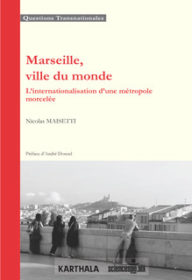
Nicolas Maisetti
Marseille, City of the World. The Internationalization of a Fragmented Metropolis.
Karthala, 2017, 316 p.
In a context of intensifying international competition between territories, cities are vying with each other to develop strategies to increase their influence and improve their attractiveness. Marseille is no exception to this rule. This book analyzes the international policies aimed at promoting a new image of Marseille as a welcoming city for investors, tourists, and organizers of cultural and sporting events.
What aspects of Marseille are being promoted to project the city and its territory beyond local and national borders? What links is the municipality forging with its foreign counterparts? How does the Region promote its interests in Brussels and secure European funding? What is at stake in hosting a World Bank branch in Marseille? What are the effects of bidding for an international event on the restructuring of urban powers?
The book answers these questions and analyzes the conditions for the internationalization of Marseille, a fragmented metropolis.
Nicolas Maisetti is a contract researcher at the Laboratoire Techniques, Territoires et Sociétés (LATTS), where he works on issues of urban production and local public action. He is the author of
Opération culturelle et pouvoirs urbains (L’Harmattan, 2014), a book about Marseille-Provence European Capital of Culture 2013.
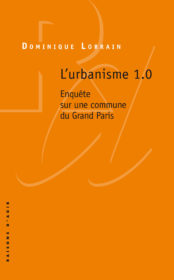
Dominique Lorrain
Urban Planning 1.0. Investigation of a Greater Paris municipality.
Raisons d'agir, 2018, 232 p.
With Greater Paris, construction has taken off again: housing, facilities, infrastructure. This book offers an interpretation of the transformations taking place in a municipality in eastern Paris based on a "political economy of detail." Thanks to a meticulous study combining several points of view, it moves beyond the big picture to explain how the city is changing through a series of operations which, when repeated, modify a street or a neighborhood and reshape it. It shows how history is written and what the impacts are for residents.
What are the effects of densification that reduces green spaces and does not take into account roads, parking, and facilities? This informative book also sheds light on several general issues. It questions the management of housing policy in Greater Paris. It questions the role of elected officials 35 years after decentralization. By studying several operations, it sheds light on the concepts of asymmetry between developers and residents and the "capture" of elected officials, revealing levels of profits and rents. Through a series of short but significant stories, it demonstrates that change cannot happen without vision and without the "right institutions." Ultimately, it helps to gauge the scale of the task ahead in designing "sustainable cities."
Tuesday
, April 10, 2018
, from 10:00 a.m. to 1:00 p.m. at the Ecole des Ponts ParisTech building (Belgrand Wing, 2nd floor, room B202) (more…)
As part of the Labex Futurs Urbains "City and Energy
" network, Sylvy Jaglin and Marika Rupeka are co-organizers of this study day entitled "Electrical Hybridizations and Diffuse Cities
."
Find out more about the Transversal Group: City and Energy:http://www.futurs-urbains.fr/groupes-transversaux/les-groupes-transversaux-du-labex/groupe-transversal-ville-et-energie/

LATTS welcomes Bruno Barroca as part of a CNRS delegation.
Bruno Barroca is a geomatics engineer, DPLG architect, and lecturer since 2007 at Lab'Urba (UPEM). He is interested in urban risks, particularly in post-crisis situations and urban design. His research focuses on unique environments such as underground spaces and areas subject to natural or technological risks.
He has participated in various national ANR and PN projects, as well as European projects, and led the Mécadépi project on the characterization and assessment of post-flood waste deposits (funded by the European Regional Development Fund – ERDF).
He has participated in numerous scientific committees, notably that of the General Secretariat of the Paris Defense and Security Zone in 2016, and chaired the scientific committee for the call for proposals (ANR-BMBF) on the future of security in urban spaces.
He leads the "resilience in action" seminar and co-directs the LABEX Futurs Urbains cross-disciplinary "risk" group with Valérie November.
Since 2002, his research has focused primarily on the vulnerability and resilience of territories subject to natural risks.
He is currently an elected member of the National Council of Universities in the "spatial planning and urbanism" section.
Networks in peril: destruction, subversion, and sabotage (19th-21st centuries)
Benjamin G. Thierry and Valérie Schafer (eds.)
From the appearance of the word sabotage
in France at the end of the 19th
century and its theorization, notably by Émile Pouget (Albertelli, 2016), to recent cyberattacks, including the destruction of communication routes during wartime, networks share a large number of common vulnerabilities despite their diversity (information and communication, energy, banks, transportation, engineering structures, etc.). In this respect, they are a prime target because of what they represent or the organization they support.
Are networks subject to a particular form of misotechnology
(Jarrige, 2016)? Do they have specific vulnerabilities that need to be guarded against (Baran, 1964; Abramovici, Bradley, 2009), and how are these negotiated, assessed, and managed? What roles do networks play as targets or objectives in conventional and unconventional conflicts (Kempf, 2014; Pinsolle, 2015)? Have the targets, issues, and actors fundamentally changed over time (Pasquinelli, 2010), and do they differ according to the scale and scope of intervention?
This issue of Flux
aims to take an interdisciplinary look at projects and acts of destruction, subversion, and sabotage of networks, as well as past and present vulnerabilities and attempts at specific protection measures.
Find out more about Flux magazine: http://www.cairn.info/revue-flux.htm
Calendar May 15, 2018
Submission of proposals (an abstract accompanied by a bibliography and a short biography of the author)
Abstracts should be sent to:
June 15, 2018
Feedback to authors (an invitation to submit a full article does not guarantee its final acceptance, which is subject to double review)
October 15, 2018
Submission of full text (50,000 characters including spaces)
References
Abramovici M., Bradley P., 2009, Integrated circuit security: new threats and solutions, in: Sheldon F., Peterson G., Krings A., Abercrombie R., Mili A. (Eds.), Proceedings of the 5th Annual Workshop on Cyber Security and Information Intelligence Research: Cyber Security and Information Intelligence Challenges and Strategies
(CSIIRW '09), New York: ACM.
Albertelli S., 2016, Histoire du sabotage. De la CGT à la Résistance
, Paris: Perrin.
Baran P., 1964, On distributed communications. Introduction to distributed communications networks
, August 1964 – Rand Corporation, Online archives.
Jarrige F., 2016, Technocritiques
, Paris: La Découverte.
Kempf O., 2014, Thinking Networks: A Strategic Approach
, Paris: L’Harmattan.
Pasquinelli M., 2010, The Ideology of Free Culture and the Grammar of Sabotage, Policy Futures in Education
Vol 8, Issue 6, pp. 671-682.
Pinsolle D., 2015, From slowdown to derailment: the development of sabotage in France (1897-1914), History, Economy & Society
, vol. 34th year, no. 4, pp. 56-72.
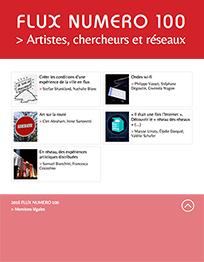
It can be accessed via the link: http://www.flux100.cnrs.fr/
.
Several conversations/interviews have been compiled and already form a wonderful collection that is just waiting to be completed!
(see here: http://www.flux100.cnrs.fr/spip.php?rubrique1
).
Contact: aurelie.bur@enpc.fr