In an interview with Le Monde on Tuesday, March 29, 2022, Gilles Jeannot explains how the use of tools such as Uber, Doctolib, and Airbnb interferes with public policies on roads, housing, health, and more.
is organizing study days on March 28 and 29, 2022 (Amphitheater of the Georges Pérec Library, Champs-sur-Marne) on the theme: What interdisciplinary advances have been made in the field of risks and crises? A look back at the UrbaRiskLab experience
The importance of studying risks and crises in urban environments is well established: all crises—whether related to natural, climatic, chemical, or pathogenic hazards, economic or societal, whether planned or unplanned, of exceptional magnitude or low-key, slow or fast-moving—generate significant scientific, technical, organizational, and political uncertainties. Crises raise crucial questions not only in terms of preparedness and emergency response, but also in terms of monitoring (sensors or warning centers), modeling and data processing tools, anticipation of cascading effects, and information flow in degraded situations. The recent pandemic has brought this home to us in a very acute way. The UrbaRiskLab (URL) project is an experimental initiative designed to generate new ideas for research, collaboration, prototypes, tools, etc. To this end, it draws on a consortium of researchers from a variety of research backgrounds (hard sciences, engineering sciences, social sciences) working on a wide range of risks, scales, and methods.
These study days were organized in two parts. The first part was devoted to presenting some of the research results produced during these four years of experimentation. The second part took a broader approach, offering a critical reflection on interdisciplinary practices in the field of risks and crises, in terms of both research and training.
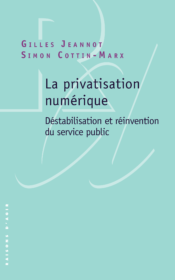 Digital privatization. Destabilization and reinvention of public services
Gilles Jeannot, Simon Cottin-Marx
Raisons d'agir, 2022, 160p.
The development of digital technology is bringing about a form of privatization of public action that is not openly acknowledged: the most powerful private digital companies are taking over activities that were previously the preserve of the public sector: in transportation (Ouibus, passenger information), urban services (smart cities), the use of public space (electric scooters), and even certain regulatory functions (traffic assistance). The computerization of public administrations, the development of online services, and the presence of public services on the internet have been achieved by outsourcing these systems to private companies. The private sector's current conquest of the public sphere is of a completely different nature: it is based on a transformation of the relationship between the state and users (simplification of relations with users, often by replacing public officials with algorithms, widespread use of rating mechanisms, development of the Uberization of tasks). This process is supported, on the one hand, by enormous investment capacities that exceed those of public authorities (engineering, data centers) and, on the other hand, by monopolies that hold powerful patents. Although this privatization often goes unnoticed, as it takes the subtle form of very practical tools that improve our daily lives, its social effects are nevertheless considerable: it destabilizes businesses and administrations, reinforces social inequalities, preempts commons, and accelerates the loss of public sovereignty. Public authorities may mobilize various resources (competitive supply, regulation, etc.), but they too often appear powerless in the face of such a process, which operates on an international scale (GAFA). However, attempts by ordinary citizens to reclaim digital commons are opening up new perspectives, sometimes in the form of activism by civil servants who defend national "digital sovereignty." The purpose of this book is to reveal the real economic and technical consequences of this privatization behind the appealing apps on our smartphones and to show the prospects for resistance and reinvention of public service.
The theme of this session will be: Fiction based on the city. A look back at two writing experiences.
Elsa Vivant and Christian Lefèvre will present their latest works:
 L’impasse Scènes de l’urbanisme ordinaire (Dead End: Scenes from Everyday
Urban Planning)
Créaphis Editions, 2021, 212 p.
Link: http://www.editions-creaphis.com/fr/catalogue/view/1254/l-impasse/?of=4

Ma vie rouge. Meurtre au Grand Paris
(My Red Life: Murder in Greater Paris) Pierre Mansat, Christian Lefèvre PUG, 2021, 180 p.
Negotiated biodiversity. Urban planning faces the challenge of implementing the Avoid-Reduce-Compensate sequence
Keywords: ACR sequence, ecological compensation, urban planning, land use, negotiations, biodiversity.
Introduced in France in 1976, the Avoid-Reduce-Compensate (ERC) sequence imposes significant constraints on land use planning. This mechanism adds an extra step to the planning process, involves intermediaries, and even partially transforms the planning project. Given that ecological compensation is specific in that it is compensation in kind, it also has significant spatial implications, particularly on local land transactions (both within and outside the market). As a necessary element for the implementation of compensation, land is de facto placed at the forefront. In fact, compensation sites are created, with a new use in the medium or long term. Local development conditions are then modified.
This research examines the application of the ERC sequence as a public policy mechanism, analyzing the strategies and practices of actors in the field who are dealing with the constraints imposed by the standard.
To study the transformations introduced by this regulatory constraint, a process-based approach has been adopted, focusing on three main stages: the construction of the standard itself (the "regulation"), its translation into an operational instrument through the establishment of equivalence agreements (the "equivalence"), and its integration into the development and land market (the "marketing"). Each of these three stages has an impact on the production of space and creates a constraint on future developments.
Analysis of these processes reveals the discrepancies between the general objectives of the standard and its operational implementation, which tends to reduce and impoverish the components of biodiversity taken into account. The thesis focuses on the negotiations and power relations that influence the operationalization of the system, as well as the operations to reduce the definition of biodiversity considered at each of the three stages. These interpretations and adaptations are necessary given the difficulties practitioners encounter in applying the standard. In addition to the difficulty of understanding biodiversity, practitioners are confronted with the harsh reality of land use, which leads some actors (project owners, intermediaries, landowners) to change their land use strategies.
This work, using a qualitative methodology, is based on several empirical materials: extensive exploratory fieldwork that helped to clarify the central question and hypotheses of this research, interviews with project owners, intermediaries, and government departments, and a case study of two development projects in a medium-sized French city.
Olivier Coutard, Director of Research at the CNRS, Thesis Supervisor
Nathalie Frascaria-Lacoste, Professor at AgroPrisTech, Examiner
Harold Levrel, Professor at AgroParisTech, Examiner
Sylvain Pioch, Senior Lecturer (HDR), University of Montpellier III
The PMMU research group is organizing a seminar on Monday, March 7, 2022, at 10:00 a.m.
Jean-Pierre Lévy will present the topic:
How is the issue of risk linked to that of security? How does this continuum unfold?
and Alin Karabel (UGE, LATTS-CNRS), with the assistance of Emmaüs France, Crésus Alsace, the Red Cross, Secours Catholique, and the Credit and Debt Observatory, will present the report Prisoner Debt: An Overview
.
How is it that many prisoners end up accumulating debts and unpaid bills? What do we know about the extent and composition of this debt? How can it be dealt with in prison? What are the obstacles to accessing the over-indebtedness procedure? Based on a survey of social workers, volunteers working in prisons, legal experts from legal aid centers, and staff from the prison administration, the Ministry of Justice, and the Bank of France, the report provides some answers.
The presentation will take place on Friday, February 18, from 10:00 a.m. to 11:30 a.m. in a hybrid format
– In person,
at the Emmaüs France premises (47 avenue de la résistance in Montreuil – Croix de Chavaux metro station – Ouagadougou room). Please reserve your place with Hélène Ducourant: helene.ducourant@univ-eiffel.fr
–
Taoufik Souami is co-holder of the "Aménager le Grand Paris" Chair, which produces scientific work on urban planning practices and how they're changing. To this end, the Chair develops monitoring and critical analyses through research, seminars, postdoctoral studies, and training activities involving professionals and students from the Paris School of Urban Planning. It puts these analyses into perspective by examining innovative international development experiences. It disseminates them to fuel debates involving development stakeholders, civil society, and elected officials.
Website of the "Developing Greater Paris" Chair
News
The "Developing Greater Paris" Chair has published its eighth newsletter presenting its research, training, and promotion activities for the period June–December 2022. Link to newsletter no. 8
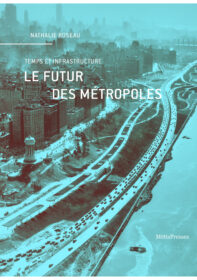 The Future of Metropolises: Time and Infrastructure
Nathalie Roseau
MétisPresses, 2022, 256 p. (Coll. vues Densemble)
A controversial subject, infrastructure is the entry point through which this book examines the imaginary and concrete production of urban space. The study of three cities—New York, Paris, and Hong Kong—provides an in-depth look at the relationship between cities and their infrastructure, which is built to last even though its functions are destined to evolve.
Nathalie Roseau offers a reinterpretation of the major urban artifacts that surround us, recounting the debates that accompanied their creation and the crises they still face today. She considers infrastructure from a situated and transnational perspective and, like an archaeologist, identifies the visible and invisible traces of its sedimentation. The stories of the New York parkway, Roissy Charles-de-Gaulle, the Parisian ring road, and Hong Kong's infrastructure reveal society's expectations for the future and clarify the power relations between authorities and representations, establishing the project as a chain of convergences and conflicts, decisions and reversals.
Reflecting on urban planning as knowledge and practice, this book questions the value of projected futures and proposes a change of perspective in the face of the transformations imposed on metropolises. Anchored in the history of cities, infrastructures engage in dialogue with the challenges of the present.
Jean-Pierre Lévy took part in this study day in Montpellier on Thursday, February 10, 2022.
Building a library is a key issue for policymakers: this facility would help to promote social diversity and thereby ensure social cohesion and equal opportunities.
Anchored in the urban space, the library must be designed to interact with an entire ecosystem, open to the outside world and reaching out to the public and non-public alike. It is also the ultimate welcoming place, neutral and imbued with kindness.
But are these expectations and ambitions being met? How do libraries connect with their local communities?
With a variety of approaches from researchers in urban planning, architecture, geography, and psycho-sociology, as well as concrete feedback from experience, this study day will address the political role of libraries.
This professional study day is organized in partnership with the Montpellier Méditerranée Métropole Media Library Network.