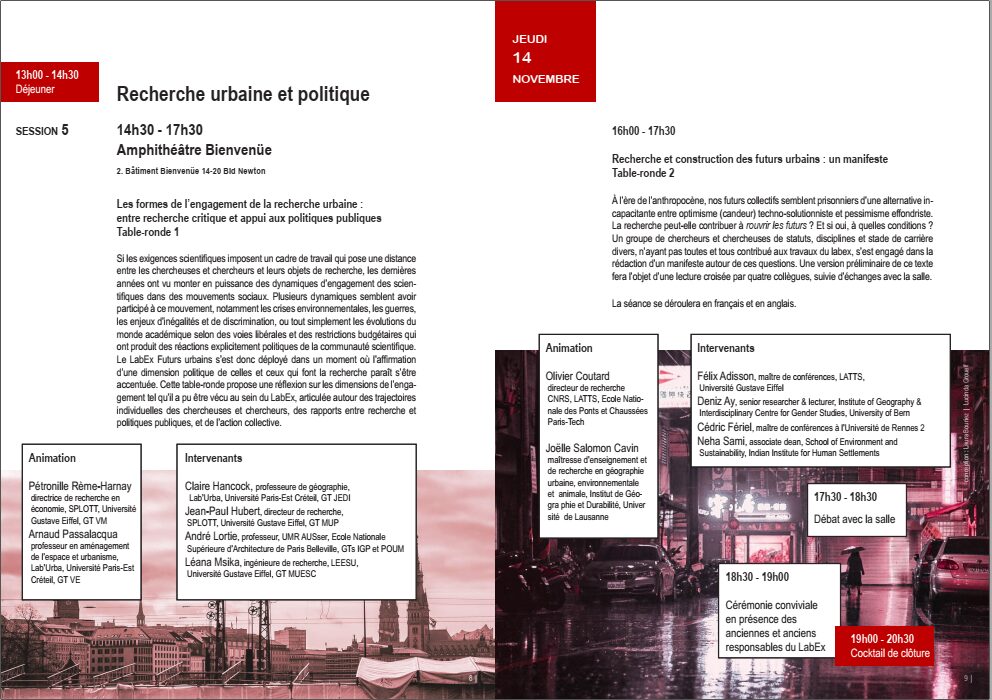
The session will take place in B235 (Bienvenüe Building) and will be broadcast via videoconferencing.
By: Margot Pellegrino
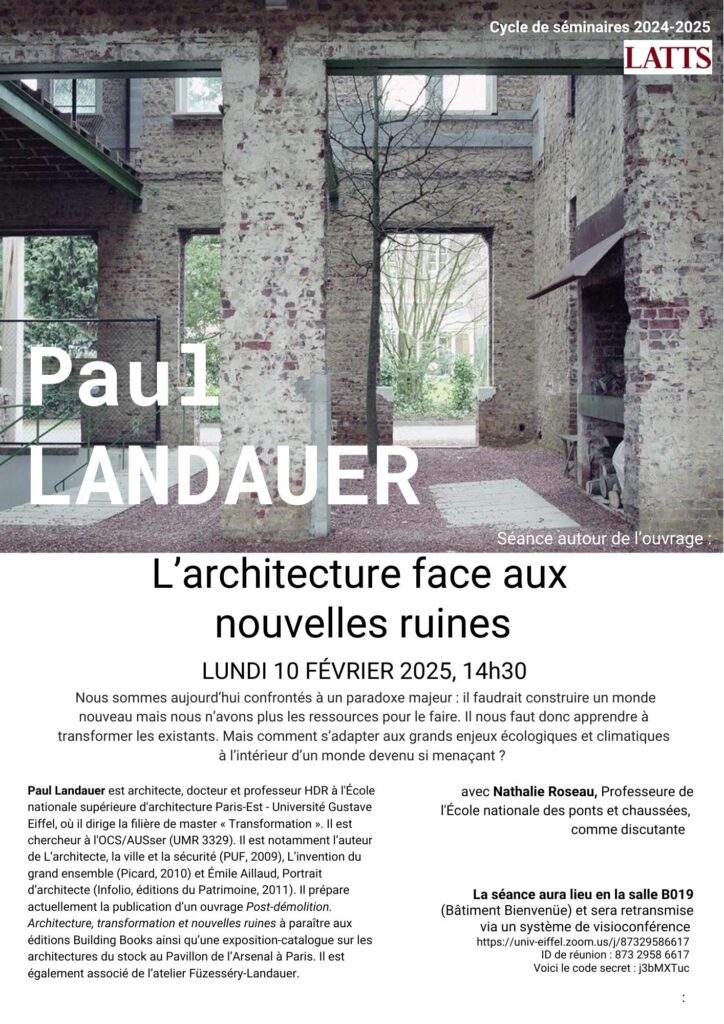
The session will take place in B019 (Bienvenüe Building) and will be broadcast via videoconference.
By: Paul Landauer

In his new book published by Princeton University Press, Michel Anteby opens the debate: how would you react to a researcher who asked you uncomfortable questions? One option is often to find ways to resist them, using every possible nuance, from categorically refusing to answer to feigning sudden memory lapses. Such behavior can ultimately delay or prevent research from being conducted in close proximity to the respondents. For Michel Anteby, however, it would be a shame to see this as nothing more than a constraint to be forgotten once access to the field is finally granted. On the contrary, the sociologist argues that it is important to take the resistance shown by respondents seriously, as it often provides valuable insights into the social worlds around us. With more than 20 years of experience in ethnography, the author helps us to reflect on this issue through a variety of research fields, from the issue of strikes at Disney to that of security at international airports, and the question of morality at a business school such as Harvard University.
The meeting will take place on Thursday, January 9, from 10 a.m. to 12 p.m. in room B 004 (Belgrand wing) of the Ecole nationale des ponts et chaussées, 6-8 avenue Blaise-Pascal, Cité Descartes in Champs-sur-Marne (RER A Noisy-Champs). It will be introduced by Stève Bernardin.

"Content creation. Just another market?" – Issue coordinated by Olivier Alexandre and Bilel Benbouzid.
Summary of the dossier:
- Making a living from views. By Olivier Alexandre and Bilel Benbouzid
- The YouTube market. Organization, revenue, and topology. By Olivier Alexandre, Bilel Benbouzid, Arnaud Lelievre, and Bertrand Roudier
- Working on your channel. Platform videographers and their sources of income. By Quentin Gilliotte and Dominique Pasquier
- Gift capitalism. Economic sociology of the Twitch platform. By Nathan Ferret
- The flip side of fame and the market. Behind the scenes with anonymous Twitch streamers. By Sylvain Juanes and Manuel Boutet
- Behind the smiles, precariousness. Content creation among independent coaches. By Anne Jourdain
- Understanding algorithms in action. The case of the content qualification infrastructure of the Dailymotion platform. By Thomas Jaffeux
Miscellaneous:
- Lancetgate or scientific publishing put to the test by Twitter. Disorganized skepticism. By Émilien Schultz, Simon Guillouet, Emma Cape, and Guillaume Lachenal
Reading notes:
Carole GAYET-VIAUD, Urban Civility: The Elementary Forms of Democratic Coexistence, Paris, Economica, 2022, coll. "Sociological Studies," 227 p. By Aude LAUPIE
Juan Sebastián CARBONELL, Le futur du travail (The Future of Work), Paris, Éditions Amsterdam, 2022, 192 p. By Marion BEAUVALET
Antoine BURRET, Nos tiers-lieux. Défendre les lieux de sociabilité du quotidien (Our Third Places: Defending Everyday Social Spaces), FYP Editions, 2023, 256 p. By Matthieu Demory
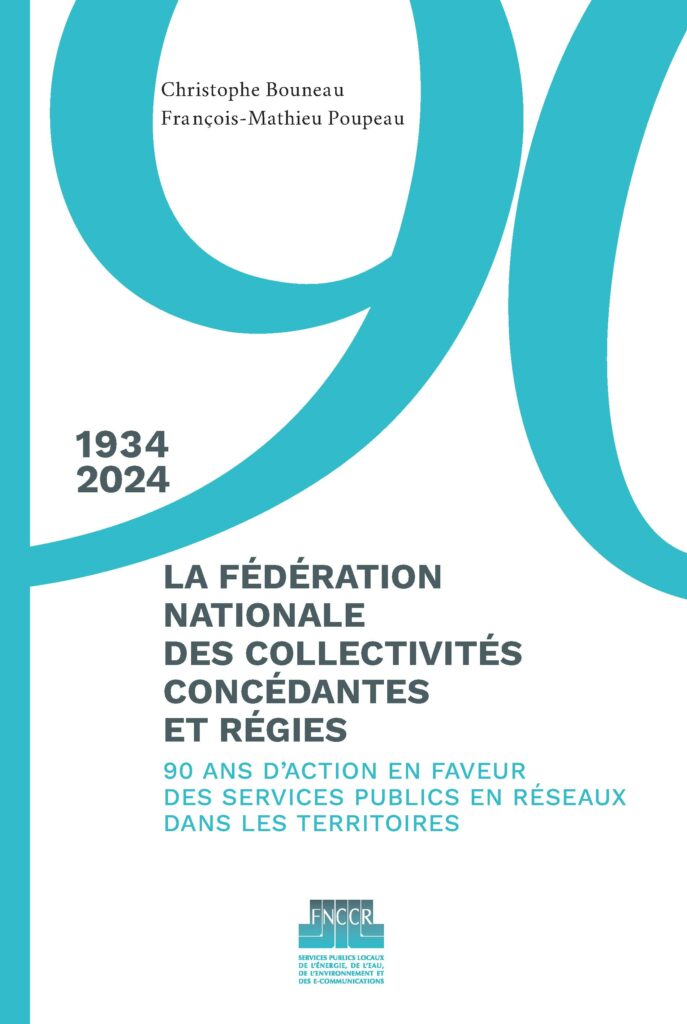
On Thursday, December 19, François-Mathieu Poupeau will participate in a roundtable discussion organized in the Salons de la Présidence du Sénat (Senate Presidential Salons) on the occasion of the 90th anniversary of the Fédération nationale des collectivités concédantes et régies (FNCCR, National Federation of Local Authorities and Public Utilities). He will present the book he co-authored with Christophe Bouneau (Professor Emeritus of Economic History at Bordeaux Montaigne University) entitled "The National Federation of Local Authorities and Public Services. 90 years of action in favor of public services in the regions."
This section mainly lists the "Company Profiles" published in Flux magazine since 1999. It is supplemented by a few references to other articles devoted to large companies.
Portraits from Flux magazine
In accordance with publishing rights, we apply a three-year "moving barrier" for company profiles published by FLUX magazine and distributed by Cairn. All texts published before this date are freely accessible, while more recent ones can be accessed via FLUX (print version) or Cairn (electronic version). Articles published before the January-March 2001 issue of Flux are available on Persée.
- JCDecaux and Clear Channel Outdoor – Maxime Huré
- Family conglomerates (5) – Ayala Corporation – Dominique Lorrain and Morgan Mouton
- Family conglomerates (4) – Salim group – Dominique Lorrain
- Family conglomerates (3) – Suharto & Co – Dominique Lorrain
- Family conglomerates (2) – "The Four Sisters" – Alvaro Artigas
- Family conglomerates (1) – Odebrecht – Flux, No. 99, January-March 2015, pp. 59-69, Alvaro Artigas
- ESKOM Holdings SOC Limited – Sylvy Jaglin and Alain Dubresson
- Port hubs (3): Operator strategies on the West African coast – Flux, No. 97/98, July-December 2014, pp. 110-117, Jean Debrie
- The energy transition – 2 – Flux, No. 96, April-June 2014, pp. 61-72, Christophe Defeuilley
- The energy transition – 1 – Flux, No. 95, January-March 2014, pp. 65-76, Christophe Defeuilley
- Logistics real estate companies – 2 – Flux, No. 93/94, July-December 2013, pp. 91-103, Nicolas Raimbault
- Logistics real estate companies – 1 – Flux, No. 92, April-June 2013, pp. 62-74, Nicolas Raimbault
- The New River Company – Flux, No. 91, January-March 2013, pp. 56-65, Christophe Defeuilley – First experience of a private drinking water company
- A.P. Møller: world leader in maritime transport – Flux, No. 88, April-June 2012, pp. 60-70, Antoine Frémont
- Port hubs (1): Major global operators – Flux, No. 87, January-March 2012, pp. 63-72, Jean Debrie
- French REITs: Foncière des Régions and Unibail-Rodamco – Flux, No. 85/86, July-December 2011, 89-104. (C. Boisnier) – Two publicly traded investment companies
- Hub 4: the strategies of Fraport AG and Aéroport de Paris – Flux, No. 84, April-June 2011, pp. 73-89. (C. Halpern) – Fourth article on airport operators devoted to the two continental majors.
- Hub 3: Has airport management changed in nature? BAA plc – Flux, No. 83, January-March 2011, 68-82. (C. Halpern) – Third article on airport operators, devoted to the British operator BAA
- Blue red chips: water companies in China – Flux, No. 82, October-December 2010, 64-80. (D. Lorrain). – The emergence of private water companies in China with three origins: municipal companies, financial conglomerates, and new entrants
- Macquarie: a bank in infrastructure – Flux, No. 81, July-September 2010, 67-78. (D. Lorrain). – Second article on airport operators: Australian bank Macquarie
- Hub (airports and ports). Ferrovial/BAA: one transaction too many? – Flux, No. 79/80, January-June 2010, 140-152. (C. Halpern, D. Lorrain) – First part of a series on airport operators: general positioning, history of the takeover of BAA (the British operator) by Ferrovial (the Spanish construction group).
- Natural gas in Europe (3). Centrica – Flux, No. 78, October-December 2009, 89-99. (C. Defeuilley) – Third part of an analysis of the European gas sector: the British group Centrica.
- Natural gas in Europe (2). Gazprom – Flux, No. 76/77, April-September 2009, 126-134. (C. Defeuilley) – Part 2 of an analysis of the European gas sector: Gazprom.
- Natural gas in Europe (1). Between market liberalization and geopolitics – Flux, No. 75, January-March 2009, 99-11. (C. Defeuilley) – Part 1 of an analysis of the European gas sector: overview and main groups
- The finance industry and infrastructure (2): private investment funds – Flux, No. 72/73, April-September 2008, 138-151. (D. Lorrain). – Second article in a series, presenting the KKR and Cerberus funds, a timeline of the financial crisis, and an assessment of the impact of private equity on infrastructure
- The finance industry and infrastructure (1): private investment funds – Flux, No. 71, January-March 2008, 78-91. (D. Lorrain). – Discussion of the industrial model of private equity funds and presentation of Blackstone, Carlyle, Apollo Management
- Major Spanish real estate developers – Flux, No. 70, October-December 2007, 74-87. (J. Pollard). – The real estate sector in Spain and presentation of Metrovacesa, Vallehermoso, Fadesa, Immobiliaria Urbis
- Major French real estate developers – Flux, No. 69, July-September 2007, 94-108. (J. Pollard) – Overview of the sector in France and five developers: Nexity, Bouygues Immobilier, Meunier Promotion, Icade, Promogim
- England: from the real estate boom to PFI – Flux No. 68, April-June 2007, 81-99. (D. Lorrain). – Fourth article in a series devoted to changes in the construction sector in Europe. Presents PFI and the Balfour Beatty, Amec, and Carillion groups
- Spanish construction groups (motorways 3) – Flux No. 66-67, March 2007, 149-162. (D. Lorrain) – Construction in Spain and the ACS-Dragados, Ferrovial, FCC, and Acciona groups.
- German construction groups (motorways 2) – Flux No. 63-64, January-June 2006, 75-84. (D. Lorrain) – Second in a series devoted to the evolution of major European construction groups towards services, presents Hochtief, Strabag, Bilfinger und Berger
- Motorways in Europe (1) – Flux No. 62, October-December 2005, 58-74. (D. Lorrain). – Series that began with the privatization of French motorways and its protagonists: Autostrade, Abertis, Brisa, Macquarie
- Enel and Scottish Power. European utilities (1) – Flux No. 60/61, April-September 2005, 105-115. (C. Defeuilley, D. Lorrain) – The multi-utility strategy of two European electricity companies (Enel, Scottish Power) and the refocusing of 2002/03 under pressure from the financial markets
- Exelon: the return of Samuel Insull's empire? – Flux No. 59, January-March 2005, 68-75. (C. Defeuilley). – Second article devoted to the electricity sector in the United States: profile of Exelon, the large Chicago-based group
- Singapore Inc. – Flux No. 58, October-December 2004, 85-96. (D. Lorrain) – The combination of a state that intervenes in urban affairs and private companies: Jurong Town Corp., SembCorp., CapitaLand, Keppel, Port of Singapore Authority
- The electricity sector in the United States (1) – Flux No. 56/57, April-September 2004, 112-126. (C. Defeuilley) – Deregulation of the electricity sector in the United States and its impact on a number of companies: Duke Energy, TXU, AES
- Hitachi, a Japanese environmental industrialist (2) – Flux No. 55, January-March 2004, 60-72. (D. Lorrain).
- The fall of Andersen – Flux No. 51, January-March 2003, 75-82. (N. May)
- Japanese environmental manufacturers (1) – Flux No. 50, December 2002, 80-90. (D. Lorrain) – The industrial and technical approach to urban issues in Japan. Overview of major groups: Kubota, Ebara, Kurita, Chiyoda, JGC, Toyo, TSK, Nippon Steel, NKK, Kobe Steel, KHI, IHI.
- Waste Management: American waste companies (2) – Flux No. 48-49, April-September 2002, 107-121. (D. Lorrain)
- Enron – Flux No. 46, October-December 2001, 76-84. (C. Defeuilley)
- Fiat – Flux No. 44-45, September 2001, 99-107. (D. Lorrain) – Starting with EDF's entry into Italy with Montedison, this article presents the history of the Fiat group and its "urban" activities.
- American waste management companies (1) – Flux No. 43, January-March 2001, 73-84. (D. Lorrain) – Portrait of a sector and its offerings: Waste Management, Allied-BFI, Superior Services, Laidlaw-Safety Kleen, Ogden, Philip Services.
- Thames Water and Kelda Group (British water companies) – Flux No. 41, July-October 2000, 71-84. (D. Lorrain) – Ten years after the privatization of the water sector.
- RWE (German electricity companies) – Flux No. 39-40, June 2000, 94-103. (D. Lorrain)
- Bechtel – Flux No. 38, October 1999, 72-78. (D. Lorrain) – A leading figure in American engineering and its "urban" activities
- Cheung Kong – Flux No. 36-37, July 1999, 61-66. (D. Lorrain) – A brief history of the large Hong Kong group created by Mr. Li Ka-shing: Cheung Kong Holdings, Hutchison Whampoa
Other references on major firms
- The discreet hand: global finance in the city (D. Lorrain) – Revue française de science politique, vol. 61, no. 6, pp. 1097-1122
- The local-global firm: Lyonnaise des Eaux, 1980-2004 (D. Lorrain) – Sociology of Work, vol. 49, 2007 (5)
- The local-global firm, (Lyonnaise des Eaux: 1980-2004) (D. Lorrain) – Sociology of Work, vol. 47 (3) 2005, 340-361
- The dynamics of French urban services companies (C. Defeuilley) – Entreprises et Histoire, no. 38, June 2005, 96-108
- Large Groups and the City – Entreprises et Histoire, Special Report, No. 30, 2002 – Articles on CGE, SAE, urban groups in Singapore, transport companies in Brazil, Enron, AT&T
Find out more
A study day featuring roundtable discussions is being organized by the École Nationale des Ponts et Chaussées on November 28, 2024, to mark the publication of the latest issue of Transitions. This issue was co-edited by Nathalie Roseau and Bruno Tassin.
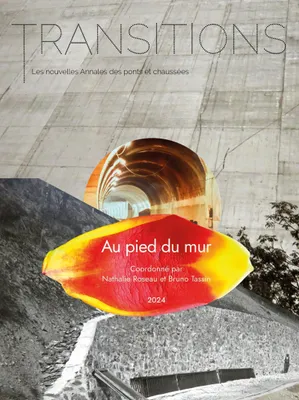
Global disruptions, their speed and intensity, are forcing us to take action. Technological innovation alone and the idea of decoupling the intensity of human activities from their impact on the Earth will not be enough to make life compatible with planetary boundaries. Based on this observation, the researchers who contributed to issue 4 of Transitions believe that a major shift in production and consumption systems is unavoidable. It is even necessary in the very short term, given the alarming nature of the situation.
Climate, biodiversity, chemical contaminants, water resources: with their backs against the wall, the world of research and higher education is analyzing, examining, and communicating possible paths for socio-ecological futures. At the crossroads of the humanities, social sciences, and environmental sciences, this day is an opportunity to examine the relationship between technology and politics and possible avenues for public action, as well as to consider the implications for society of putting these transitions into practice.
Don't hesitate to register for this event: here
Rocio Calzado Lopez and Manon Espinasse will speak at the OCS/AUSser laboratory seminar on Monday, November 18, 2024, at 6:00 p.m.
This session will take place in the boardroom (Banham space) at the École nationale supérieure d'architecture Paris-Est.
The session will open with a presentation by Rocio Calzado Lopez: "While the housing crisis is the starting point for this research, the alarming context of social housing demolitions is the subject to be examined. To discuss this crisis and examine these demolitions, this research addresses the relationship between the three dimensions of politics (politics, policy, and polity) and architecture, and questions not whether architecture is political, but rather how architecture is political. What are the material resources of a building that influence governance processes? Perhaps if we trace the political role of buildings in the decision-making behind a demolition, we could learn something new about the role of architects in the current housing crisis.
To explore this idea, I develop the biography of two housing complexes, one in Rome and the other in Paris, which were about to be demolished but instead ended up undergoing a long process of transformation. "Beyond Demolition, Caring for Architecture" is not a finished work, but an ongoing research project, tested both through a doctoral project currently underway at the LATTS laboratory at the École des Ponts et Chaussées and a documentary film produced by the film collective "docar," with the support of the Pavillon de l'Arsenal. The session will begin with the screening of several excerpts from the documentary.
It will continue with a presentation by Manon Espinasse: "The highway is an infrastructure considered essential to the functioning of our current societies and economies.
Since its inception, it has been the subject of a series of actions (repair, adaptation, regeneration, transformation) to ensure its permanence. Because it both contributes to exceeding planetary limits and is exposed to the consequences of these exceedances, it has been included in public policies for "ecological transition." The highway (as a socio-technical system) of the 21st century is increasingly "multi-functional ": a support for plural mobility (from automobility to shared mobility), a habitat for biodiversity and carbon sinks (in its dependencies and edges), a vector for renewable energy (from the highway hosting urban networks to the highway producing urban solar energy). This diversified highway is being built in the Bordeaux metropolitan area, based on the one that originated in the late 1960s. It is the result of adjustments and reconfigurations between highway planning and land-use planning (and their imaginaries) since 1967, which gave rise to specific architectural, urban, landscape, and infrastructural forms. This paper proposes to look at the early stages of the Bordeaux motorway, the genesis of the co-construction of the motorway and the metropolis, and to question the "infrastructural permanence."
In the 1960s, the highway was a local and national project, a tool for establishing Bordeaux as a balanced metropolis (DATAR) and a city with over a million inhabitants (Jacques Chaban Delmas). This highway of metropolitanization was both a means of large-scale development in the creation of Bordeaux as a metropolis (as seen in the development plans) and a means of economic development (as seen in the aerial photographs)."

The Techniques, Territories, and Societies Laboratory (Latts, UMR 8134, CNRS, École des Ponts ParisTech, Gustave Eiffel University) invites candidates for the CNRS competition (sections 36, 39, and 40, CID 52, 53, and 55) who wish to obtain its support to contact the laboratory management: Elsa Vivant (elsa.vivant@univ-eiffel.fr) and Jonathan Rutherford (jonathan.rutherford@enpc.fr).
Please send the laboratory management a document presenting the CNRS project, along with a brief CV and a letter explaining your reasons for requesting support, by December 15, 2024 at the latest.
Applications will be reviewed by the laboratory council in early January in order to issue a letter confirming their suitability for the Latts scientific project. Subsequently, for those who are eligible and wish to be assigned to Latts, support will be offered in preparation for the interview, as well as an opportunity to meet with members of the laboratory.
More information is available on this website.
The next RUE session will take place on Thursday, November 7, 2024, from 3:00 p.m. to 5:00 p.m. in room B235 (Bienvenüe Building). Its purpose is to clarify what death studies are. A presentation will be given by Louis D'Allaglio, and two researchers from LATTS, Christine Fassert and Rina Kojima, will present a collective project.
David Guéranger announces the defense of his habilitation to supervise research in political science on November 26, 2024 at 1 p.m. at Gustave Eiffel University, Bienvenüe Building, Room A301.
The jury will be composed of:
- Catherine Achin (rapporteur)
- Paul Bouffartigue (rapporteur), Béatrice Hibou (rapporteur)
- Christian Le Bart (guarantor)
- Rémi Lefebvre
- Maud Simonet
- Béatrice Hibou (rapporteur)
Summary of the original thesis “Unfaithful loyalties. Municipal political engagement through the prism of its ordinary dissonances”
The thesis opens with a puzzle posed by the latest municipal elections: the countless declarations by mayors announcing that they would not seek re-election, followed by a remarkable re-election rate. The puzzle can be solved by attributing a strategic or moral sense to the mayors; it can also be seen as the possibility of being loyal without being faithful, of remaining a practitioner while having lost faith. This interpretation opens up a reflection on the ordinary misalignments of commitment, forms of loyalty despite everything, more intermittent and ambivalent, from which it is difficult to simply infer adherence or satisfaction. Often conceptualized in terms of abnormality and psychology (such as cognitive dissonance), these misalignments are understood in the thesis as a common and ordinary component of mayors’ political commitment. They are also reinserted into social spaces and trajectories that give them varying meanings. Thus, as the reflections unfold, various ways of rationalizing and legitimizing the discrepancies inherent in political engagement emerge, that is, accepting them without necessarily seeking to reduce them.
With contributions from Noémie Suissa, Olivier Coutard, Félix Adisson, Martine Drozdz, and Nathalie Roseau.