Hélène Ducourant is organizing this roundtable discussion on reducing excessive debt in France, in collaboration with CRÉSUS – JEAN-LOUIS KIEHL and Emmaüs France -Thibaut Largeron.
It will take place on Wednesday, March 29 at 6:30 p.m. at the Emmaüs France headquarters in Montreuil.
Statistics from the Banque de France show a drastic decline in the number of cases of excessive debt filed by households. In fact, these cases have been cut in half in 10 years. How can this phenomenon be explained? Do households have fewer financial problems, or are they discouraged by the procedure? Are successive reforms of the credit market having an effect, or is this trend linked to prevention and budget support policies? And finally, should we be happy or worried about this decline?
Speakers:
- Mark Béguery, Director of Private Individuals at the Banque de France. He will discuss statistical trends in the use of the over-indebtedness procedure and how the BdF identifies their causes.
- Delphine Depaix, Director of Social Cohesion and Solidarity at Emmaüs Habitat – She works with the Emmaüs communities and is familiar with the challenges faced by social workers who work with beneficiaries on debt cases.
- Clara Deville, Sociologist at INRAE, specialist in access to justice in rural areas. Clara will offer insights into the hypothesis of "non-recourse."
- Pauline Dujardin, Project Manager for the Crésus Federation. She will present some "feedback from the field" on current filings for excessive debt.
- Caroline Jeanmart, Director of the (Belgian) Credit and Debt Observatory. Caroline will provide points of comparison with the situation in Belgium. There too, over-indebtedness statistics are falling… but perhaps not for the same reasons.
There will be time for discussion with the audience and a cocktail reception.
These meetings are open to everyone: citizens, people interested in financial inclusion, bankers, social workers and volunteers, students, etc.
People with excessive debt will share their experiences.
Registration: https://my.weezevent.com/les-rencontres-de-linclusion-financiere-2

This session examines the difficulties encountered by professionals managing risk situations (psychologists, psychiatrists, and risk and crisis managers) when faced with the emotions of their patients and/or victims. How do these professionals work with the intimacy of their patients? How do they manage to distance themselves from emotion? How does emotion overflow onto them and change their practices? How is this proximity to intimacy managed in circumstances of remote monitoring?
• Alexandre Mathieu-Fritz, University Professor, LATTS, presentation title to be confirmed
• Véronique Héroin, Psychologist, presentation title to be confirmed
• Rina Kojima, Associate Researcher, LATTS, presentation title to be
confirmed• Pascal Ughetto, University Professor, LATTS, Discussant
Samuel Ripoll (MTE History Committee, associate researcher at the TRIANGLE laboratory) will present a reflection drawn from his thesis (2022) entitled "The origins of the 'Mediterranean cities': anti-colonialism, urban planning, and environmental protection (1960s–1990s)."
The seminar will be discussed by Martine Drozdz.
Partic
New perspectives on the history of off-grid technologies
Issue coordinated by Olivier Coutard, Benjamin Bothereau, and Joël Tarr
Elise Muller's thesis defense will be held in the Cauchy amphitheater at Ecole des Ponts ParisTech.
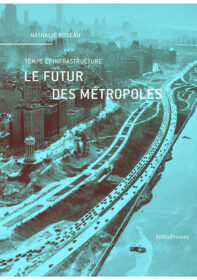 The session will focus on Nathalie Roseau's book:
Le futur des métropoles. Temps et infrastructure (The Future of Metropolises: Time and Infrastructure),
MétisPresses, 2022, 256 p.
Discussant: Jonathan Rutherford, researcher at LATTS
A controversial subject, infrastructure is the entry point through which this book examines the imaginary and concrete production of urban space. The study of three metropolises—New York, Paris, and Hong Kong—provides an in-depth look at the relationship between cities and their infrastructure, built to last even though their functions are destined to evolve.
Nathalie Roseau offers a reinterpretation of the major urban artifacts that surround us, recounting the debates that accompanied them and the crises they still face. She considers infrastructure from a situated and transnational perspective and, like an archaeologist, identifies the visible and invisible traces of its sedimentation. The stories of the New York parkway, Roissy Charles-de-Gaulle, the Parisian ring road, and Hong Kong's infrastructure reveal society's expectations for the future and clarify the power relations between authorities and representations, establishing the project as a chain of convergences and conflicts, decisions and reversals.
Reflecting on urban planning as knowledge and practice, this book questions the value of projected futures and proposes a change of perspective in the face of the transformations imposed on metropolises. Anchored in the history of cities, infrastructures engage in dialogue with the challenges of the present.
Program for the session on Monday, March 6, 2023
Zoom link: https://sciencespo.zoom.us/j/9637802275
 Aminata Coly is beginning her PhD at LATTS under the supervision of Hélène Ducourant and Alexandre Mathieu-Fritz, as part of a CIFRE program with Orange. Her research focuses on young people's digital financial practices, specifically their use of technical devices for accessing money and the risks associated with this. She began her studies with a bachelor's degree in sociology at Gustave Eiffel University, before continuing with a master's degree in quantitative sociology and demography at Paris-Saclay University. Her thesis topic is a continuation of her final thesis, which focused on online banking fraud and the socio-demographic characteristics of its victims.
The Ministry for Ecological Transition and Territorial Cohesion
is launching a new recruitment campaign for sustainable development research fellows. A position in sociology/political science is available at ENPC and assigned to the Techniques, Territories, and Societies Laboratory (LATTS, UMR 8134) on the theme:
"Analysis and evaluation of public energy and climate policies
."
The deadline for applications is Friday, March 17, 2023, at 12:00 p.m. (Paris time).
The Ministry invites candidates to contact the heads of the research units to prepare their application and define their scientific project. Those interested in the position assigned to LATTS are encouraged to contact the laboratory's management (Elsa Vivant, elsa.vivant@univ-eiffel.fr, Jonathan Rutherford, jonathan.rutherford@enpc.fr) or François-Mathieu Poupeau (fm.poupeau@enpc.fr) for further information, particularly regarding the scientific aspects of the application.
For information on how to apply: https://www.concours.developpement-durable.gouv.fr/charge-e-de-recherche-du-developpement-durable-de-a126.html
For the ENPC-LATTS job description: https://www.concours.developpement-durable.gouv.fr/IMG/pdf/crcn_09_enpc_recrutement_2023.pdf
A position as a sustainable development research fellow is also available at the Laboratoire ville, mobilité, transport
(LVMT) on the theme: "Transitions in mobility systems in cities in the Global South (planning, regulation, governance)"
 Sandrine Zawacki began her thesis in 2018 at the University of Nantes, under the supervision of Corinne Delmas. Her field of study is located in the southeastern United States, in the state of Georgia. Her thesis focuses on the role of American universities in the segmentation between art and craft. She is particularly interested in ceramists, and her research is mainly based on interviews with potters. She holds a Master's degree in Political and Social Sciences from Paris-Dauphine University. She has been working for fifteen years as a teacher in the Romance Languages Department at the University of Georgia, near Atlanta.
LATTS is pleased to invite you to the next session of its seminar,
which will take place on Monday, February 13, 2023, from 2:00 p.m. to 4:00 p.m.
Armelle Choplin, geographer and urban planner, professor at the University of Geneva, will present her book:
Matière grise de l'urbain. La vie du ciment en Afrique (Urban Gray Matter: The Life of Cement in Africa), MétisPresses, 2020, 256 p.
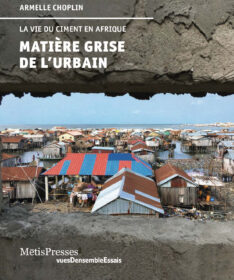
Seminar poster LATTS_Session of 02/13/2023
Stève Bernardin will speak at this PARI Chair seminar on this topic on Thursday, February 16 (8:30-9:45 a.m.) in webinar format.
The promoters of autonomous vehicles predict that, in the long term, artificial intelligence will make it possible to eradicate accidents by simply eliminating the human factor from driving. There will no longer be any question of drunk driving, speeding, or inattention. How are insurers approaching this anticipated revolution, which ultimately calls into question the very usefulness of car insurance? We propose to analyze this through the lens of an industry mobilization currently underway in the United States.
Initiated shortly before the latest lockdown, our survey is currently based on some 60 interviews conducted on both sides of the Atlantic. It reveals a development in actuarial studies that emphasizes not only the possible reduction of certain risks, but also the potential emergence of new problems, particularly serial ones, linked to the deployment of connected vehicles. Incidentally, it reflects a desire to defend the insurance industry at a time when manufacturers in the automotive and new technology sectors are considering becoming insurers for their current and future customers, as is the case with Tesla in California, Texas, and Illinois.
Using the textbook case of autonomous vehicles, the analysis reveals, in short, a form of forced mobilization in the face of technological innovation. It highlights unexpected constraints for a sector that no longer has the research and development capabilities that characterized it in the last century, while also demonstrating the new resources available to certain insurers, who are even becoming entrepreneurs in political and social causes.
Registration required: https://docs.google.com/forms/d/e/1FAIpQLSdveSXssJU46CdAl2boskiWRoXb0rGx_FBJ4BTJ2vITynfvbg/viewform
PARI Chair website: https://www.chaire-pari.fr/#1