Thesis supervisor
: François-Mathieu Poupeau
Solène David and Agathe Euzen contributed to this article
Solène David, Jean-Pierre Revéret, and Agathe Euzen,
"Ouvrir ou fermer les bouches d'incendie ?" (Should fire hydrants be opened or closed?), Développement durable et territoires [Online], Vol. 10, No. 3 | December 2019, published online on December 20, 2019, accessed on June 17, 2020.
URL: http://journals.openedition.org/developpementdurable/15635
DOI: https://doi.org/10.4000/developpementdurable.15635
Well known and widely reported in the Île-de-France region since 2015, "wild openings" refer to the practice of spontaneously opening fire hydrants, producing high geysers of water in urban areas. The ephemeral and illicit use of this equipment, which is connected to the drinking water network and used for firefighting, is at the heart of a complex phenomenon that reveals, as much as it provokes, a set of technical, social, and territorial tensions and disruptions surrounding the singular object that is the fire hydrant.
Thesis supervisors
: Taoufik Souami, Xavier Bonnaud (more…)
Alexandre Coulondre contributed to this article:
Bardet, Fabrice, Alexandre Coulondre, and Lucia Shimbo.
"Financial natives: Real estate developers at work."
Competition & Change, 2020, 1–22.
https://doi.org/10.1177/1024529420920234.
Financialization, even contested, is a major focus of contemporary urban studies. The growing interest of institutional investors in real estate investments has been the subject of in-depth analyses that have suggested the need to critically examine their weight in contemporary urban production. Have investors become the new masters of the urban fabric, to the detriment of historical players such as property developers or local authorities? This article informs the discussion by looking at developers at work and identifying how financial profitability calculations could have invaded their activities. Based on a qualitative survey conducted in France on practicing or retired professionals, it shows that there has actually been a surprising degree of stability in professional practices over the past 50 years, even though the economic environment changed at the beginning of the 1990s. Since the origins of the property development sector in France, real estate firms have had close ties with the financial industry and have been using financial instruments. This is why they were considered as "financial natives," while employees at the operational level remain outside the scope of the colonization of organizations by financial quantifications. The specific nature of real estate work, particularly its political component, means that decisions lower down in these companies cannot be guided solely by financial ratios. The extent of the changes triggered by the massive arrival of financial investments has not been as great as it may seem, since developers appear to have maintained most of their ability to influence contemporary urban governance.
 Félix Adisson received the 2019 Jim Lewis Prize for his article:
The members of LATTS, meeting in Extraordinary General Assembly on February 7, 2020, based on their reading of the three preparatory reports for the draft multi-year research programming bill (LPPR), express their deepest concerns about the initial directions that are emerging.
The next PMMU seminar will take place on Thursday, March 12, 2020 (LATTS, Bienvenüe, B235) on the theme of "Energy and Urban Planning."
The speakers will be:
Meriam Bechir (LATTS) What architectural and spatial integration of energy technologies in dense urban environments? The case of Nanterre Cœur Université
Griet Juwet (Cosmopolis Center for Urban Research, Vrije Universiteit Brussel) Exploring the ambiguous socio-spatial potential of collective heating in Flanders: four scenarios for the city of Roeselare
Jill Simone Gross is Professor of Urban Policy at Hunter College, City University of New York, and Director of the Master's program in Urban Policy and Leadership. She is currently collaborating with Hank Savitch on a book about New York entitled New York Megacity: Coping with the Pressures of the 21st Century, to be published in 2021 by Agenda Publishing. Her latest book, J. Gross, E. Gualini, L. Ye (eds.) Constructing Metropolitan Space: Actors, Policies and Processes of Rescaling in World Metropolises (Routledge, 2019), deals with the construction of scales in several countries. More generally, his work focuses on the governance of economic development and migration issues in cities in North America and Western Europe.
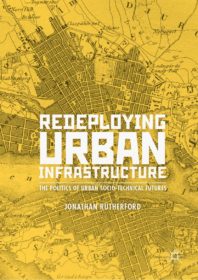 Jonathan Rutherford
Redeploying urban infrastructure: The politics of urban socio-technical futures
Palgrave Macmillan, 2020, 191 p.
The seminar "Socio-economic challenges of net metering
" organized by the "City and Energy" working group will take place on Friday, March 20, 2020 (Bienvenüe Building, rooms B017-B020).
Political authorities and markets are implementing a variety of solutions to encourage the deployment of decentralized energy production systems using renewable sources. Net metering systems appear to be an effective way to encourage investment in renewable energies, as they allow energy that is not consumed to be fed back into the public grid at attractive rates.
While the first applications of net metering date back to the 1980s in the United States, according to the professional association REN21, more than 50 countries had implemented programs to develop this system in 2014, and today that number exceeds 60. However, this proliferation has been accompanied by controversy over electricity consumption volumes and the effects on grid maintenance.
During the seminar, three guest speakers will offer different perspectives on the socio-economic and political issues surrounding net metering in Europe and North America.
Scientific coordination: Sylvy Jaglin and Margot Pellegrino
Group assistant: Marika Rupeka
The doctoral students' reading seminar will take place on January 28, February 4, and February 10, 2020. This year's theme will be regulation.