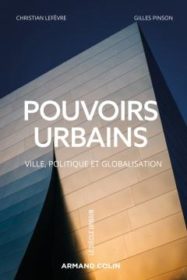
Christian Lefèvre, Gilles Pinson
Urban Powers: Cities, Politics, and Globalization.
Paris, Armand Colin, 240 p. (Coll. The Urban Century)
More than half of the world's population now lives in cities.
Urban areas have become the dominant setting for social practices and relationships,
but also the ecosystem in which globalized capitalism flourishes. Cities have thus
emerged as a key scale for understanding and acting on the economic, social, and environmental issues of our time.
Urban actors, Urban actors,
whether elected officials, bureaucrats, economic actors, city professionals,
or researchers, strive to make sense of the transformations affecting cities
and to respond to them with political, economic, and social innovations.
As a space for innovation, the urban environment has also become the subject of both
scientific and political controversy.
This book provides a critical assessment of these debates, focusing on five
controversies: widespread urbanization, the relationship between urban environments and
capitalism, the relationship between cities and states, the distribution of power in
cities and urban democracy, and the governance of metropolitan areas.
In collaboration with Emmanuelle Paradis, Simon Cottin-Marx contributed to the writing of this article in the journal RECMA (Revue internationale de l'économie sociale).
To read the article: http://recma.org/article/les-directeurs-trices-de-centres-sociaux-face-la-bureaucratisation-les-conditions-de-travail
Mathilde Marchand and François-Mathieu Poupeau contributed to the writing of the book:
Repenser l'aménagement du territoire
(Rethinking Land Use Planning) Edited by Stéphane Cordobès, Xavier Desjardins, and Martin Vanier
Berger Levrault, June 2020, 320 p.
Land use planning, regional attractiveness, competitiveness, then equality, and finally, territorial cohesion: for 20 years, the succession of terms has signaled the quest for a reformulation of land use planning thinking in France. None of them seem convincing. The world is rushing headlong into global change, French society is continuing to transform, and with it the territories in which it projects itself and is embedded. But can the same be said of its conception of what "regional planning," so dear to the country, should be? Is collective planning thinking lagging behind the social, economic, environmental, and cultural transformations it claims to regulate?
Prompted by the frequency and intensity of the debates, controversies, and crises that currently surround the issue of territory, some forty researchers and stakeholders gathered from September 7 to 13, 2019, at the Cerisy-la-Salle International Cultural Center to examine planning thinking and action.
Since the end of the Trente Glorieuses, spatial planning policy has clearly struggled to change the fundamentals that justified it. Is it still a question of "planning"? Does it still deal exclusively with "territory"? The time seems ripe to change the categories of analysis, the system of actors, the language and the horizon that bring them together. Planning thinking? A complete overhaul!
Far from the tired debates that pit territories against metropolises, local power against central power, or development against ecology, this collective work offers a series of avenues for rethinking planning in 21st-century France.
Contribution by Marie Dégremont and François-Mathieu Poupeau
: Do network operators have a planning mindset?
Contribution by Mathilde Marchand
: For a humble approach to urban planning in the Anthropocene era
Publisher's website
: https://boutique.berger-levrault.fr/ouvrages/collectivites-locales/au-fil-du-debat/repenser-l-amenagement-du-territoire.html
Juliette Pinard contributed to the writing of the article:
Juliette Pinard and Hélène Morteau (2020)
"Actors in temporary urban planning, new professionals in city building? From the emergence of a profession to the renewal of methods in urban planning"
Revue Internationale d'Urbanisme, No. 8.
FLux
magazine is calling for submissions for a future issue scheduled for 2021.
Félix Adisson, Sabine Barles, Nathalie Blanc, Olivier Coutard, Leïla Frouillou (Coord.)
Pour la recherche urbaine (For Urban Research).
Paris, CNRS Editions, 2020, 448 p.
Global urbanization and growing awareness of environmental issues have made the "urban" a key focus for public policy and research. It is indeed through an urban perspective that we are now able to better understand contemporary societies and living environments.
By linking social, ecological, political, and material dimensions, current research is providing new insights into theories and definitions of the urban, urban populations, and the production of their living environments. The stakes are high. They affect the quality of life of city dwellers and the shape of our societies: diversification of populations, growing inequalities, restructuring of urban flows, scales, and powers, changes in the global environment, etc.
This book, which is based on a major collective work on cities in the North and South, offers a committed overview of these current and, above all, future challenges for urban research.
Geneviève Zembri-Mary
Uncertainty and risk in land use planning and urban development. Between risk management and risk exploitation in projects.
ISTE Editions, 2020, 314 p.
Associations, elected officials, experts, residents, and project owners involved in land use planning, urban development, and transportation projects face an uncertain environment in which they must understand, manage, or take advantage of risk. The risks are many and varied, ranging from social and political to institutional, financial, environmental, and archaeological.
This book examines the origin and nature of uncertainties and risks, as well as the practices implemented to mitigate or take advantage of them. Paradoxically, these practices generate new risks and power relationships between actors that differ from the collaborative planning model of reference.
These paradoxes require a rethinking of practices such as the territorialization of projects, risk-taking in planning and implementation, and the societal and political choices that must be made between project implementation and the protection of the natural and human environment.
English version:
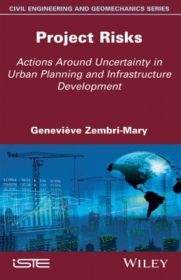
Geneviève Zembri-Mary
Actions around uncertainty in Urban Planning and Infrastructure
Development
London, ISTE / WILEY, 2019, 316 p.
Those tasked with the planning and construction of infrastructure and development operations face an increasingly uncertain context in which they must address risks across a number of different fields. These range from the environmental and archaeological to the social, political, and financial. As a consequence, the formal and informal practices of stakeholders often incorporate projections of risk and opportunity.
Project Risks analyzes this paradigm shift. It reviews the origin and nature of these uncertainties, and the practices implemented by the actors to mitigate or take advantage of them. Paradoxically, these practices generate new risks and power relations that are not compatible with the collaborative planning model. These paradoxes force the rethinking of practices such as project territorialization, risk taking in planning and the responsibility of actors, as well as the societal and political choices that must be made between the realization of projects and the protection of the environment.
David Guéranger. Interpreting the "mayors' blues": Institutional communication and the crisis of voluntary political engagement. Métropolitiques.eu
, Métropolitiques, 2020. ⟨halshs-02490241⟩
With municipal elections approaching, 50% of mayors do not wish to stand for re-election. This figure reflects a "mayors' blues," i.e., a deep unease among those who embody local democracy. The author sees this as a sign of a crisis in voluntary political engagement, in a context of disengagement by the state and an aging population of local officials, in addition to the success of a communication campaign orchestrated by the Association of Mayors of France.
David Guéranger. Sad municipal campaigns: Some worrying developments in local democracy. La vie des idées
, La Vie des Idées, 2020. ⟨hal-02524501⟩
At a time when democratic representation is experiencing a serious crisis of confidence at the national level and inter-municipal cooperation is developing, depriving mayors of some of their power, local democracy is suffering from decentralization laws.
contributed to this article:
Hélène Morteau, Elsa Vivant. Independent cinema scenes in northeast Paris. Interventions Economiques: Papers in Political Economy
, Association d’Économie Politique, 2020, ⟨10.4000/interventionseconomiques.7132⟩
Faced with the highly vertical logic of the film industry, individuals are self-organizing and structuring themselves to offer independent and fringe cinema in northeast Paris. The emergence of these new scenes responds to different cinematic desires. We will highlight the dynamics of the formation, structuring, and organization of two independent cinema scenes that benefit from strong local political commitment to supporting artistic creation and distribution in this area. Based on this empirical work, we will discuss the relevance of the usual explanatory models of creative ecosystems in light of debates in the field of urban studies. Rather than economic geography approaches in terms of clusters, we prefer the notion of a scene to highlight the role of aesthetic proximities in the emergence and structuring of networks of actors and practices that come to life in shared territories (residences, filming locations, post-production facilities, movie theaters, etc.).
 Valérie November and Alice Azémar contributed to the article:
Valérie November, Alice Azémar, Sophie Lecacheux, and Thierry Winter
The anticipation/decision pair grappling with the exceptional, the unexpected, and uncertainty.
EchoGéo, No. 51
https://doi.org/10.4000/echogeo.18949
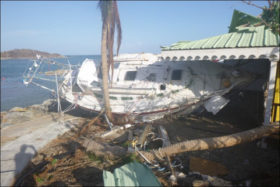
Photo: House destroyed by a ship running aground during Hurricane Irma in Cul-de-Sac (Saint Martin), Source: BRGM
Anticipation and decision-making in crisis situations have been the subject of numerous studies that highlight the polysemy of these concepts and the difficulties regularly encountered in their implementation (context of uncertainty, format and circulation of information, different perceptions of the situation between actors and geographical scales, etc.). Through two case studies set during the Irma-José-Maria crisis, one observed in CIC at the interministerial level and the other experienced by a state operator at the territorial level, this article illustrates these obstacles and highlights the fragmentation of the anticipation/decision pair in the practice of the various ORSEC levels. It appears that the lack of a shared vision within and between crisis units on the nature, time frame, and methodological framework of the anticipation function were all obstacles to its effective implementation during the hurricane sequence. This situation stems in particular from the coexistence of different ministerial cultures of anticipation. As time appears to be a structuring and critical element of an adaptive and shared anticipatory approach, the authors argue for an understanding of the anticipation/decision-making pair in terms of a continuum, assuming the plurality of cultures and integrating all time frames.