The RUE research group is organizing a half-day study session on the theme of "The Circulation of Knowledge" on October 17, 2022.
The program:
10 a.m. Introduction to the study session by the RUE research group leaders
Sofia Guevara Viquez, Rina Kojima, Valérie November
10:10 a.
m. "Circulation of risk assessment and management methods. Benefits and limitations"
Jean-Pierre Galland, Associate Researcher, LATTS
10:
40 a.m. "The (non)circulation of knowledge related to radiological risks: before and after Fukushima"
Christine Fassert, LATTS Researcher
Rina Kojima, LATTS Post-doc
11:
10 a.
m. "Circulation, cross-fertilization, and transformation of lay and expert knowledge. The example of the environmental impacts
of development projects" Geneviève Zembri-Mary, Professor – CY Cergy Paris University, LATTS Associate Researcher
11:
40 a.
m. "From the circulation of expert knowledge to the proposal of an aesthetic relationship to risk.
Experts and lay people in Ault (Baie de Somme)" Sofia Guevara Viquez, Post-doc – CITERES, Associate Researcher at LATTS
12:
10 p.
m. Discussion
 Jean-Michel Denis, 2022
The CFDT, the Caisse Nationale d'Action Syndicale, and the strike
Working Paper, No. 22-22, October 2022
URL: https://hal-enpc.archives-ouvertes.fr/hal-03775961
The next session of the LATTS Seminar will be held on Monday, October 17, 2022, at 2:00 p.m. in hybrid mode.
Giacomo Parrinelo, historian specializing in environmental history at Sciences Po, will present on the topic: The Water Engine: The Rise and Fall of Water-Intensive Growth in the Po River Basin, 1800-2003.
LATTS Seminar poster_ session of 10/17/2022
You can find all the information about the seminar at this link: https://latts.fr/les-recherches/le-seminaire-du-latts-2/
This article, written by Hélène Ducourant, was published on Monday, October 16, 2022, in The Conversation.
Link to the article: https://theconversation.com/coupe-du-monde-au-qatar-shell-danone-ou-nike-les-questions-que-soulevent-les-boycotts-191815

 Jean-Michel Denis co-edited this issue.
Summary of issue no. 21 of La Nouvelle Revue du Travail
(https://journals.openedition.org/nrt/12268
)
Corpus – Labor relations, a never-ending story?
Hervé Champin, Jean-Michel Denis, Marnix Dressen-Vagne, and Catherine Vincent
Industrial relations, a never-ending story? [Full text]
Michel Lallement
The origins of a field of research on industrial relations in France [Full text]
Thomas Collombat and Martine D’Amours
What has become of the Quebec model of industrial relations? [Full text]
Samuel Zarka
Behind the Screen: Collective Bargaining in the Film Industry (1975-2020) [Full text]
Meike Brodersen and Esteban Martinez
From the Networked Enterprise to the Platform Economy: The Deadlocks of Negotiation [Full text]
Pauline Grimaud
The Ambivalences of Night and Sunday Work Law [Full text]
Stéphane Le Queux, David Peetz, John Burgess, and Peter Waring
Farewell to Fair Go? Neoliberalism and the reconfiguration of industrial relations in Australia [Full text]
Controversy
Jean-Michel Denis, Camille Dupuy, Baptiste Giraud, Pauline Grimaud, Arnaud Mias, Frédéric Rey, and Karel Yon
Industrial relations: a paradigm in decline or undergoing reconfiguration? [Full text]
Miscellaneous
Marc Perrenoud, Pierre Bataille, and Camila Moyano Dávila
Musicians in all their forms: Chile, France, Switzerland [Full text]
Fields and counterfields
Mario Billela, Dorine Brun, Sarah Jacquet, Séverin Muller, and François Sarfati
Democratic work in images. A discussion about the film Commune commune [Full text]
Materials and Methods
Fitter at a flight test center under the direction of ANACT. Interview with François Guérin (ANACT) [Full text]
Reviews and reading notes
Elsa Boulet
Soline Blanchard and Sophie Pochic (eds.), Quantifying professional equality. Political tools and scientific issues,
Douglas Sepulchre
Paul Bouffartigue and Jean Vandewattyne (eds.), Postal workers in Europe: trade unionism in the face of liberalization and changes in postal activities: Belgium, Bulgaria, Spain, France, and the United Kingdom,
Brice Nocenti
Valérie Boussard, Marie-Anne Dujarier, and Ferruccio Ricciardi (eds.), Management Workers,
Paul Bouffartigue
Hervé Champin, Jean Finez, Alexandre Largier (eds.), The SNCF in the 21st Century: Perspectives on French Railways
Daniel Bachet
Patrick Cingolani, The Colonization of Everyday Life, In the Laboratories of Platform Capitalism,
Olivier Cousin
Yves Clot, Jean-Yves Bonnefond, Antoine Bonnemain, Mylène Zittoun, The Price of a Job Well Done. Conflictual Cooperation in Organizations,
Damien Collard
Nicolas Duvoux and Nadège Vezinat (eds.), Social Health,
Jean-Luc Metzger
Isabelle Ferreras, Julie Battilana, and Dominique Méda (eds.), The Work Manifesto: Democratize, De-commodify, Decontaminate,
Mara Bisignano
Timo Giotto, The Desynchronization of Working Hours: Towards a New Temporal Order?,
Angelo Soares
Helena Hirata, Care, theories and practices,
Jean Vandewattyne
Marc Loriol, The extended lives of the Japy factories. Labor in Beaucourt from 1938 to 2015,
David Sanson
Olivier Masclet, Thomas Amossé, Lise Bernard, Marie Cartier, Marie-Hélène Lechien, Olivier Schwartz, Yasmine Siblot (eds.), Being like everyone else. Female and male workers in contemporary France,
Patrick Cingolani
Sylvie Monchatre, Sociology of wage labor,
Lucie Tanguy
Gilles Moreau, Sitting and watching oneself pass by. Itinerary(ies) of a provincial sociologist,
Mateo Alaluf
Pierre Rolle, Towards a sociology of movement,
Étienne Bourel
Jean-Pierre Olivier de Sardan, The revenge of contexts. The misadventures of social engineering in Africa and beyond,
 Julie Chouraqui is an assistant professor at the Paris School of Urban Planning.
She is currently completing her PhD under the supervision of Sylvie Fol, which is the result of a research partnership between the Géographie-cités laboratory, the National Agency for Territorial Cohesion, and the Caisse des Dépôts. Her thesis focuses on the dynamics of decline in medium-sized cities in France and the urban policies implemented in these cities. During her career, she has also participated in research on urban decline and the territorial effects of public service reforms.
The next RUE–PMMU inter-axis seminar will be held on Thursday, September 29, 2022.
The session aims to explore the relationship between risk and infrastructure:
- Konstantinos Chatzis (UGE-LATTS) will speak on: Quantifying urban flood risk; a brief history of the concept of project rainfall (mid-19th century to late 20th century).
- Servane Guében-Venière (CSO – Sciences Po) and Valérie November (CNRS-LATTS) will speak on: Crisis management as infrastructure
(Internal seminar at LATTS)
Mariana Reis Santos spoke at the TM 20th Annual Conference in Padua on September 24-25, 2022.
Summary: Transportation is becoming progressively important in the development of cohesive and sustainable regions. In fact, developing adequate transport infrastructure is critical for connecting regions to larger financial, social, and political networks in the context of a globalized economy. At the same time, transport development and policy may have controversial effects, intensifying rather than alleviating regional disparities. In this context, problems of spatial (dis)connection are a major concern, particularly in rural-urban regions. Using the example of Greater Paris, this paper explores the two-folded role of transport infrastructure in the socio-spatial development of rural-urban areas. Specifically, this article takes interest in the north-eastern departments of the aforementioned region, namely, Seine-Saint-Denis and Vale d’Oise. Through a historical analysis of transport plans and policy and the collection of empirical data, it demonstrates the disparities between planning objectives and outcomes. With this analysis, this article challenges the model of Transit-oriented Development (TOD) and contributes to the existing body of literature on rural-urban development, urban morphology, and mobility justice in France and elsewhere.
Link to the conference: https://t2m.org/call-for-papers-mobilities-disruptions-and-reconnections/
During the 4th IRES.ISST meetings, Jean-Michel Denis will lead Session 1 on the theme "After the ordinances, a new relationship between the industry and the company?"

"Living with": emergence and challenges of integrated practices for dealing with risks and crises locally. A survey of local risk scenarios in the urban areas of Nantes and Le Havre.
The thesis focuses on practices for integrating risk prevention and crisis management policies in local areas. While the cyclical representations promoted by disaster prevention encourage us to think about the coherence of all actions to reduce their effects, public action to "deal with" risks and crises remains extremely fragmented in France. The regulations, tools, and actors responsible for preventing risks coexist with those who prepare for the occurrence of crises. By following the activities of the main local actors who address these issues at the metropolitan level (inter-municipal officials and decentralized state services), the analysis highlights the existence of areas of common practice, describing their emergence and effects.
Integration is first studied from the perspective of the political sociology of local administrations and organizations. These envisage and practice integration in very different ways: through the institutionalization of collaboration between services on the one hand, and through the deepening of an integrated approach based on an endo-urban definition of risks (Gralepois 2008) on the other. Integration is then interpreted through the articulation of public policy instruments and other local socio-technical mechanisms. These articulations, negotiated between local actors, ultimately transform the way in which risks and crises are integrated into urban systems.
This thesis places local actors and their actions at the heart of the analysis. But by exploring the common ground between risk prevention and crisis management practices, the thesis also seeks to highlight the continuities and porosities between the concepts of risk and crisis.
Composition of the jury:
- Olivier Borraz, Director of Research, CNRS Sciences Po (Rapporteur)
- Mathilde Gralepois, Senior Lecturer, University of Tours (Rapporteur)
- Gilles Jeannot, Director of Research, ENPC (Examiner)
- Andrew Lakoff, Professor, University of Southern California (Examiner)
- Valérie November, Director of Research, CNRS (Thesis Supervisor)
- Magali Reghezza-Zitt, Associate Professor, École Normale Supérieure (Examiner)
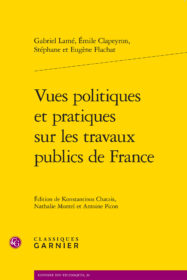
Konstantinos Chatzis, Nathalie Montel, and Antoine Picon
present a critical edition of Vues politiques et pratiques sur les travaux publics de France
(Political
and Practical Views on Public Works in France
), originally published in 1832 by engineers Gabriel Lamé, Benoît-Paul-Émile Clapeyron, and brothers Stéphane and Eugène Flachat.
Publisher's website: https://classiques-garnier.com/vues-politiques-et-pratiques-sur-les-travaux-publics-de-france.html
In 1832, four engineers published a book entitled Vues politiques et pratiques sur les travaux publics de France. Its authors, Gabriel Lamé (1795-1970), Émile Clapeyron (1799-1864), Stéphane Flachat (1800-1884), and Eugène Flachat (1802-1873), would go on to make their mark on the history of science and technology and achieve fame. While Lamé and Clapeyron contributed to mechanics and thermodynamics, Stéphane and Eugène Flachat participated in the railway revolution. Their co-authored work provides an overview of French transport infrastructure. Both a review and a program, it examines existing connections and proposes an overall plan for canals and railways to be built with a view to systematically linking technical excellence and economic profitability to the overall progress of society and its institutions, hence the combination of the words "political" and "practical" in the book's title.
Often cited by historians and geographers, the views of our four engineers are representative of a key moment in the development of transport infrastructure in France, at a time when an approach to infrastructure in terms of networks was taking shape and railways embodied the promise of a future of widespread mobility. At the same time, it is tempting to see in them the expression of underlying trends in "French-style development," such as a taste for ambitious plans sponsored by the state or the search for a balance between public intervention and private initiative that would give rise to what is known as the "mixed economy." Written by authors with links to Saint-Simonism, and at least one of whom, Stéphane Flachat, was heavily involved in this movement, which combined strongly utopian ideals with practical considerations on subjects ranging from public works to bank credit, one might wonder how much the book owes to Saint-Simonian doctrine and experience. By setting out to be both "political" and "practical," visionary and concrete, the book seems faithful to one of the most consistently reaffirmed ambitions of Saint-Simonism. At the same time, it contributes to raising with particular acuity the question of the relationship between utopia and technical and economic achievements.
Never republished, this key book has not been the subject of in-depth study either. However, the circumstances that led its authors to embark on this undertaking are just as revealing as the arguments they put forward and the projects they defend. The context in which they operate, the existing infrastructure to which they refer, and the foreign examples they use to support their proposals provide a better understanding of the genesis of a number of key French urban planning projects.
This critical edition aims to fill that gap. An extensive introduction first sheds light on the contrasting personalities and trajectories of the four authors of Vues politiques et pratiques, as well as their respective contributions to the work. Placing the latter in the context of the technical, economic, and political debates of the early years of the July Monarchy, marked by recurring tension between liberalism and authoritarianism, it reveals the very special position occupied by a book that seeks to reconcile private initiative with the coordinating role of the public works administration.
This critical edition then provides a series of insights into the text by Lamé, Clapeyron, and the Flachat brothers, offering details on the men and works mentioned, as well as the technical innovations and legal structures referred to, by means of notes designed to enlighten the reader without hindering their reading. A bibliography of the works cited in Vues politiques et pratiques sur les travaux publics de France, a set of maps showing the canals and railways that have been built or are planned, and finally a list of sources and references complete this edition.
Interpretations of Lamé, Clapeyron, and des Flachat's book generally oscillate between emphasizing the concrete nature of the proposals it contains, which are landmarks in the history of French transport infrastructure and territorial planning, and insisting that it is one of the emblematic works of Saint-Simonism. What is the truth? Should Vues politiques et pratiques really be considered a product of the Saint-Simonian movement? This critical edition has been produced with the aim of providing answers to these questions, or more precisely, of providing readers with all the information they need to form their own opinion. It is based on original research carried out in French and foreign archives, which sheds new light on a work that is both famous and little known.
Specialists in the history of science and technology will find many reasons to take an interest in this critical edition. It provides useful details on the careers of Lamé, Clapeyron, and the Flachat brothers, whose differences prove to be just as illuminating as their shared interests. While Lamé and Clapeyron came from the École Polytechnique, which trained state engineers—both were members of the Corps des Mines—the Flachat brothers embodied the rising figure of the civil engineer working in a primarily private setting. The Russian adventure of the former, who taught and built in Saint Petersburg from 1820 to 1831, had no equivalent among the latter. Although they had different relationships with science, they nevertheless came together around a common interest in canals and railways. The introduction by Kostas Chatzis, Nathalie Montel, and Antoine Picon reveals in particular the links between the publication of the work and a railway project between Paris and Rouen, itself the successor to a canal project between these two cities. Above all, it sheds light on the complex relationship between canals and railways, as well as the technical and economic debates surrounding them.
For historians of urban planning and geographers, Les Vues politiques et pratiques sur les travaux publics de France is even more important. It provides a better understanding of the state of transport routes in France on the eve of the transformations brought about by the railroad. The overall project they present is also part of the emergence of the concept of a territorial network, which would have a lasting impact on territorial and urban planning practices. It is the modern French territory, structured by major infrastructure networks, that the four authors of Vues politiques et pratiques help to outline.
In concrete terms, the book proposes the establishment of a national transport system combining road, canal, and rail networks. This general transport infrastructure plan is characterized by being both multimodal and hierarchical: it envisages the digging of canals and the construction of railways as complementary and links their different uses, foremost among which are passenger and freight traffic. The route of the new transport links takes into account both the physical geography of the country and the location of mineral resources and seaports. The need to create docks and warehouses, similar to those in England, is also emphasized, as these new facilities are an integral part of this vast public works plan designed to open up France's regions. Estimated at two billion francs and scheduled to be completed in ten years, this ambitious program of major works is also considered an investment plan, likely to serve as a stimulus for the French economy, which was in decline in the early years of the July Monarchy.
Beyond these specialized interests, Vues politiques et pratiques is also likely to appeal to a much wider readership interested in the genesis of modern France as a nation-state. In his 2013 book, The Birth of Territory, devoted to the origins of modern territorial concepts, British political scientist and geographer Stuart Elden gives only marginal attention to communication routes. However, these play an essential role in many countries, starting with France, whether in contributing to the emergence of national markets or facilitating the mobility of individuals and, by the same token, their sense of belonging to a community much larger than the parishes, countries, and regions that had long prevailed over vague and abstract national identities. In the case of France, roads and railways contributed powerfully to the "end of the terroirs" highlighted by the American historian Eugen Weber in his eponymous book, which took full effect in the last decades of the 19th century.
However, the materiality of the transformations brought about by public works and communication routes, their "positive" nature, to use an expression that was in vogue during the first half of the 19th century, should not obscure the fact that the nations whose emergence they facilitated remained, to a large extent, "imagined communities," as the Anglo-Irish political scientist Benedict Anderson rightly pointed out. According to Anderson, public works and transport links contribute to the construction of the collective imagination that constitutes national identities. They are themselves inseparable from a set of representations that can be traced back in history.
While set in the context of the early years of the July Monarchy, the Vues politiques et pratiques refer to the much broader undertaking of constructing a national identity corresponding to a specific territory. Once again, we may question the utopian nature of the overall plan they propose. It amounts to the same thing as questioning "the reality of utopia," to use the apt expression coined by historian Michèle Riot-Sarcey.
Whether exploring the origins of modern France, reflecting on the relationship between planning and private enterprise, or questioning the ability of utopia to permeate very concrete efforts to transform the world, Les Vues politiques et pratiques resonates with many contemporary debates.